What Actually Determines the Price
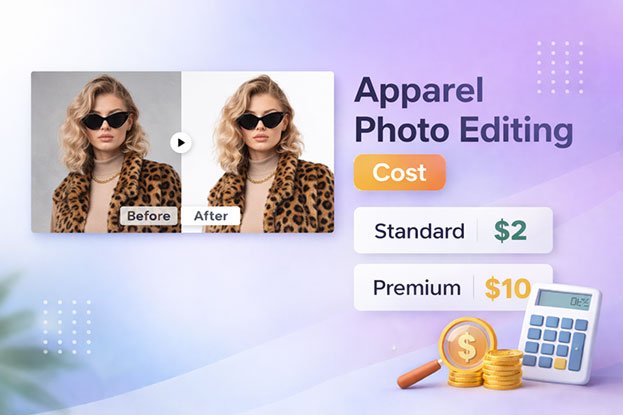
Apparel photo editing cost depends less on “price per image” and more on complexity, volume, and consistency requirements.
Many clothing brands start by asking:
“How much do you charge per image?”
But that question alone doesn’t give a real answer.
Because apparel photo editing is not one service.
It’s a category of services.
And pricing varies based on what your images actually require.
Why Apparel Photo Editing Cost Is Not One-Size-Fits-All
Unlike simple background removal, clothing images often require:
-
Color correction
-
Shadow balancing
-
Wrinkle refinement
-
Shape alignment
-
Ghost mannequin effect
-
Fabric texture clarity
-
Detail enhancement
-
Batch consistency
Each layer adds time.
And time determines cost.
If your goal is accurate color and realistic texture — as discussed in Why Apparel Product Colors Look Wrong Online — the editing must be precise, not automated.
Precision costs more than basic clipping.
But it protects conversion and reduces return rates.
The 5 Main Factors That Affect Apparel Photo Editing Cost
Let’s break it down clearly.
1️⃣ Type of Editing Required
Basic editing:
-
Background cleanup
-
Minor exposure correction
Advanced editing:
-
Ghost mannequin creation
-
Neck joint retouching
-
Sleeve reconstruction
-
Fabric reshaping
-
Multi-layer compositing
Ghost mannequin editing, for example, requires multiple source images and manual assembly — far more complex than standard background removal.
That’s why it’s priced differently.
2️⃣ Image Complexity
A plain white T-shirt requires less time than:
-
Lace dresses
-
Sheer fabrics
-
Layered garments
-
Reflective materials
-
Dark-on-dark fabrics
More detail = more precision.
And precision increases editing time.
3️⃣ Volume & Batch Size
This is where many brands misunderstand pricing.
Editing 10 images is expensive per image.
Editing 1,000 images allows process efficiency.
Most professional services offer:
-
Tiered pricing
-
Bulk discounts
-
Long-term contract rates
Large apparel brands benefit from system-based pricing.
Small brands pay higher per-image rates.
4️⃣ Turnaround Time
Standard delivery (24–48 hours) is normal.
Rush delivery (same day) increases cost.
If you’re launching collections frequently — like discussed in Apparel Product Image Checklist Before Launching a Collection — turnaround speed becomes part of your operational cost.
Faster turnaround often requires more editors working simultaneously.
That affects pricing.
5️⃣ Consistency & Quality Control Level
Not all editing services operate the same way.
Some offer:
-
Single-editor workflow
-
Minimal quality review
Others use:
-
Multi-level quality control
-
Color calibration standards
-
Collection-wide consistency checks
Higher quality control systems cost more.
But they reduce:
-
Revisions
-
Color inconsistencies
-
Return risk
-
Performance drops
As explained in DIY vs Professional Apparel Photo Editing: Cost, ROI & What Actually Saves You Money, cheap editing often increases hidden costs later.
Typical Apparel Photo Editing Cost Ranges (2026)
While pricing varies by provider and complexity, general ranges look like this:
Basic background removal:
$0.50 – $1.50 per image
Color correction & basic retouching:
$1.00 – $3.00 per image
Ghost mannequin editing:
$2.00 – $7.00 per image
Advanced retouching & shape correction:
$3.00 – $10.00+ per image
Bulk contracts reduce these significantly.
But remember:
The cheapest rate is not always the lowest cost.
Because if editing quality reduces conversion or increases return rates, your real expense is hidden in lost revenue.
The Cost Question Most Brands Don’t Ask
Instead of asking:
“How much does apparel photo editing cost per image?”
A better question is:
“How much does weak editing cost my brand?”
If poor color accuracy increases returns by 3–5%, that loss often exceeds editing fees.
If inconsistent images reduce conversion by 0.3–0.5%, the revenue impact compounds monthly.
Editing cost should be evaluated against performance impact — not just per-image price.
Key Takeaway
Apparel photo editing cost depends on:
✔ Type of editing required
✔ Image complexity
✔ Volume
✔ Turnaround time
✔ Quality control standards
Per-image pricing is only part of the equation.
For clothing brands, the real cost is tied to conversion, return rates, and operational efficiency.
In-House vs Outsourcing — What Really Costs More?
When clothing brands evaluate apparel photo editing cost, they usually compare:
-
Hiring an in-house editor
vs -
Outsourcing to a professional editing service
On paper, in-house can look cheaper.
In reality, the math is more complicated.
The True Cost of In-House Apparel Photo Editing
Let’s break down what in-house actually includes.
1️⃣ Salary & Employment Costs
A full-time photo editor typically costs:
-
Base salary
-
Taxes
-
Benefits
-
Equipment
-
Software licenses
Even conservatively, this can reach:
$35,000–$60,000+ per year depending on region.
That cost exists whether you have 50 images to edit — or 5,000.
2️⃣ Software & Hardware
In-house editing requires:
-
Adobe subscription
-
High-performance computers
-
Calibrated monitors
-
Storage systems
These are ongoing costs.
And if color accuracy matters — as discussed in
Why Apparel Product Colors Look Wrong Online —
monitor calibration and workflow precision become essential.
Cheap hardware leads to inconsistent output.
3️⃣ Productivity Limits
One editor can only handle so much volume.
If you launch:
-
200+ SKUs per collection
-
Monthly drops
-
Frequent ad campaigns
Your in-house editor becomes a bottleneck.
Delays impact launch speed.
And slower launches impact revenue timing.
We explored how operational delays affect growth in
Apparel Product Image Checklist Before Launching a Collection.
Speed has value.
4️⃣ Consistency Risk
If your editor:
-
Takes leave
-
Resigns
-
Changes workflow style
Your image consistency shifts.
And inconsistency hurts performance — as explained in
Why Clothing Product Photos Don’t Convert.
In-house editing relies heavily on one person’s skill and consistency.
The True Cost of Outsourcing Apparel Photo Editing
Outsourcing changes the structure.
Instead of fixed salary cost, you pay:
-
Per image
-
Per batch
-
Per project
This converts fixed overhead into variable cost.
1️⃣ Scalable Volume
Whether you have:
-
100 images
-
1,000 images
-
5,000 images
A professional editing team can scale faster than one internal editor.
This protects launch timelines.
And timeline protection supports revenue predictability.
2️⃣ System-Based Quality Control
Professional services often use:
-
Multi-level QC review
-
Standardized color calibration
-
Defined editing guidelines
-
Batch consistency checks
This reduces:
-
Revisions
-
Inconsistent lighting
-
Tone shifts
Which ultimately reduces return risk — as covered in
Why Online Clothing Stores Get High Return Rates.
3️⃣ Lower Operational Management
Outsourcing removes:
-
Hiring time
-
Training cost
-
Software management
-
Hardware upgrades
-
Sick leave gaps
You focus on:
Product development
Marketing
Growth
Not editing management.
Side-by-Side Cost Perspective
Let’s simplify it.
| Factor | In-House Editing | Outsourced Editing |
|---|---|---|
| Cost Structure | Fixed salary | Variable per image |
| Scalability | Limited | High |
| Consistency | Person-dependent | System-dependent |
| Turnaround | Slower at scale | Faster for bulk |
| Operational Overhead | High | Low |
| Risk | Staff turnover | Vendor selection |
In-house may appear cheaper if you edit high volumes consistently year-round.
Outsourcing often becomes cheaper when:
-
Volume fluctuates
-
Speed matters
-
Quality consistency is critical
-
You want flexibility
When In-House Makes Sense
In-house editing may work if:
-
You produce extremely high daily volume
-
You have stable workflow year-round
-
You maintain strict color calibration internally
-
You can afford redundancy (multiple editors)
Otherwise, outsourcing offers flexibility without fixed burden.
The Hidden Cost Brands Overlook
If weak editing reduces conversion by even 0.3%, the revenue loss can exceed editing savings.
If poor color accuracy increases return rate by 3–5%, the margin impact compounds monthly.
This is why we emphasized in
Professional Apparel Photo Editing Increases Online Sales
that editing affects performance — not just aesthetics.
Cost must be evaluated in performance terms.
Not isolation.
Key Takeaway
The real apparel photo editing cost is not just salary vs per-image pricing.
It includes:
✔ Scalability
✔ Speed
✔ Consistency
✔ Operational management
✔ Conversion impact
✔ Return reduction
In-house controls cost visibility.
Outsourcing controls performance flexibility.
The right choice depends on your growth stage.
ROI, Revenue Impact & When Cheap Becomes Expensive
By now, you understand what affects apparel photo editing cost.
But here’s the real question serious brands should ask:
What is the return on apparel photo editing?
Because cost alone means nothing without performance context.
The ROI Formula Most Clothing Brands Ignore
Let’s make this practical.
Imagine your store gets:
-
100,000 monthly visitors
-
2.0% conversion rate
-
$80 average order value
That equals:
2,000 orders → $160,000 monthly revenue.
Now imagine improving image clarity, color accuracy, and consistency increases conversion to 2.4%.
That’s:
2,400 orders → $192,000 monthly revenue.
That’s $32,000 additional revenue per month.
And the only change?
Better visual presentation.
Even a 0.3–0.5% lift creates measurable impact.
This aligns with what we discussed in
Why Clothing Product Photos Don’t Convert —
visual hesitation reduces performance more than brands realize.
Return Rate Impact (The Quiet Margin Killer)
Now let’s look at returns.
If your return rate is 20% and you reduce it to 16% through better expectation alignment, you’re protecting margin immediately.
As explained in
Why Online Clothing Stores Get High Return Rates,
many returns are driven by visual expectation gaps:
-
Color mismatch
-
Fabric thickness misrepresentation
-
Unrealistic garment shape
If editing improves color accuracy and realistic texture presentation, returns decrease.
Return reduction is often the hidden ROI multiplier.
When Cheap Editing Becomes Expensive
Low-cost editing can:
-
Over-smooth fabric
-
Shift color temperature
-
Distort garment shape
-
Create inconsistency across collections
These issues may seem minor.
But they impact:
-
Conversion
-
Return rate
-
Brand perception
-
Ad performance
As discussed in
Why Fashion Brands Lose Sales Because of Bad Product Images,
inconsistent visuals reduce trust.
Cheap editing that increases return rate by even 3% can cost far more than premium editing fees.
How to Calculate Editing ROI for Your Brand
Ask these questions:
1️⃣ What is your current conversion rate?
2️⃣ What is your average order value?
3️⃣ What is your return rate?
4️⃣ How many SKUs do you launch per month?
5️⃣ How much do delays cost in lost ad efficiency?
Then estimate:
-
A modest 0.3–0.5% conversion lift
-
A 2–4% return rate reduction
Multiply that by monthly traffic.
Most brands discover:
Editing cost is small compared to performance upside.
Decision Framework for Clothing Brands
Choose in-house if:
✔ You have very high, stable daily volume
✔ You maintain strong internal quality control
✔ You can afford operational redundancy
Choose outsourcing if:
✔ Volume fluctuates
✔ You launch collections frequently
✔ Speed impacts revenue
✔ You want scalable flexibility
✔ You want system-based consistency
As covered in
DIY vs Professional Apparel Photo Editing: Cost, ROI & What Actually Saves You Money,
the decision is less about cost per image and more about performance per image.
The Bigger Shift
Apparel photo editing should not be viewed as:
An operational expense.
It should be evaluated as:
A revenue performance lever.
Because in fashion eCommerce:
Better images increase confidence.
Confidence increases conversion.
Accuracy reduces returns.
Consistency strengthens brand authority.
And all four directly affect profit.
Final Takeaway
The real apparel photo editing cost is not what you pay per image.
It’s the difference between:
-
Inconsistent performance
-
And predictable growth.
When evaluated through ROI, return reduction, and scalability, high-quality editing often costs less than the revenue it protects.
The cheapest option is rarely the most profitable.
📊 Case Study: In-House vs Outsourced Apparel Photo Editing — A Real Cost Comparison
Brand Profile
Business Type: Mid-size online women’s apparel brand
Monthly Traffic: ~85,000 visitors
Monthly SKU Output: 300–500 images
Average Order Value: $76
Return Rate (Before Optimization): 22%
🚨 Scenario 1: In-House Editing
The brand hired one full-time photo editor.
Annual Cost Breakdown:
-
Salary: $42,000
-
Software (Adobe, storage, tools): $1,200
-
Hardware upgrades & calibration: $2,000
-
Overhead (workspace, management time): ~$4,000
Total Annual Cost: ~$49,200
Monthly cost ≈ $4,100
If they process 400 images/month:
Cost per image ≈ $10.25
But that’s only direct cost.
Operational issues appeared:
-
Editing backlog before launches
-
Inconsistent color tone between collections
-
Slow turnaround during seasonal peaks
Conversion rate remained unstable.
🚨 Scenario 2: Outsourced Professional Editing
They switched to outsourced editing with:
-
Standardized color calibration
-
Multi-level quality control
-
24–48 hour turnaround
-
Bulk contract pricing
Average bulk rate:
$2.80 per image (advanced apparel editing)
At 400 images/month:
Monthly cost ≈ $1,120
Annual cost ≈ $13,440
Significantly lower than in-house fixed cost.
📈 Performance Impact After 3 Months
After outsourcing:
-
Conversion increased from 1.9% → 2.3%
-
Return rate dropped from 22% → 17%
-
Launch delays disappeared
-
ROAS stabilized
Let’s calculate revenue impact.
At 85,000 monthly visitors:
Old conversion (1.9%) → 1,615 orders
New conversion (2.3%) → 1,955 orders
340 additional orders/month
At $76 AOV → ~$25,840 additional monthly revenue
Annualized: ~$310,000+ revenue impact
Even if only 20% of that lift is attributed to improved image consistency, the ROI far exceeds editing cost.
🎯 What This Case Reveals
In-house looked cheaper at first glance.
But when calculating:
-
Per-image cost
-
Operational delays
-
Conversion improvement
-
Return reduction
Outsourcing delivered both lower direct cost and stronger performance.
This reinforces what we discussed in:
-
DIY vs Professional Apparel Photo Editing: Cost, ROI & What Actually Saves You Money
-
Why Clothing Product Photos Don’t Convert
-
Why Online Clothing Stores Get High Return Rates
Editing cost is not just a line item.
It’s a growth lever.
FAQs
How much does apparel photo editing cost per image?
Apparel photo editing cost typically ranges from $0.50 to $10 per image depending on complexity, volume, and editing requirements such as ghost mannequin effects, color correction, and advanced retouching.
Is outsourcing apparel photo editing cheaper than hiring in-house?
Outsourcing apparel photo editing is often cheaper when accounting for salary, software, equipment, and operational overhead. It also provides scalability and flexible volume management.
Does better photo editing increase ecommerce conversion rates?
Yes. Improved color accuracy, realistic garment shape, and consistent presentation reduce hesitation and can increase conversion rates in clothing ecommerce stores.
Can professional apparel photo editing reduce return rates?
Professional apparel photo editing can reduce return rates by aligning visual expectations with actual product appearance, particularly in color and texture representation.
How do I calculate ROI from apparel photo editing?
To calculate ROI, compare editing cost against improvements in conversion rate, return rate reduction, and operational efficiency. Even small conversion lifts can significantly outweigh editing expenses.
Ready to Evaluate Your Real Editing Cost?
If you’re comparing in-house vs outsourced apparel photo editing, don’t guess based on per-image pricing alone.
Look at:
✔ Conversion impact
✔ Return rate influence
✔ Launch speed
✔ Operational flexibility
Send us 3–5 recent product images.
We’ll:
-
Analyze editing complexity
-
Estimate realistic cost range
-
Highlight performance improvement opportunities
-
Provide a professionally optimized sample
No contract.
No pressure.
Just clarity before you decide.
If editing is limiting your growth, you’ll see it immediately.