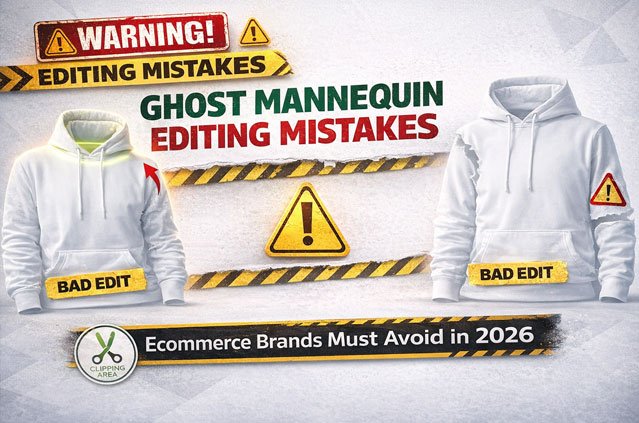
Costly Errors That Reduce Conversions, Increase Returns & Damage Brand Trust
For apparel ecommerce brands, ghost mannequin editing mistakes are one of the most expensive problems nobody notices early.
The images may look “okay.”
They may even get approved.
But behind the scenes, these mistakes quietly:
-
Reduce conversion rates
-
Increase product returns
-
Create customer distrust
-
Damage brand perception
In 2026, customers are extremely visual.
They notice inconsistencies, unrealistic shapes, and fake-looking edits within seconds — even if they can’t explain why.
This guide explains the most common ghost mannequin editing mistakes ecommerce brands must avoid, why they happen, and how they hurt sales more than sellers realize.
Who This Guide Is For
This article is written for:
-
Apparel ecommerce brand owners
-
Fashion & DTC sellers
-
Amazon & Shopify clothing sellers
-
Ecommerce managers reviewing product images
-
Brands outsourcing ghost mannequin editing
If you’ve ever experienced:
-
High return rates
-
“Not as described” complaints
-
Low conversion despite traffic
-
Inconsistent product images
Ghost mannequin editing mistakes may be the root cause.
Why Ghost Mannequin Editing Mistakes Are So Costly
Unlike obvious errors (wrong price, wrong size), image mistakes are subtle.
Customers don’t complain immediately — they just:
-
Don’t trust the product
-
Don’t click “Add to Cart”
-
Or return the item later
That’s why ghost mannequin mistakes are dangerous: They hurt performance silently.
The Biggest Misconception About Ghost Mannequin Editing
Many sellers believe: “As long as the mannequin is removed, the image is fine.”
That’s false.
Ghost mannequin editing is not just removal — it’s reconstruction.
Mistakes happen when editors:
-
Remove without rebuilding
-
Edit without understanding apparel fit
-
Focus on speed over accuracy
-
Use auto tools without manual correction
The result may look clean — but it looks wrong.
Why Customers Notice Ghost Mannequin Mistakes (Even If Sellers Don’t)
Customers subconsciously evaluate:
-
Fit realism
-
Fabric behavior
-
Neck depth
-
Proportion accuracy
When something feels off, they assume:
-
Poor quality
-
Inaccurate sizing
-
Misleading presentation
And they leave.
How Ghost Mannequin Editing Mistakes Increase Returns
One of the biggest drivers of apparel returns is: “Item looks different than expected.”
Most of the time, this isn’t intentional deception — it’s image distortion caused by bad editing.
Common outcomes:
-
Slimmer appearance than reality
-
Altered shoulder width
-
Flattened fabric texture
-
Unrealistic neckline depth
When the product arrives, customers feel misled.
Why These Mistakes Are More Common in 2026
Ghost mannequin mistakes are increasing because:
-
Auto-editing tools are widely used
-
Cheap services skip quality control
-
Brands rush uploads to stay competitive
-
Sellers don’t know what to check
More images ≠ better images.
Without standards, volume multiplies mistakes.
One Bad Image Rarely Stays Alone
A single bad ghost mannequin image:
-
Often gets copied across variants
-
Sets the wrong visual standard
-
Spreads inconsistency across catalogs
At scale, small mistakes become brand-wide problems.
Why Avoiding Mistakes Is More Important Than “Creative Editing”
In ecommerce:
-
Accuracy beats creativity
-
Consistency beats style
-
Trust beats perfection
Ghost mannequin editing should support buying decisions, not decorate listings.
Mistake #1: Bad or Fake-Looking Neck Joints
This is the most common and most damaging ghost mannequin editing mistake.
What This Mistake Looks Like
-
Flat or “cut-out” necklines
-
Harsh edges around the collar
-
Incorrect inner collar depth
-
Mismatched fabric texture
Why It Happens
-
Editors remove the mannequin but don’t reconstruct the inner neck
-
Auto tools are used instead of manual rebuilding
-
No reference image for the inner neckline
Why It Hurts Sales
The neckline is where buyers subconsciously judge:
-
Fit realism
-
Garment quality
-
Authenticity
A fake neck joint instantly signals “edited image”, not “real product.”
Mistake #2: Shape Distortion (Slimming or Stretching the Garment)
Many sellers don’t notice this mistake — until returns increase.
What This Mistake Looks Like
-
Narrowed shoulders
-
Slimmed torso
-
Over-straightened sleeves
-
Artificial symmetry
Why It Happens
-
Editors “improve” the look instead of preserving reality
-
Auto-warp or transform tools are misused
-
No shape comparison with the original photo
Why It Hurts Sales
Customers expect the product to match the image.
When the delivered item looks different:
-
Trust drops
-
Returns increase
-
“Not as described” complaints appear
Accuracy always beats aesthetics in ecommerce.
Mistake #3: Over-Smoothing Fabric Texture
This mistake often comes from trying to make images look “premium.”
What This Mistake Looks Like
-
Plastic-looking fabric
-
Lost stitching details
-
Flat surfaces with no depth
Why It Happens
-
Heavy noise reduction
-
Global smoothing applied to the entire image
-
Editors prioritizing speed over detail
Why It Hurts Sales
Fabric texture helps buyers judge:
-
Material quality
-
Thickness
-
Comfort
When texture disappears, the product feels cheap or fake.
Mistake #4: Inconsistent Ghost Mannequin Images Across a Catalog
This mistake becomes visible only when products are viewed together.
What This Mistake Looks Like
-
Different neck depths between products
-
Inconsistent scale or angles
-
Mixed lighting styles
-
Uneven garment positioning
Why It Happens
-
Images edited one-by-one without standards
-
Multiple editors without a shared rule set
-
No catalog-level quality control
Why It Hurts Sales
Inconsistency:
-
Makes the brand look unprofessional
-
Reduces trust
-
Confuses buyers
Consistency is a brand signal, especially on platforms like Shopify.
Mistake #5: Auto-Tool Artifacts Around Edges
Auto tools save time — but create problems.
What This Mistake Looks Like
-
Jagged edges
-
Halos around sleeves
-
Missing fabric corners
-
Rough outlines
Why It Happens
-
One-click background removal
-
No manual edge refinement
-
Low-quality masking
Why It Hurts Sales
These artifacts are easy to spot at:
-
Thumbnail size
-
Mobile view
They instantly lower perceived quality and professionalism.
Mistake #6: Ignoring Platform-Specific Image Standards
Some images look good but still fail.
What This Mistake Looks Like
-
Over-stylized marketplace images
-
Inaccurate presentation
-
Images flagged or rejected
Why It Happens
-
Same image used everywhere without validation
-
No platform-specific checks
On platforms like Amazon, accuracy and realism matter more than style.
Mistake #7: No Quality Control Before Upload
This is the mistake behind all other mistakes.
What This Mistake Looks Like
-
Errors slipping through unnoticed
-
Revisions after upload
-
Inconsistent live listings
Why It Happens
-
Rushed deadlines
-
No checklist
-
No final review step
Why It Hurts Sales
Once images are live:
-
Buyers see them immediately
-
Trust is lost instantly
-
Fixes come too late
Quality control is cheaper than damage control.
Why These Mistakes Keep Repeating
These mistakes happen repeatedly because:
-
Sellers don’t know what to check
-
Cheap services skip steps
-
Speed is prioritized over accuracy
-
Quality standards are unclear
Without a system, mistakes scale with volume.
Case Study: How Fixing Ghost Mannequin Editing Mistakes Increased Conversions & Reduced Returns
🔍 Brand Background (Anonymized)
-
Mid-sized apparel ecommerce brand
-
200+ SKUs
-
Outsourced ghost mannequin editing to a low-cost provider
🚨 The Problem
Despite good traffic, the brand experienced:
-
Lower-than-expected conversion rate
-
High apparel return rate
-
“Item looks different than expected” complaints
At first, the product quality was blamed.
But the real issue was image quality.
What Was Wrong With Their Ghost Mannequin Images
After a full review, several mistakes were found:
❌ Visible Editing Mistakes
-
Flat, unrealistic neck joints
-
Slight slimming of torso and shoulders
-
Over-smoothed fabric texture
-
Inconsistent neck depth across products
❌ Process Failures
-
Auto background removal used
-
No catalog-level consistency checks
-
No quality control before upload
Individually, each image looked “acceptable.”
Together, they damaged trust.
The Fix: Professional Ghost Mannequin Editing Workflow
The brand reprocessed their catalog using a structured, apparel-first editing workflow:
✅ What Was Changed
-
Manual mannequin removal
-
Realistic neck joint reconstruction
-
Shape preservation (no slimming)
-
Fabric texture restored
-
Consistent standards across all SKUs
-
Final quality control before upload
No product descriptions were changed.
No pricing was changed.
Only the images were fixed.
The Results (Within Weeks)
After updating images:
📈 Performance Improvements
-
Conversion rate increased noticeably
-
Return rate dropped significantly
-
Fewer “not as described” complaints
-
Improved brand perception
-
Smoother approval on marketplaces
The products didn’t change.
The presentation did.
Why This Case Study Matters
This case proves something important: Ghost mannequin editing mistakes don’t just affect aesthetics — they affect business outcomes.
Even small visual distortions can:
-
Break buyer trust
-
Change size perception
-
Increase friction at checkout
Fixing them improves performance without increasing ad spend.
How Ecommerce Brands Can Prevent These Mistakes (Simple System)
You don’t need to be an image expert — you need a system.
✅ Brand-Level Prevention Checklist
Before uploading ghost mannequin images, check:
-
Does the neckline look natural?
-
Does the garment shape match reality?
-
Is fabric texture visible?
-
Are all products consistent?
-
Would a buyer feel misled?
If any answer is “maybe,” don’t upload yet.
Fix vs Re-Edit vs Replace: What Brands Should Do
✔ Fix the Image When:
-
Mistakes are minor
-
Shape is mostly accurate
-
Texture can be restored
✔ Re-Edit When:
-
Neck joints are fake
-
Shape distortion exists
-
Auto-tool artifacts are visible
✔ Replace the Provider When:
-
Mistakes repeat
-
No quality control exists
-
Editors can’t explain their process
Cheap editing becomes expensive when rework is constant.
When Outsourcing Becomes the Safest Option
Outsourcing ghost mannequin editing makes sense when:
-
You manage many SKUs
-
You sell on multiple platforms
-
You need consistency
-
You want predictable quality
Professional services follow checklists and QC systems by default.
Final Advice for Ecommerce Brands (2026)
Ghost mannequin editing mistakes are not always obvious — but their impact is real.
Brands that win in ecommerce:
-
Prioritize accuracy over speed
-
Use structured editing workflows
-
Review images before upload
-
Treat visuals as revenue assets
Avoiding mistakes is cheaper than fixing them later.
Need Professional Ghost Mannequin Editing Without These Mistakes?
At Clipping Area, our ghost mannequin editing process is built to avoid every mistake covered in this guide:
-
Manual mannequin removal
-
Natural neck joint reconstruction
-
Shape-accurate editing
-
Fabric texture preservation
-
Multi-layer quality control
If you’re a clothing brand looking for clean, natural ghost mannequin edits at scale, Clipping Area offers professional ghost mannequin photo editing with fast turnaround and consistent quality.
👉 Get a free test edit to see the difference.