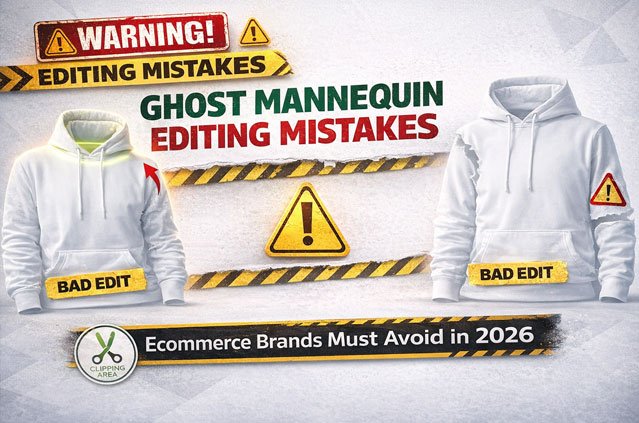
How to Avoid Ghost Mannequin Editing Mistakes for Ecommerce Brands
A good ghost mannequin image shows a garment as if someone invisible is wearing it. The shape is natural, the inside of the collar is visible, and nothing distracts from the product. But small ghost mannequin editing mistakes can quickly break that illusion.
A crooked neck joint, a shirt that looks narrower than it really is, a gray patch where the mannequin used to be, or a navy jacket that turns purple after editing. These problems make garments look distorted, unrealistic, or inconsistent across a catalog.
This guide covers the most common problems, from bad neck joints and poor masking to uneven backgrounds, fake shadows, and wrong colors, and shows ecommerce brands how to spot and prevent each one.
Quick Answer: How Can You Avoid Ghost Mannequin Editing Mistakes?
Avoid ghost mannequin editing mistakes by treating every image as a product record, not just a photo to clean up. Focus on:
- Accurate garment shape that matches the real product
- Clean mannequin removal with no leftover edges
- Natural neck-joint construction using a real inner-garment shot
- Preserved fabric details like texture, seams, and stitching
- Correct proportions for sleeves, shoulders, and length
- Clean edges without halos or jagged masking
- Accurate color checked against the physical garment
- Consistent backgrounds across the whole collection
- Natural shadows that ground the garment
- Final quality control on every image before publishing
Each point is explained below with causes, fixes, and quick checks.
What Is Ghost Mannequin Editing?
Ghost mannequin photography is a method of shooting clothing on a mannequin so the garment holds a natural, three-dimensional shape. Ghost mannequin editing is the post-production step that removes the mannequin and makes the garment look hollow, sometimes called the invisible mannequin or hollow man effect.
A typical process looks like this:
- The garment is photographed on a mannequin, usually one with removable parts.
- A second shot captures the inner garment, such as the back of the neckline or the inside of the collar.
- The editor removes the mannequin with a clipping path or masking.
- The inner shot is combined with the main image to create the neck joint.
- Shadows, color, and background are finished to match the catalog.
How it differs from other styles:
| Style | What the shopper sees |
|---|---|
| Ghost mannequin | Garment with 3D shape, no mannequin visible |
| Standard mannequin | Garment on a visible mannequin |
| Flat lay | Garment laid flat, usually from above |
| Model photography | Garment worn by a person |
Why Ghost Mannequin Editing Quality Matters for Ecommerce
Shoppers cannot touch clothing online, so the image carries a lot of the product information. Careful ghost mannequin photo editing can:
- Create a more consistent catalog
- Make garment details easier to see
- Show shape, structure, and fit more clearly than a flat lay
- Reduce visual distractions on product pages
- Make side-by-side product comparison easier
- Support a recognizable visual identity for the brand
Good editing can improve product presentation. It does not replace good photography, accurate descriptions, or sizing information, and it does not guarantee sales on its own.
Mistake #1: Poor Neck Joint
What it is: The neck joint is the visible inside back of the neckline. Common problems include a misaligned neckline, visible mannequin edges, the wrong inner neck shape, an uneven collar, an opening that looks pasted in, and a joint that is too big or too small for the garment.
Why it happens: The inner shot was missing or taken at a different angle, the editor warped the inner section to force a fit, or the joint was painted in instead of built from a real photo.
Why it matters: The neck is usually the first place a shopper’s eye lands. A fake-looking joint makes the whole image feel edited.
How to prevent it:
- Shoot a proper inner-neck image at the same lighting and a matching angle.
- Match the inner section to the original garment structure, including label placement and fabric.
- Align the inner curve with the front neckline so both sides look even.
- Use accurate masking where the inner and outer sections meet.
- Blend light and shadow so the inside looks slightly darker, as it would in real life.
QC check: View the neck at 100% zoom. The collar should look even and the inner section should follow the same curve as the neckline.
Mistake #2: Distorting the Garment Shape
What it is: Editing changes how the product actually looks. A shirt becomes too narrow, a jacket too wide, sleeves get longer or thinner, the neckline stretches, or the waist gets pulled in so the garment looks unusually slim.
Why it happens: Heavy use of Liquify or warp tools, trying to “fix” a poorly dressed mannequin, or aiming for an idealized look.
Why it matters: If the image does not match what arrives in the box, customers lose trust. Misleading product images can also create problems with marketplace policies.
How to prevent it:
- Keep the original shot open for comparison while editing.
- Limit shaping to small corrections, like smoothing a lump from a pin or clamp.
- Fix big shape problems at the shoot with better styling, not in Photoshop.
- Agree on shaping rules in your style guide.
The goal is to improve presentation, not change the product.
Mistake #3: Removing Important Fabric Details
What it is: Over-editing wipes out fabric texture, stitching, seams, natural fabric folds, buttons, zippers, pockets, embroidery, prints, and patterns.
Why it happens: Aggressive smoothing, heavy noise reduction, or cloning over areas to remove wrinkles.
Why it matters: These details tell shoppers about quality, material, and construction. A linen shirt that looks like plastic sells the wrong idea.
How to prevent it:
- Remove only temporary flaws: lint, dust, loose threads, pins, and tags.
- Use frequency separation or targeted healing instead of global blur.
- Keep folds that show how the fabric drapes, and soften only harsh creases.
- Check logos, prints, and embroidery for smearing after retouching.
QC check: Compare texture at 100% between the original and edited image. The weave or knit should still be visible.
Mistake #4: Visible Mannequin Parts
What it is: Leftover mannequin areas at the neck, sleeve openings, arm holes, waist, or bottom hem. Often they show as small gray, white, or skin-tone slivers.
Why it happens: Rushed selections, automatic tools that treat the mannequin as part of the garment, or skipping the zoom-in check.
Why it matters: Even a small sliver ruins the invisible effect and looks careless.
How to prevent it:
- Use a precise clipping path or mask around every opening.
- Pay extra attention where the mannequin meets thin fabric.
- Place a dark or colored layer behind the garment during editing so leftovers stand out.
QC check: Inspect every opening at 100% against a contrasting background before switching back to white.
Mistake #5: Poor Inner Garment Editing
What it is: The inside of the garment is missing, incorrect, or inconsistent. This affects the inner neck, inner sleeves, the inside of an open jacket, shirt openings, collars, cuffs, and lining.
Why it happens: The inner shots were never taken, or the editor copied the outside fabric and flipped it to fake the inside.
Why it matters: Real garments show their insides: the lining color, the care label area, the back of a knit. When the inside is blank or wrong, the product looks flat or artificial.
How to prevent it:
- Plan inner shots for every garment type during the photoshoot.
- Keep lining color and texture accurate, especially on jackets and coats.
- Make inner areas slightly darker than the outside to show depth.
Mistake #6: Incorrect Garment Proportions
What it is: Uneven sleeves, asymmetrical shoulders, the wrong collar width, a distorted waist, an uneven hem, or a garment that looks longer or shorter than it is.
Why it happens: The mannequin was tilted, the garment was not dressed evenly, or the image was stretched during cropping or resizing.
How to prevent it:
- Dress the mannequin carefully and check symmetry at the shoot.
- Always scale images proportionally when resizing.
- Use guides in Photoshop to compare the left and right sides.
- Compare the edited file with the original photo, not just with other edited files.
QC check: Toggle between the original and the edit. If the garment’s overall length or width changed, find out why.
Mistake #7: Poor Edge Quality
What it is: Jagged edges, rough masking, white or dark halos, missing fine fabric fibers, or over-sharpened outlines.
Why it happens: Low-resolution files, fast automatic selections, too much feathering, or leftover background color along the edge.
Why it matters: Poor edges make the product look cut out and pasted on, even when the rest of the edit is good.
How to prevent it:
- Use a Pen Tool path for firm edges like collars and cuffs.
- Use careful masking for soft edges like knits, fleece, and fringe.
- Remove color fringing so the old background does not tint the edge.
- Avoid heavy feathering on structured garments.
QC check: View edges at 100% and at normal page size. Check the garment on both black and white to spot halos.
Mistake #8: Incorrect Background
What it is: Uneven white backgrounds, light gray patches, color contamination, stray background shadows, inconsistent cropping, and different image dimensions.
Why it happens: Uneven studio lighting, different editors working without rules, or skipping a final background check.
How to prevent it: Create a background style guide that defines:
- The exact background color (for example, pure white or a specific brand tone)
- Whether a transparent background version is also needed
- Canvas size and image dimensions
- Where shadows are allowed
Also check each sales channel’s current image requirements, since marketplaces and platforms can have their own rules.
Mistake #9: Unrealistic Shadows
What it is: Shadows that point the wrong way, are too dark, are missing completely, or leave the garment looking like it is floating.
Why it happens: Removing the original shadow with the background and adding a generic one, or using heavy drop shadows.
Why it matters: A soft shadow gives the garment a sense of weight. A harsh one pulls attention away from the product.
How to prevent it:
- Keep natural shadows where possible, or recreate soft ones.
- Match shadow direction to the lighting in the photo.
- Use the same shadow style across the collection.
Shadows should support the garment, not become the focus.
Mistake #10: Incorrect Color
What it is: Color casts, wrong white balance, over-saturated or dull colors, and the same shade looking different across products in a collection.
Why it happens: Mixed lighting, uncalibrated monitors, no color reference in the shoot, or editing each image by eye.
Why it matters: Color is one of the first things shoppers judge. If the garment arrives in a noticeably different shade, customers can feel misled.
How to prevent it:
- Shoot a gray card or color checker with each lighting setup.
- Edit on a calibrated monitor.
- Compare the edited image with the physical garment in neutral light.
- Keep a reference swatch for each colorway.
Accurate color correction can reduce color-related confusion, but it cannot guarantee zero returns, since screens display color differently.
Mistake #11: Over-Retouching
What it is: Removing all texture, smoothing every fold, over-sharpening, pushing color, and producing plastic-looking fabric.
Why it happens: Trying to make every image look “perfect.”
The key difference: Cleaning an image removes temporary problems like lint, pins, tags, and dust. Changing the product alters texture, color, shape, or construction. Clean freely. Change carefully, or not at all.
Mistake #12: Inconsistent Images Across a Collection
What it is: Products in the same category look different because of different crop sizes, garment positions, background tones, shadows, brightness, color balance, or dimensions.
Why it happens: Multiple photographers, multiple editors, or different shoots without shared rules.
Why it matters: On a category page, inconsistent images look messy and make comparison harder.
How to prevent it: Use an image style guide (covered later in this article) and review images side by side in a grid before publishing.
Mistake #13: Incorrect Cropping and Alignment
What it is: Garments sit off-center, have uneven headroom, are shown at different scales, or have sleeves positioned differently from one product to the next.
How to prevent it:
- Set fixed canvas dimensions and margins.
- Center garments consistently, horizontally and vertically.
- Keep similar garments at a similar scale.
- Leave consistent white space around each product.
Consistent framing makes a product grid look organized and professional.
Mistake #14: Ignoring Different Garment Types
Different clothing needs different apparel photo editing approaches.
- T-shirts: Neck joint and sleeve symmetry matter most. Keep the rib collar texture.
- Shirts: Collar points must be even, and the button placket straight.
- Jackets: Show the lining and inner neck. Keep lapels and zippers sharp.
- Blazers: Lapels, shoulder structure, and lining need careful work.
- Dresses: Keep the waistline, drape, and hemline natural. Avoid over-slimming.
- Hoodies: Hood shape and inner hood need attention. The drawstrings should hang naturally.
- Sweaters: Protect the knit texture. Avoid smoothing it flat.
- Pants: Waistband inner area and leg symmetry need attention.
- Jeans: Keep denim texture, stitching, and wash color accurate.
- Skirts: Show the waistband and natural flare without stretching it.
- Coats: Heavy fabric, collars, and lining need strong structure.
- Sportswear: Mesh panels, reflective prints, and technical fabrics need careful masking.
- Lingerie: Lace, straps, and sheer fabric need fine masking and a tasteful, accurate presentation.
Mistake #15: Using the Same Editing Workflow for Every Image
A single automated process may work for a plain gray tee but struggle with:
- Dark garments that lose detail in shadows
- White garments that blend into white backgrounds
- Patterned clothing where prints must line up at the neck joint
- Transparent fabric like chiffon or mesh
- Lace with many small openings
- Reflective or metallic materials
- Fine details like tassels or fringe
Even with AI-assisted tools, human quality control still matters for these harder cases.
How to Create a Professional Ghost Mannequin Editing Workflow
Step 1: Review the Original Photos
Check sharpness, lighting, and whether inner shots exist. Flag problems before editing starts.
Step 2: Select the Garment
Create a clean clipping path or mask around the garment.
Step 3: Remove the Mannequin
Remove all visible mannequin areas, especially around openings.
Step 4: Build the Inner Garment
Combine inner-neck and interior shots to create a natural neck joint.
Step 5: Refine the Edges
Check collars, sleeves, cuffs, and hems. Remove halos and color fringing.
Step 6: Correct Color
Match the garment to the reference swatch or color checker.
Step 7: Adjust Shape Carefully
Make only small corrections that keep realistic proportions.
Step 8: Add or Refine Shadows
Keep shadows soft, natural, and consistent.
Step 9: Standardize the Background
Apply the brand’s background color and check for uneven patches.
Step 10: Resize and Crop
Follow your style guide and each platform’s image requirements.
Step 11: Quality Control
Inspect every image before delivery or publishing.
Ghost Mannequin Quality Control Checklist
Review every image against this list:
- Neckline looks natural and even
- Collar points and width are symmetrical
- Sleeves are even with no mannequin traces
- Cuffs are clean and show inner detail where needed
- Hem is straight or follows the natural drape
- Seams and stitching are visible
- Fabric texture is preserved
- Buttons and zippers are sharp and complete
- Pockets keep their shape
- Patterns and prints line up, including at the neck joint
- Color matches the physical garment
- Background is even and correct
- Shadows are natural and consistent
- Alignment matches the catalog
- Crop and margins follow the style guide
- Dimensions are correct
- File format is correct (for example, JPEG for listings, PNG for transparency, PSD or TIFF masters)
A single bad image can make a whole category page look careless, so review everything before publishing.
Before-and-After Analysis: What to Look For
Before (original photo):
- Visible mannequin
- Distracting background or studio edges
- Uneven presentation
- Raw color and lighting
After (edited image):
- Clean garment with no mannequin traces
- Natural hollow effect with a believable neck joint
- Consistent background
- Preserved fabric texture and details
- Professional, catalog-ready presentation
When comparing, check that the “after” image still shows the same product as the “before” image. A cleaner image is the goal. A different-looking product is not.
DIY vs Professional Ghost Mannequin Editing
| Factor | DIY Editing | Professional Editing |
|---|---|---|
| Learning curve | Steep for neck joints and masking | Handled by trained editors |
| Photoshop skills | Required in-house | Not required on your side |
| Large image volume | Slows down internal teams | Built for batch workflows |
| Complex garments | Challenging for beginners | Usually handled by specialists |
| Consistency | Depends on your rules and skill | Follows agreed guidelines |
| Quality control | Your team’s responsibility | Usually part of the service |
| Turnaround requirements | Depends on your team’s capacity | Depends on provider and volume |
| Workflow management | Fully in your control | Requires clear briefs and communication |
DIY editing can work well for small volumes and skilled in-house teams. Outsourcing may be useful when catalogs are large, launches are frequent, or garments are complex. Neither option is right for every brand.
When Should Ecommerce Brands Outsource Ghost Mannequin Editing?
Outsourcing may make sense when you have:
- Large clothing catalogs
- Frequent product launches or seasonal collections
- Multiple garment categories with different needs
- Tight publishing schedules
- Limited Photoshop expertise in-house
- A need for consistent image quality across hundreds of products
- Repeated, large editing batches
There is also an opportunity cost. Time your creative team spends on repetitive masking is time not spent on campaigns, styling, or content. Whether outsourcing saves money depends on your volume and internal costs, so test before committing.
AI-Assisted Ghost Mannequin Editing in 2026
In 2026, AI-assisted tools can help with parts of the workflow, including:
- Subject selection
- Background removal
- Initial mask creation
- Basic cleanup and retouching
- Sorting and organizing large image sets
Human review is still important for:
- Neck-joint construction
- Fabric detail and texture
- Complex garments like lace, sheer fabric, and outerwear
- Fine edges
- Shape and proportion accuracy
- Color accuracy
- Product authenticity
- Final quality control
AI is not automatically better or worse than human editing. Many teams use AI for speed on simple steps and rely on skilled editors for judgment and final checks.
How Much Does Ghost Mannequin Editing Cost?
Pricing varies by provider and project, so there is no single standard rate. Common cost factors include:
- Number of images
- Garment complexity
- Neck-joint requirements
- Whether inner-garment photos are provided
- Clipping path complexity
- Retouching level
- Color correction needs
- Shadow creation
- Turnaround time
- Revision requirements
- Quality-control standards
- Bulk volume
Common pricing structures:
- Per image
- Per garment (which may include several views)
- Project-based quotes
- Bulk packages
- Monthly arrangements for ongoing work
The most reliable way to compare cost is to send the same sample images to each provider and compare quotes and results side by side.
How to Choose a Ghost Mannequin Editing Company
Evaluate providers on:
- Portfolio quality, especially apparel work
- Apparel editing experience across garment types
- Neck-joint quality in their samples
- Edge quality at full zoom
- Color accuracy
- Consistency across a batch
- Communication and response to briefs
- Revision policy
- File formats accepted and delivered
- Security and privacy practices for unreleased products
- Quality-control process
- Bulk editing capability
- Sample quality on your own images
- Turnaround expectations that match your schedule
Start with a small test batch or sample before committing to a large project.
How Clipping Area Helps Ecommerce Brands With Ghost Mannequin Editing
Clipping Area is a Post-Production Photo Retouching Agency that supports ecommerce and fashion brands with image editing, including:
- Ghost Mannequin Photo Editing
- Apparel Photo Editing
- Clothing Photo Editing
- Ecommerce Product Photo Editing
- Clipping Path
- Background Removal
- Image Masking
- Product Photo Retouching
- Color Correction
- Shadow Creation
- Bulk Image Editing
For clothing catalogs, the value of a consistent post-production workflow is that every garment follows the same rules for neck joints, background, shadows, color, and framing, whether you send ten images or a full seasonal collection.
Get a Free Sample: send a small batch of your clothing images and review the results before deciding on a larger project.
How to Create a Ghost Mannequin Style Guide
A style guide is a simple document that sets your editing standard. Include:
- Canvas size and image dimensions
- Background color (and whether transparent versions are needed)
- Garment scale within the frame
- Position and alignment
- Crop and margin rules
- Neck-joint style (for example, full inner back visible or partial)
- Shadow style (natural, soft drop, or none)
- Color standard and reference process
- Brightness and contrast targets
- File format for each use
- Naming convention for files
- Quality-control process and sign-off
With a style guide, products shot on different days or edited by different people can still look like part of the same collection.
Questions to Ask a Ghost Mannequin Editing Provider
- Can you handle ghost mannequin images for all our garment types?
- How do you create natural neck joints?
- How do you preserve fabric texture?
- Can you handle complex garments like lace, sheer fabric, or outerwear?
- Can you edit large bulk batches?
- How do you handle color correction?
- What file formats do you accept and deliver?
- How are revisions handled?
- Do you provide sample editing?
- How is quality checked before delivery?
FAQs
1. What are the most common ghost mannequin editing mistakes?
Poor neck joints, distorted garment shape, leftover mannequin parts, lost fabric detail, bad edges, uneven backgrounds, fake shadows, and incorrect color.
2. How do I make ghost mannequin photos look realistic?
Use a real inner-garment shot for the neck joint, keep natural texture and folds, match color to the physical garment, and add soft, consistent shadows.
3. Why does my ghost mannequin neck joint look unnatural?
Usually the inner shot is missing, taken at a different angle, or warped to fit. Reshoot the inner neck with matching lighting and align it carefully.
4. How do you remove a mannequin from clothing photos?
Select the garment with a clipping path or mask, hide the mannequin, then combine inner-garment shots to rebuild the hollow areas.
5. How can I preserve fabric details during ghost mannequin editing?
Remove only temporary flaws like lint and pins, use targeted retouching instead of global smoothing, and compare texture at 100% zoom.
6. Why do ghost mannequin images have white or dark halos?
Leftover background color or rough masking along the edge. Refine the mask and remove color fringing, then check on both light and dark backgrounds.
7. How do I keep clothing colors accurate after editing?
Shoot with a gray card or color checker, edit on a calibrated monitor, and compare the result with the physical garment.
8. Can AI create ghost mannequin images automatically?
AI can help with selection, background removal, and masks, but neck joints, complex fabrics, and color accuracy usually still need human review.
9. Should ecommerce brands outsource ghost mannequin editing?
It can make sense for large catalogs, frequent launches, or complex garments. Small volumes with skilled in-house editors may not need it.
10. How much does ghost mannequin editing cost?
It varies by provider, image volume, garment complexity, turnaround, and retouching level. Request quotes on the same sample images to compare.
11. How do I choose a ghost mannequin photo editing service?
Review apparel portfolios, test neck-joint and edge quality on a sample batch, and confirm color handling, revisions, security, and turnaround.
12. What should I check before publishing ghost mannequin product images?
Neckline, collar, sleeves, hem, texture, closures, patterns, color, background, shadows, alignment, crop, dimensions, and file format.
Conclusion
Most ghost mannequin editing mistakes come from missing inner shots, rushed masking, heavy retouching, or the lack of shared editing rules. The fixes are practical: plan the photoshoot for editing, protect the real garment shape and fabric details, build neck joints from real inner images, keep color accurate, and apply the same background, shadow, and framing rules to every product.
Quality control ties it all together. Every image should be checked before it goes live.
For small volumes and skilled teams, in-house editing can work well. When volume or garment complexity grows, a professional post-production partner like Clipping Area can help keep your ghost mannequin workflow consistent across the whole catalog.