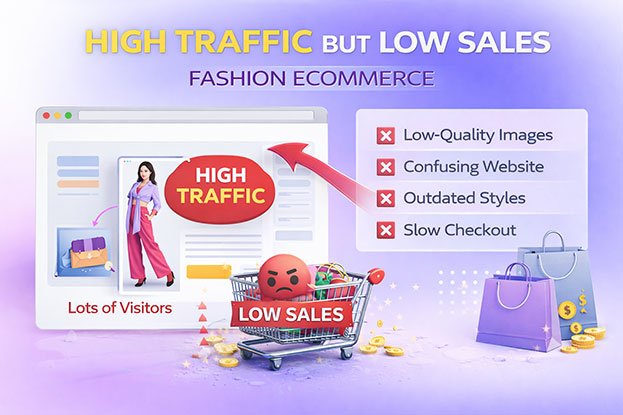
High traffic but low sales fashion ecommerce is usually not a traffic problem — it’s a product page trust problem. High traffic but low sales fashion ecommerce usually means something deeper is wrong.
It’s rarely a traffic crisis.
It’s usually a confidence crisis.
If you run an online clothing store, you’ve likely seen this pattern:
Traffic is climbing.
Ads are active.
Visitors are browsing product pages.
But sales don’t move the way they should.
Your analytics look busy.
Your revenue doesn’t.
So naturally, your mind goes to:
“Is my pricing off?”
“Is my targeting wrong?”
“Do I need better creatives?”
“Is competition just too strong?”
Sometimes those factors matter.
But in most fashion ecommerce stores, the real issue is more subtle — and more uncomfortable to admit:
👉 Your product presentation isn’t building enough trust.
Why High Traffic Doesn’t Guarantee Sales
Traffic only means one thing:
People are curious.
Sales mean something different:
People feel confident.
In fashion eCommerce, confidence is everything.
Customers can’t:
-
touch the fabric
-
try the fit
-
see real color under normal lighting
-
judge stitching or material thickness
They rely almost entirely on one thing:
Your product images.
If those images fail to remove doubt, traffic becomes meaningless.
This is exactly why we explained earlier that clothing product photos don’t convert when they fail to clearly communicate quality, shape, and color.
Traffic brings attention.
Images create belief.
The Silent Behavior Pattern in Fashion Stores
Let’s break down what actually happens when someone lands on your product page.
1️⃣ They look at the main image.
2️⃣ They scroll through the gallery.
3️⃣ They zoom in.
4️⃣ They hesitate.
That hesitation is everything.
They may not even realize it consciously.
But their brain is scanning for:
-
“Does this look real?”
-
“Will this look the same when it arrives?”
-
“Is this brand professional?”
-
“Is the fabric quality clear?”
If the images feel:
-
slightly off
-
inconsistent
-
flat
-
unclear
-
overly edited
-
poorly shaped
The buyer doesn’t complain.
They leave.
Why Fashion Is More Sensitive Than Other Niches
In electronics, specs matter.
In home decor, size matters.
In fashion, perception matters.
Clothing is emotional and visual.
If a shirt looks:
-
dull
-
wrinkled
-
badly aligned
-
oddly shaped
Buyers don’t think:
“The lighting is bad.”
They think:
“This feels cheap.”
Even if it isn’t.
This is why fashion brands lose sales because of bad product images — even when the product itself is strong.
The Most Misunderstood Metric: Conversion Rate
When traffic is high but sales are low, brands usually focus on:
-
improving ad targeting
-
lowering price
-
offering discounts
-
adding urgency
But conversion rate is mostly influenced by:
✔ trust
✔ clarity
✔ presentation
✔ consistency
If those are weak, every other optimization struggles.
That’s also why your clothing ads don’t convert when product pages fail to reinforce the promise made in the ad.
Ads create expectation.
Product images must fulfill it.
The Hidden Cost of Ignoring Image Quality
When presentation isn’t strong enough:
-
cost per acquisition increases
-
return rates increase
-
reviews suffer
-
repeat purchases drop
-
brand perception weakens
You might not feel it immediately.
But over time, growth slows.
And you start thinking:
“Maybe fashion eCommerce is just harder now.”
It’s not harder.
It’s more competitive.
And in competitive markets, small trust gaps create big revenue gaps.
Signs Your Problem Is Presentation (Not Traffic)
Here are clear signals:
✔ High product page views but low add-to-cart
✔ Good click-through rate on ads but poor ROAS
✔ Customers ask questions about color or fabric
✔ High bounce rate on product pages
✔ Inconsistent look across collections
✔ Returns due to “not as expected”
These are not traffic issues.
They’re image clarity and trust issues.
We’ve seen this repeatedly in brands that later improved performance after refining:
-
color accuracy
-
lighting balance
-
shape correction
-
ghost mannequin execution
-
catalog consistency
Exactly the areas covered in:
What Most Brands Don’t Realize
Your product images are not decoration.
They are your salesperson.
If your salesperson:
-
looks unsure
-
speaks unclearly
-
appears inconsistent
Customers don’t feel confident buying.
In fashion eCommerce, weak image presentation creates micro-doubt.
Micro-doubt reduces conversion.
Reduced conversion wastes traffic.
And wasted traffic makes you think the problem is marketing.
Key Takeaway
High traffic but low sales in fashion eCommerce is rarely just a marketing issue.
It’s usually a trust gap — caused by product images that fail to clearly communicate quality, color, and fit.
Traffic brings people in.
Confidence turns them into buyers.
And confidence is built visually.
The Image Mistakes That Quietly Kill Conversion
If your fashion store has traffic but weak sales, the issue usually isn’t dramatic.
It’s subtle.
And subtle problems are the most expensive ones — because they go unnoticed.
Let’s break down the most common image mistakes that reduce conversion even when traffic is strong.
1️⃣ Color That Feels “Almost Right” (But Not Trustworthy)
Color problems are one of the biggest silent conversion killers in apparel.
The issue is rarely extreme.
It’s usually:
-
whites that look slightly yellow
-
blacks that look washed out
-
reds that lean orange
-
inconsistent tones across products
When buyers see this, they don’t analyze it technically.
They think:
“Will this look the same in real life?”
That hesitation reduces purchase confidence.
We explained this deeply in
Why Apparel Product Colors Look Wrong Online (And How to Fix Them) —
color inaccuracy directly increases returns and lowers trust.
If customers are asking about color in reviews or messages, this is likely part of your conversion problem.
2️⃣ Flat Fabric Texture (No Depth, No Premium Feel)
Fashion buyers judge quality visually.
If fabric looks:
-
dull
-
flat
-
overly smooth
-
unclear in detail
The product feels cheaper than it is.
Even good clothing can look average if lighting and editing fail to highlight:
-
stitching
-
folds
-
material thickness
-
natural depth
This is one reason we see brands improve performance after refining clarity and texture in
How Professional Apparel Photo Editing Increases Online Sales.
Buyers don’t need dramatic effects.
They need visual proof of quality.
3️⃣ Awkward Ghost Mannequin Execution
Ghost mannequin is powerful — when done properly.
But when shape correction is poor, problems appear like:
-
collapsed shoulders
-
unnatural waist curves
-
hollow neck areas
-
distorted sleeves
-
uneven symmetry
When ghost mannequin photos look unprofessional, buyers feel something is “off.”
They don’t always know why.
But they don’t feel confident.
We covered this in detail in
Why Ghost Mannequin Photos Look Unprofessional —
shape and structure directly affect perceived quality and fit confidence.
If your product pages feel visually unstable, this may be the issue.
4️⃣ Inconsistent Image Style Across the Catalog
This is one of the most overlooked problems.
Individually, each image might look acceptable.
But when buyers browse:
-
some products look bright
-
others look dark
-
some backgrounds are pure white
-
others are slightly gray
-
color temperature shifts between collections
The store feels inconsistent.
And inconsistency reduces brand authority.
When a brand doesn’t look visually cohesive, buyers subconsciously assume the business is less established.
This directly connects to what we explained in
Why Fashion Brands Lose Sales Because of Bad Product Images —
presentation consistency builds trust at scale.
5️⃣ Product Page Gallery That Doesn’t Remove Doubt
High-traffic stores often have this pattern:
✔ good hero image
❌ weak supporting images
Buyers scroll through:
-
limited angles
-
unclear zoom
-
no fabric close-up
-
no structure view
-
poor back view
So even if the main image looks good, the gallery fails to complete the story.
And when questions remain unanswered, buyers hesitate.
Hesitation increases bounce rate.
Bounce rate reduces ROAS.
ROAS makes you think ads are failing.
But as we explained in
Why Your Clothing Ads Don’t Convert (Image Problems Brands Ignore),
ads are not the issue when product pages don’t reinforce trust.
6️⃣ “Good Enough” Editing That Isn’t Competitive Enough
In today’s fashion eCommerce environment, “good enough” is not enough.
Buyers compare your store instantly with:
-
established fashion brands
-
DTC competitors
-
influencer brands
-
marketplace listings
If your images look slightly weaker, the perception gap grows.
Even if your product quality is high.
Fashion is perception-driven.
And perception is image-driven.
The Conversion Chain Most Brands Miss
Let’s simplify this:
Traffic → Product Page → Trust → Add to Cart → Purchase
Most brands optimize:
-
Traffic
-
Checkout
But skip optimizing:
-
Trust
Trust is visual.
Visual trust comes from:
✔ accurate color
✔ natural shape
✔ clear texture
✔ consistent presentation
✔ clean backgrounds
If any of these are weak, high traffic won’t save the store.
Key Takeaway
When fashion eCommerce stores have high traffic but low sales, the issue is often hidden in subtle image problems — color inaccuracy, flat texture, inconsistent style, weak ghost mannequin execution, or incomplete galleries.
These don’t look dramatic.
But they reduce trust just enough to block conversion.
And blocked conversion makes traffic feel useless.
How to Fix It Systematically (And Turn Traffic Into Sales)
By now, one thing should be clear:
High traffic isn’t the problem.
The problem is what happens after the click.
And if product images are creating even small amounts of doubt, your conversion rate will never scale properly — no matter how much traffic you send.
The good news?
This is fixable.
But not randomly.
It needs to be systematic.
Step 1: Audit Your Product Pages Like a Buyer, Not a Brand Owner
Most founders review their store emotionally.
Instead, review it like a skeptical customer.
Open one product page and ask:
-
Does the color look fully accurate?
-
Is fabric texture clearly visible?
-
Does the garment shape look natural?
-
Do all products in this category feel consistent?
-
Would I feel confident buying this without touching it?
If even one answer feels uncertain, you’ve found a friction point.
Many brands discover this only after reading
Why Clothing Product Photos Don’t Convert,
because they realize clarity and confidence were missing.
Step 2: Fix Color Accuracy First (It’s the Fastest Trust Builder)
Color is the most sensitive element in apparel.
If buyers worry about shade differences, hesitation increases immediately.
This is why correcting color inconsistency often delivers quick improvement — especially when issues like:
-
yellow whites
-
faded blacks
-
inconsistent tone between products
are present.
We broke down the psychology and impact in
Why Apparel Product Colors Look Wrong Online.
Color accuracy reduces:
✔ return rates
✔ pre-purchase questions
✔ buyer hesitation
And increases perceived professionalism instantly.
Step 3: Correct Shape & Structure (Especially Ghost Mannequin)
Fit anxiety is real in fashion eCommerce.
If shape looks:
-
collapsed
-
distorted
-
uneven
-
unnatural
Buyers struggle to imagine wearing it.
Refining structure — especially in ghost mannequin images — is often the difference between “looks okay” and “looks premium.”
As we explained in
Why Ghost Mannequin Photos Look Unprofessional,
natural alignment and realistic depth are critical for trust.
When shape feels right, confidence increases.
Step 4: Standardize Your Entire Catalog (Consistency Scales)
One of the biggest growth blockers is inconsistency.
Even if some images look great, inconsistent lighting, background tone, or editing style across collections makes the store feel unstable.
High-performing fashion brands don’t rely on random image quality.
They follow visual standards:
✔ same lighting balance
✔ same background tone
✔ same color correction level
✔ same editing style
This consistency is what transforms image presentation from “acceptable” to scalable.
And it directly supports what we showed in
Why Fashion Brands Lose Sales Because of Bad Product Images.
Trust multiplies when presentation feels unified.
Step 5: Align Ad Creative With Product Page Reality
One overlooked issue in high-traffic stores:
The ad looks premium.
The product page looks average.
That gap destroys conversion.
If your ad promises:
-
luxury feel
-
rich fabric
-
premium brand
But the product page images don’t reinforce that visually, trust drops immediately.
This is why
Why Your Clothing Ads Don’t Convert (Image Problems Brands Ignore)
often traces back to product presentation, not targeting.
Your product page must visually confirm the promise made in the ad.
Step 6: Treat Image Optimization as a Growth Lever, Not a Design Task
Most brands treat photo editing as cosmetic.
In reality, it’s strategic.
Professional apparel photo editing increases online sales not because it makes images “pretty,” but because it:
✔ removes micro-doubt
✔ clarifies quality
✔ improves perceived value
✔ builds brand consistency
✔ reduces cognitive friction
This is exactly what we detailed in
How Professional Apparel Photo Editing Increases Online Sales.
When image quality improves, conversion improves — even with the same traffic.
The Compound Effect Most Brands Miss
Here’s what happens when you systematically fix image presentation:
-
Conversion rate improves
-
ROAS improves
-
Cost per purchase decreases
-
Return rate drops
-
Reviews improve
-
Repeat purchases increase
Traffic starts working harder for you.
Instead of increasing ad budget, you increase efficiency.
That’s how scalable growth happens in fashion eCommerce.
Final Reality Check
If your clothing store has:
✔ strong traffic
✔ active ads
✔ solid products
But weak conversion —
The issue is likely not marketing fatigue.
It’s a visual trust gap.
And trust in fashion is built image by image.
Final Takeaway
High traffic but low sales in fashion eCommerce is rarely a mystery.
It’s usually the result of product images that fail to remove doubt and reinforce confidence.
When you fix color, structure, texture, and consistency systematically, traffic stops being wasted — and starts converting.
Case Study: High Traffic, Low Sales — Then Image Optimization Changed Everything
Client Profile
Business Type: DTC online clothing brand
Products: Women’s casual wear (dresses, blouses, knit tops)
Platform: Shopify
Monthly Traffic: ~48,000 visitors
Ad Spend: $9,000/month
Problem: Strong traffic, weak conversion
🚨 The Situation
The brand was doing many things right:
✔ Active Facebook & Instagram ads
✔ Influencer collaborations
✔ Seasonal campaigns
✔ Professional lifestyle ad creatives
✔ Good product reviews
But their numbers looked like this:
-
Conversion rate: 0.9%
-
Add-to-cart rate: low
-
ROAS: inconsistent
-
Return rate: rising
-
Revenue growth: stagnant
The founder believed the issue was:
-
Ad targeting
-
Audience fatigue
-
Increasing competition
So they tested:
-
New creatives
-
Different audiences
-
Higher budgets
-
Discount campaigns
Nothing significantly improved.
🔎 The Real Problem: Visual Trust Gap
When we reviewed their store from a buyer’s perspective, several issues stood out:
1️⃣ Color Inconsistency
-
Whites slightly warm in some products
-
Blacks faded in others
-
Different tone levels across collections
Buyers were asking:
“Is this true white?”
“Is the color darker in real life?”
This aligned with what we explained in
Why Apparel Product Colors Look Wrong Online.
2️⃣ Flat Fabric Texture
Fabric looked soft in real life —
but dull and flat in product images.
Lighting and editing weren’t highlighting depth or stitching clearly.
The clothes looked average, even though they weren’t.
3️⃣ Inconsistent Catalog Style
-
Some products had brighter lighting
-
Some had grayish backgrounds
-
Some ghost mannequin shapes looked slightly collapsed
Individually acceptable.
Together? Unstable.
This connects directly to
Why Fashion Brands Lose Sales Because of Bad Product Images.
4️⃣ Ad vs Product Page Mismatch
Their ads looked polished and premium.
But product pages looked slightly less refined.
That gap reduced confidence — exactly as described in
Why Your Clothing Ads Don’t Convert.
🔧 The Solution: Structured Image Optimization
Instead of changing ads again, we focused on systematic image refinement.
What Was Done:
✔ Accurate color correction across all bestsellers
✔ White balance standardization
✔ Fabric texture enhancement (natural, not over-sharpened)
✔ Ghost mannequin shape refinement
✔ Background consistency alignment
✔ Catalog-wide visual standard implementation
No reshoot.
No dramatic changes.
No filters.
Just precise, consistent optimization.
This followed the framework from
How Professional Apparel Photo Editing Increases Online Sales.
📈 Results After 60 Days
Without increasing traffic or ad spend:
-
Conversion rate increased from 0.9% → 1.6%
-
ROAS improved by 38%
-
Add-to-cart rate increased significantly
-
Return rate dropped by 17%
-
Customer complaints about color decreased
-
Repeat purchase rate improved
Revenue increased — with the same traffic.
The founder’s comment:
“We thought we needed more ads.
We actually needed stronger product confidence.”
🧠 Why It Worked
Because the issue wasn’t traffic.
It was trust.
When buyers landed on the product page after clicking an ad, they now saw:
✔ consistent lighting
✔ believable colors
✔ clearer fabric detail
✔ natural garment shape
✔ professional presentation
That removed hesitation.
And hesitation is the silent killer of fashion conversion.
🔍 Key Insight for Clothing Brands
If you have:
✔ 20,000+ monthly visitors
✔ consistent ad traffic
✔ decent product reviews
But weak conversion —
Your growth ceiling may not be marketing.
It may be visual presentation.
Small improvements in image trust can produce large improvements in revenue efficiency.
FAQs
Why does my clothing store get traffic but no sales?
If your clothing store gets traffic but no sales, the issue is usually not traffic volume — it’s buyer confidence. In fashion eCommerce, customers rely heavily on product images to judge color, fabric, and fit. If your product presentation creates doubt, visitors leave without purchasing.
What causes high traffic but low sales in fashion ecommerce?
High traffic but low sales fashion ecommerce situations are often caused by weak product presentation, including:
-
inaccurate or inconsistent product colors
-
flat fabric texture that hides quality
-
unnatural garment shape in ghost mannequin images
-
inconsistent lighting across collections
-
incomplete product image galleries
These issues reduce trust after the click.
Can product images really affect conversion rate in clothing stores?
Yes. Product images directly impact conversion rate because buyers cannot touch or try clothing online. Clear, consistent, and realistic images build confidence. Poor or inconsistent visuals increase hesitation and reduce sales — even with strong traffic.
Why are my clothing ads getting clicks but not conversions?
When clothing ads get clicks but no conversions, the problem is usually on the product page. If the product images don’t visually reinforce the quality promised in the ad, buyers lose trust and abandon the page.
How do better product photos increase online clothing sales?
Better product photos increase online clothing sales by:
-
showing accurate, believable color
-
highlighting real fabric texture
-
presenting clean and natural garment shape
-
maintaining consistent editing across the catalog
When buyers feel visually confident, they are more likely to complete the purchase.
Does improving product images increase revenue without increasing traffic?
Yes. Many fashion brands improve revenue simply by increasing conversion rate through better image presentation. Stronger visual trust improves return on ad spend and reduces wasted traffic.
How do I know if product images are hurting my sales?
Common signs include:
-
high product page views but low add-to-cart rate
-
frequent customer questions about color or fit
-
high return rates due to “not as expected”
-
inconsistent image style across products
These signals usually indicate a visual trust gap.
Should I increase my ad budget or improve product images first?
If your store already has strong traffic, improving product images typically delivers higher ROI than increasing ad budget. Optimized visuals help existing visitors convert more efficiently.
Can professional apparel photo editing improve conversion rate?
Professional apparel photo editing improves conversion rate by correcting color accuracy, enhancing fabric clarity, refining garment shape, and standardizing presentation. These improvements reduce hesitation and increase buyer confidence.
Ready to Turn Traffic Into Revenue?
If your fashion store has traffic but conversion is underperforming, your images may be limiting growth.
Before increasing ad spend or changing strategy, test what stronger presentation can do.
Send us one of your product images and we’ll optimize it specifically for apparel eCommerce — free.
You’ll receive:
✔ Accurate color correction
✔ Fabric clarity enhancement
✔ Natural shape refinement
✔ Clean, consistent presentation
No obligation.
No contracts.
Just a direct comparison so you can evaluate the impact yourself.
If visual trust is blocking your sales, you’ll see it immediately.