The Cost Illusion Most Clothing Brands Believe
If you run an online clothing store, you’ve likely told yourself this:
“We’ll edit product photos in-house. It’s cheaper.”
At first glance, that sounds smart.
You already have:
-
A team
-
Editing software
-
Someone who knows Photoshop
-
A photographer on payroll
So outsourcing feels like an added cost.
An unnecessary expense.
But here’s the uncomfortable reality:
DIY editing looks cheaper — only when you calculate the visible cost.
The invisible cost is where most brands lose money.
Because the real expense isn’t just software or salary.
It’s:
-
Slower product launches
-
Inconsistent color across collections
-
Missed seasonal windows
-
Higher return rates
-
Lower conversion performance
-
Creative team bandwidth drained by revisions
On paper, DIY protects budget.
In practice, it often limits growth.
And growth — not cost cutting — is what scaling apparel brands actually need.
The Visible Cost vs The Real Cost
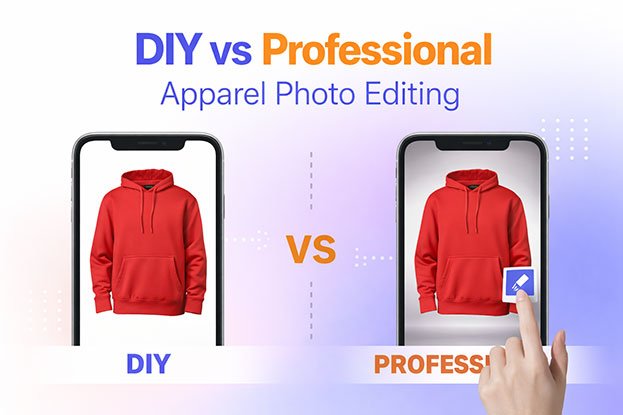
When brands compare DIY vs professional apparel photo editing, they usually calculate only:
-
Software subscription
-
Salary of an in-house editor
-
Basic hardware cost
That’s the visible cost.
But the real cost includes:
-
Training time
-
Revision cycles
-
Color inconsistency across collections
-
Missed launch deadlines
-
Slower product uploads
-
Lower conversion rates
-
Higher return rates
Those hidden costs rarely appear in spreadsheets.
But they directly impact revenue.
What DIY Apparel Photo Editing Actually Costs
Let’s break it down realistically.
1️⃣ Salary & Overhead
A full-time in-house editor isn’t just salary.
It includes:
-
Benefits
-
Taxes
-
Equipment
-
Workspace
-
Software
-
Ongoing training
Even a modest $2,500–$4,000/month salary quickly becomes $40,000–$60,000 per year in real cost.
And that’s for one person.
What happens during:
-
Peak season?
-
Product launch spikes?
-
Sick leave?
-
Staff turnover?
Scaling becomes difficult.
2️⃣ Time-to-Publish Delays
In fashion, speed matters.
If editing slows down:
-
New arrivals launch late
-
Ads can’t start on time
-
Influencer campaigns stall
-
Seasonal trends pass
The opportunity cost of delay is rarely measured.
But every delayed launch affects revenue.
Professional services are built for scale.
In-house teams often struggle when volume increases suddenly.
3️⃣ Quality Inconsistency (The Silent Revenue Killer)
This is where most DIY setups fail.
Different editors produce slightly different:
-
color tones
-
shadow depth
-
background brightness
-
fabric clarity
At first, it seems minor.
But across 200+ SKUs, inconsistency weakens brand trust.
We’ve already seen how this affects:
-
conversion rates
-
ad performance
-
return rates
This connects directly to:
-
Why Apparel Product Colors Look Wrong Online
-
Why Clothing Product Photos Don’t Convert
-
Why Online Clothing Stores Get High Return Rates
DIY editing often struggles with maintaining visual standards at scale.
The ROI Question Most Brands Ask Too Late
Most clothing brands ask:
“How much does professional apparel photo editing cost per image?”
The better question is:
“How much revenue are inconsistent images costing us?”
If:
-
Conversion improves by even 0.5%
-
Return rate drops by 5–8%
-
ROAS increases because product pages convert better
The ROI quickly outweighs per-image editing costs.
But brands only realize this after they compare both systems side by side.
When DIY Actually Makes Sense
Let’s be fair.
DIY editing can work if:
-
You sell very low volume
-
You have limited SKUs
-
Brand consistency is simple
-
Growth isn’t aggressive
But once you scale:
-
Multiple collections
-
Frequent launches
-
Paid ads
-
Large catalogs
DIY starts becoming operational friction.
And friction limits growth.
The Real Difference
DIY apparel photo editing is often optimized for:
👉 Cost control
Professional apparel photo editing is optimized for:
👉 Revenue performance
And in competitive fashion eCommerce, revenue performance usually wins.
Key Takeaway
DIY editing may look cheaper on paper.
But when you account for hidden labor costs, inconsistency, slower scaling, and lost conversion opportunities, the true cost can be higher than professional outsourcing.
The real question isn’t “What does editing cost?”
It’s “What is inconsistency costing your growth?”
Real Cost Comparison — What You’re Actually Paying For
Now let’s move beyond theory.
Instead of asking:
“How much does professional apparel photo editing cost?”
Let’s ask:
“What does each system cost per usable, revenue-ready image?”
Because in fashion eCommerce, the goal isn’t just edited photos.
It’s images that:
-
Convert
-
Reduce returns
-
Maintain consistency
-
Support ad performance
Scenario 1: In-House (DIY) Editing Cost Breakdown
Let’s say you hire one in-house editor.
Annual Cost Estimate:
-
Salary: $40,000
-
Taxes & benefits: ~$8,000
-
Software subscriptions: ~$1,000
-
Hardware & upgrades: ~$2,000
-
Training / onboarding time: ~$2,000
Total annual cost: ~$53,000
Now let’s say they process 8,000 images per year.
That equals:
👉 $6.62 per image (minimum)
And that doesn’t include:
-
Sick leave
-
Vacation
-
Revision cycles
-
Peak season overtime
-
Creative direction time
-
Quality control management
Realistically, cost per image often ends up higher.
And if quality is inconsistent, hidden revenue loss adds up.
We’ve already discussed how inconsistency affects performance in:
-
Why Fashion Brands Lose Sales Because of Bad Product Images
When image quality varies, trust drops — and trust impacts revenue.
Scenario 2: Professional Apparel Photo Editing
Let’s say outsourced editing costs:
$1.20–$3.00 per image (depending on complexity)
For 8,000 images per year:
👉 $9,600 – $24,000 annually
Even at the higher end, it can be less than half the total cost of in-house editing.
But cost isn’t the only factor.
The Hidden Revenue Impact
Here’s where ROI becomes real.
If professional editing improves:
-
Conversion rate by just 0.5%
-
Return rate by even 5%
-
ROAS efficiency by 10–15%
The revenue difference often outweighs cost savings.
For example:
If your store generates $500,000 annually and:
-
Conversion increases modestly
-
Returns decrease slightly
That improvement could mean tens of thousands in retained revenue.
This connects directly to:
-
High Traffic but Low Sales Fashion Ecommerce
Professional editing doesn’t just reduce cost per image.
It improves revenue per visitor.
Speed & Scalability (Where DIY Struggles)
In-house editing systems often struggle during:
-
New collection launches
-
Holiday campaigns
-
Influencer drops
-
Seasonal spikes
Professional teams are built for volume scaling.
When speed improves:
-
Products launch faster
-
Ads start sooner
-
Trends are captured on time
Time-to-market directly affects revenue — especially in fashion.
Consistency at Scale
Professional systems operate with:
✔ Standardized color calibration
✔ Defined lighting benchmarks
✔ Shape correction protocols
✔ Catalog-wide editing guidelines
This level of consistency is difficult to maintain internally without:
-
Senior art direction
-
Dedicated QA processes
-
Multiple staff
And we’ve seen how consistency affects trust in:
-
Why Apparel Product Colors Look Wrong Online
Small inconsistencies may seem minor.
At scale, they become brand perception issues.
The Opportunity Cost Most Brands Ignore
Every hour your internal team spends editing:
They are not:
-
Planning campaigns
-
Optimizing conversion
-
Developing new collections
-
Improving brand strategy
DIY editing consumes creative bandwidth.
Professional editing protects operational focus.
And focus accelerates growth.
The Real Question Isn’t “Cheaper or Not?”
It’s:
Which system produces higher revenue per image?
Because in fashion eCommerce:
Better images improve:
✔ Conversion
✔ Trust
✔ Retention
✔ Ad efficiency
✔ Brand perception
That’s ROI — not just cost control.
Key Takeaway
DIY editing may appear cheaper on paper.
But when you factor in hidden labor cost, inconsistency risk, slower scaling, and missed revenue opportunities, professional apparel photo editing often delivers stronger ROI.
The true comparison isn’t cost per image.
It’s profit per image.
When DIY Makes Sense — And When Professional Editing Wins
By now, one thing should be clear:
This isn’t about “editing software vs outsourcing.”
It’s about:
👉 Operational efficiency
👉 Revenue impact
👉 Brand consistency
👉 Long-term scalability
So let’s break this down practically.
When DIY Apparel Photo Editing Actually Makes Sense
DIY editing can work if:
✔ You have fewer than 50–100 SKUs
✔ Product launches are infrequent
✔ Traffic volume is low
✔ Conversion rate pressure is minimal
✔ Brand presentation standards are simple
✔ You’re early-stage and testing the market
At this stage, your focus is survival — not optimization.
If you’re validating product-market fit, in-house editing might be fine temporarily.
But once growth begins, the equation changes.
When Professional Apparel Photo Editing Clearly Wins
Outsourcing becomes powerful when:
✔ You run paid ads consistently
✔ You launch new collections frequently
✔ You manage hundreds of SKUs
✔ You care about brand perception
✔ You want consistent color accuracy
✔ Return rates are hurting margins
At this level, editing is no longer a design task.
It’s a growth lever.
We’ve already explored how image clarity affects:
-
Why Clothing Product Photos Don’t Convert
-
High Traffic but Low Sales Fashion Ecommerce
-
Why Online Clothing Stores Get High Return Rates
When presentation affects both conversion and retention, editing becomes strategic.
The Scaling Question Most Brands Avoid
Here’s the uncomfortable truth:
DIY systems break under scale.
You may handle:
-
200 images per month easily.
But what about:
-
2,000 images during holiday season?
-
Multiple collections at once?
-
48-hour campaign deadlines?
Professional systems are built for:
✔ Volume
✔ Turnaround time
✔ Standardized quality control
✔ Multi-editor coordination
DIY setups depend heavily on individual capacity.
Outsourced systems depend on process.
Process scales.
Individuals don’t.
The Brand Perception Factor
In fashion, perception equals value.
Inconsistent editing creates:
-
color shifts
-
shadow variation
-
lighting differences
-
shape irregularities
Customers don’t analyze it technically.
They feel it emotionally.
And emotional doubt reduces trust.
We saw how consistency affects perception in:
-
Why Fashion Brands Lose Sales Because of Bad Product Images
-
Why Apparel Product Colors Look Wrong Online
Professional editing isn’t just about fixing images.
It’s about standardizing brand presence.
A Simple Decision Framework
Ask yourself:
1️⃣ Is image consistency affecting my brand perception?
2️⃣ Is my team spending too much time editing instead of growing?
3️⃣ Are return rates linked to expectation gaps?
4️⃣ Is my catalog growing faster than my editing capacity?
5️⃣ Am I leaving conversion improvements unexplored?
If the answer to more than two is “yes,” outsourcing likely delivers stronger ROI.
The Revenue Lens
Here’s the shift that matters most.
DIY focuses on:
👉 Reducing visible expense.
Professional editing focuses on:
👉 Increasing revenue performance.
In competitive apparel eCommerce, small conversion lifts and reduced return rates compound quickly.
The goal isn’t cheapest editing.
It’s strongest profit per image.
Final Takeaway
DIY apparel photo editing may seem cost-effective early on.
But as your brand grows, consistency, speed, accuracy, and scalability matter more than simple cost control.
Professional apparel photo editing often wins not because it’s cheaper — but because it protects revenue, improves conversion, reduces returns, and frees your team to focus on growth.
In fashion eCommerce:
Editing is not an expense.
It’s an operational growth system.
📊 Case Study: From DIY Editing to Outsourcing — And a 42% ROI Improvement
Client Profile
Business Type: Mid-size DTC women’s apparel brand
Platform: Shopify
Monthly Revenue: ~$220,000
Monthly SKUs Processed: ~600–900 images
Initial Editing Model: In-house (1 full-time editor)
🚨 The Situation
The brand handled all apparel photo editing internally.
They had:
✔ One dedicated editor
✔ Adobe Creative Cloud subscription
✔ Basic workflow system
At first, it seemed efficient.
But as the brand scaled, cracks appeared.
🔍 Problems with DIY Editing
1️⃣ Launch Delays
New arrivals were often delayed by 3–5 days due to editing backlog.
That meant:
-
Ads couldn’t launch on time
-
Influencer campaigns stalled
-
Seasonal trends were missed
In fashion, timing is revenue.
2️⃣ Inconsistent Color & Lighting
Different product batches had slight color variation.
Whites leaned warm in one collection, cooler in another.
This directly affected:
-
Buyer confidence
-
Return rates
We’ve already seen how color inconsistency increases dissatisfaction in
Why Apparel Product Colors Look Wrong Online.
3️⃣ Rising Return Rate
Return rate had crept up to 22%.
Most common reason?
“Not as expected.”
That matched what we explained in
Why Online Clothing Stores Get High Return Rates —
visual expectation gaps were driving refunds.
4️⃣ Hidden Cost Reality
Annual cost of in-house editing:
-
Salary + overhead: ~$52,000
-
Software + equipment: ~$3,000
-
Overtime during peak season: ~$5,000
Total: ~$60,000+ annually.
And still struggling with scale.
🔧 The Shift to Professional Apparel Photo Editing
Instead of hiring another in-house editor, they tested outsourcing.
They began with:
✔ 300-image pilot batch
✔ Standardized color calibration
✔ Defined lighting guidelines
✔ Ghost mannequin structure correction
✔ Catalog-wide editing consistency
The focus wasn’t just making images look “better.”
It was making them look:
✔ Accurate
✔ Consistent
✔ Reliable
Exactly what we described in
How Professional Apparel Photo Editing Increases Online Sales.
📈 Results After 6 Months
Without increasing traffic or ad budget:
-
Return rate dropped from 22% → 15.5%
-
Conversion rate improved from 1.7% → 2.2%
-
Launch turnaround improved by 40%
-
ROAS improved due to stronger product page trust
-
Editing cost reduced to ~$32,000 annually
Net Impact
Savings + retained revenue =
Approximate 42% ROI improvement within the first year.
The founder’s comment:
“We thought outsourcing would increase cost.
It actually increased control and improved profit.”
🧠 Why It Worked
Because the brand stopped treating editing as a design task.
They started treating it as:
👉 A revenue performance system.
Consistency improved trust.
Trust improved conversion.
Accuracy reduced returns.
Speed improved opportunity capture.
And those effects compound.
FAQs
Is outsourcing apparel photo editing more cost-effective than DIY?
Outsourcing apparel photo editing is often more cost-effective when you factor in salary, overhead, software, training, and scalability. Professional services typically reduce hidden operational costs and improve ROI.
Does professional apparel photo editing increase ROI?
Yes. Professional apparel photo editing increases ROI by improving conversion rates, reducing return rates, and maintaining visual consistency that strengthens brand trust.
When should clothing brands outsource photo editing?
Clothing brands should consider outsourcing when product volume increases, return rates rise, editing delays affect launches, or in-house consistency becomes difficult to maintain.
What are the risks of DIY apparel photo editing?
DIY editing risks include inconsistent color, uneven lighting, delayed product launches, higher return rates, and limited scalability during peak seasons.
How does professional editing reduce clothing return rates?
Professional editing reduces clothing return rates by improving color accuracy, enhancing realistic texture, correcting garment shape, and aligning online expectations with real products.
Scaling Your Brand? Don’t Let Editing Limit Growth.
If your clothing store is growing but your editing process feels like a bottleneck, it may be time to evaluate the system — not just the cost.
Before hiring more internal staff, test a smarter approach.
Send us one of your best-selling apparel images.
We’ll professionally optimize it using standardized color calibration, realistic texture enhancement, and consistent presentation guidelines — tailored for fashion eCommerce.
No contracts.
No commitment.
Just a direct comparison so you can measure the difference in clarity, consistency, and brand perception.
If your images are limiting conversion or increasing returns, you’ll see it clearly.
👉 Request your free apparel optimization test and evaluate the ROI for your brand.