A clothing brand might shoot 300 products for a new season and end up with 1,200 images. Some are simple cotton T-shirts. Others are lined jackets with high collars, zippers, and layered fabric. Every image needs to look clean and consistent on the product page, but they do not all need the same amount of editing work.
That is why Ghost Mannequin Editing Pricing rarely comes down to one number. The cost depends on source image quality, garment complexity, image volume, retouching level, and how the editing provider runs its workflow.
There is no single universal price for every apparel image. This article explains how ghost mannequin editing is priced in 2026, what affects the cost of each image, which pricing models providers use, and how to compare quotes so you know exactly what you are paying for.
1. What Is Ghost Mannequin Editing?
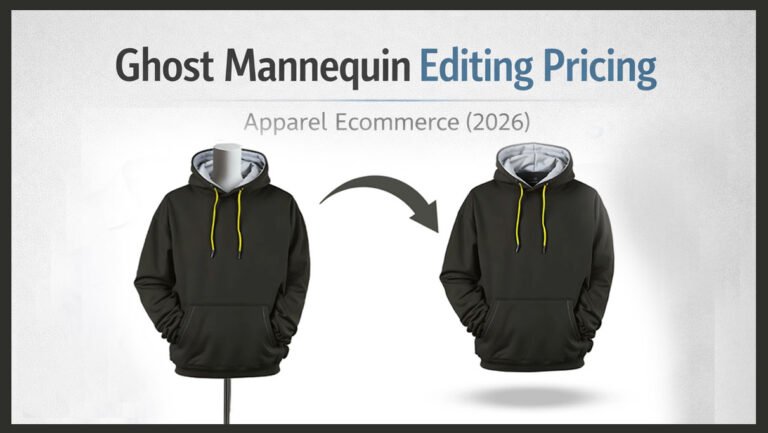
Ghost mannequin editing (also called invisible mannequin editing) is a post-production technique that removes the mannequin from a clothing photo so the garment appears to hold its shape on its own. The result shows the true fit, structure, and neckline of the product without a model or visible mannequin.
How the invisible mannequin effect works
The photographer usually shoots two or more images of the same garment:
- The main shot: the garment on a mannequin, showing the front or back.
- The inner shot: the garment turned inside out or placed flat, showing the inside of the neckline, collar, or label area.
The editor then removes the mannequin from the main shot and blends the inner section into the empty space. This creates a natural-looking inside view of the neck, often called the neck joint.
Photography vs editing
Ghost mannequin photography captures the raw material. Ghost mannequin editing turns that raw material into a finished product image. Good photography makes editing easier, but the invisible effect itself is created in post-production, usually in Photoshop.
What the editing process may involve
- Background removal using a clipping path or masking
- Mannequin removal
- Neck-joint creation and inner garment compositing
- Retouching (dust, lint, loose threads, minor wrinkles)
- Color correction to match the real garment
- Shadow adjustment or creation
- Straightening, alignment, and cropping
- Final quality control
Apparel brands use this style because it keeps the customer’s attention on the garment and gives a catalog a clean, uniform look across hundreds of SKUs.
2. Why Does Ghost Mannequin Editing Pricing Vary?
Short answer: Pricing varies because each image requires a different amount of skilled work. Two photos that look similar at first glance can take very different editing time.
The main factors include:
- Image complexity: clean edges versus fur, lace, or frayed hems
- Garment type: a tank top versus a double-breasted coat
- Source image quality: lighting, focus, and positioning
- Number of images: a small test batch versus a full catalog
- Number of views: front only, or front, back, side, and detail shots
- Neck-joint requirements: simple crew necks versus hooded or high-collar garments
- Retouching level: basic cleanup versus detailed wrinkle and fabric work
- Background requirements: white, colored, or transparent
- Color correction: general balancing versus matching exact brand swatches
- Shadow requirements: none, natural, drop, or reflection shadows
- Revision requirements: how many rounds are expected
- Delivery specifications: sizes, formats, naming conventions, and margins
- Rush requirements: standard delivery versus tight deadlines
A basic T-shirt photographed on a clean background may need background removal, mannequin removal, and a simple neck joint. A detailed wool jacket with a lining, lapels, and a textured weave may need careful masking, a multi-layer neck composite, fabric retouching, and precise color work. Both are “one image,” but they do not represent the same workload.
3. What Is Usually Included in Ghost Mannequin Editing?
A standard ghost mannequin workflow commonly covers:
- Background removal
- Mannequin removal
- Neck joint
- Inner garment compositing
- Basic retouching
- Color correction
- Straightening and symmetry adjustment
- Cropping and alignment
- Background cleanup
- A basic shadow
However, every provider defines its package differently. One company may include shadows and basic color correction in its standard rate. Another may treat both as separate services. Some include one revision round; others include more or charge for extra rounds.
Before approving any quote, ask for a written list of what is included and what is not. This single step prevents most pricing disputes.
4. Ghost Mannequin Editing Pricing Models
Providers usually charge using one of the following models, or a mix of them.
Per-Image Pricing
You pay a set rate for each finished image. This model is easy to understand and budget for, and it works well for small or irregular orders. The rate usually depends on the complexity level of the image, so a provider may have different per-image rates for simple and complex garments.
Bulk Pricing
For larger batches, providers may quote differently based on:
- The total number of images
- How consistent the images are in style and setup
- Whether the same workflow repeats across the batch
- The number of SKUs involved
- How similar the garment types are
Large, consistent batches can be more efficient to edit because the editor sets up a process once and applies it repeatedly. Bulk volume does not automatically mean a lower price, though. A large batch of complex, inconsistent images may still require significant work per file.
Project-Based Pricing
For a complete catalog, seasonal launch, or campaign, a provider may quote one price for the entire project. This model can suit brands that need a defined scope, a fixed deadline, and a single budget line. It depends on a clear agreement about image count, style, and revisions before work starts.
Complexity-Based Pricing
Some providers group images into tiers such as basic, medium, and complex. A plain T-shirt might fall into the basic tier, while a layered coat with a hood falls into the complex tier. This model reflects the actual work more accurately than a flat rate.
Rush Pricing
Urgent delivery may affect the quote. Rush work can require more editors, overnight shifts, or rescheduling of other projects. If your deadline is tight, mention it at the start so the provider can confirm whether it is possible and how it affects the price.
5. Ghost Mannequin Editing Cost Per Image: What Determines It?
The cost per image reflects the specific tasks that image needs.
Basic editing
- Background removal on a clean backdrop
- Simple mannequin removal
- Basic dust and lint cleanup
- A standard crew-neck joint
Advanced editing
- Difficult neck joints (hoods, turtlenecks, shirt collars, lapels)
- Complex garment structure, such as structured blazers or tailored coats
- Multiple layers, linings, or attached accessories
- Detailed fabric like knits, sequins, lace, or sheer materials
- Heavy retouching of wrinkles, creases, or fabric pulls
- Advanced color correction to match physical samples
“Per image” is a billing unit, not a promise that every image needs the same effort. This is why providers often ask to see sample images before confirming a rate.
6. How Garment Type Affects Pricing
Garment construction has a direct effect on editing difficulty.
| Garment Type | Common Editing Considerations |
|---|---|
| T-shirts | Usually simpler; crew or V-neck joints |
| Shirts and polo shirts | Collars, plackets, and buttons need careful neck work |
| Dresses | Long silhouettes, flowing hems, sometimes sheer layers |
| Jackets and blazers | Lapels, linings, structured shoulders |
| Hoodies | Hood shape and inner hood compositing |
| Sweaters | Knit texture and fuzzy edges need careful masking |
| Coats | Multiple layers, heavy fabric, large surface retouching |
| Jeans and trousers | Waistband inner view, belt loops, leg openings |
| Sportswear and activewear | Mesh panels, stretch fabric, reflective details |
| Children’s clothing | Small details, prints, and embellishments |
Collars, layered garments, textured fabric, transparent materials, loose shapes, and complicated construction can all add editing work. A brand with mostly basic tees will usually have a simpler workflow than a brand selling outerwear and tailoring.
7. How Source Image Quality Affects Ghost Mannequin Editing Cost
The photo you send is the starting point for every edit. Common problems that add work include:
- Poor lighting: uneven light creates color shifts and shadows that must be corrected
- Low resolution: limits detail and makes clean edges harder
- Wrinkles: every crease that should have been steamed must be retouched
- Incorrect garment positioning: crooked or twisted garments need reshaping
- Blurry edges: make clipping and masking less precise
- Missing inner garment photographs: without an inner shot, the neck joint may need to be rebuilt manually or reshot
- Overexposure or underexposure: loses detail in whites or darks
- Inconsistent angles: makes a catalog look uneven and requires alignment work
Better source images can make the editing workflow more predictable, but they do not eliminate the need for professional post-production. Even well-shot garments still need mannequin removal, compositing, cleanup, and color checks.
8. How Image Volume Affects Pricing
Different volumes often need different workflows:
- 10 images: often a test batch or small drop; usually handled quickly with direct communication
- 50 images: a small collection where consistency starts to matter
- 100 images: a full collection that benefits from a clear style guide
- 500 images: a larger catalog that needs file organization, batch planning, and staged quality control
- 1,000+ images: a production workflow with scheduled deliveries, multiple editors, and structured review
Factors that shape a volume-based quote include batch consistency, file organization, whether a style guide exists, quality-control steps, revision handling, delivery schedule, and how many product categories are mixed together.
Always share your actual image count when requesting a quote. An estimate of “a few hundred” can lead to a quote that does not match the real project.
9. What Additional Services Can Increase Editing Cost?
Depending on the provider, these requirements may affect the price:
- Advanced retouching
- Color matching to physical swatches
- Complex clipping paths
- Difficult background removal
- Shadow creation
- Multiple product views
- Image resizing for different platforms
- File-format conversion
- Transparent background delivery
- Additional revision rounds
- Detailed restoration of damaged or stained garments
- Urgent delivery
These are potential pricing factors, not universal extra charges. Some providers bundle several of them into a standard package.
10. Ghost Mannequin Editing vs Other Apparel Image Styles
| Image Style | Main Purpose | Editing Needs | Typical Use |
|---|---|---|---|
| Ghost Mannequin | Show garment shape without a visible mannequin | Moderate to advanced | Ecommerce clothing |
| Flat Lay | Show garment from above | Moderate | Catalog and social media |
| Model Photography | Show garment worn | Retouching | Fashion marketing |
| Standard Mannequin | Show garment structure | Basic to moderate | Product listings |
No single style is best for every brand. The right choice depends on your brand style, product type, customer expectations, and catalog goals. Many stores combine styles, using ghost mannequin images for the main listing and model photos for lifestyle context.
11. How to Request an Accurate Ghost Mannequin Editing Quote
Send the provider these details:
- Total number of images
- Several sample images (simple and complex)
- Garment types included
- Required views (front, back, side, detail)
- Source file format (JPEG, RAW, TIFF)
- Desired output format and dimensions
- Background requirements (white, colored, transparent)
- Neck-joint requirement
- Retouching level
- Color correction needs
- Shadow requirements
- Delivery deadline
- Revision expectations
Clear information reduces pricing misunderstandings and helps the provider give you a quote that reflects the real work.
12. Questions to Ask Before Hiring a Ghost Mannequin Editing Company
- What is included in your ghost mannequin editing price? Get the full list in writing.
- Do you charge per image or per project? This helps you compare quotes fairly.
- Do you offer bulk project quotes? Useful for seasonal catalogs.
- How do you handle complex garments? Ask whether they use complexity tiers.
- Is neck-joint editing included? Some treat it as a separate task.
- Are color corrections included? Clarify general balancing versus exact matching.
- Are shadows included? Confirm the shadow type you need.
- How are revisions handled? Ask how many rounds are included and what counts as a revision.
- What file formats do you deliver? Confirm JPEG, PNG, PSD with layers, or others.
- How do you manage quality control? Ask who checks images before delivery.
- Can I submit a sample first? A sample shows real quality before you commit.
- How do you handle large apparel catalogs? Ask about file naming, batching, and staged delivery.
13. Cheap vs Professional Ghost Mannequin Editing
A low price is not automatically a bad choice, and a high price is not automatically a good one. Look at overall project value instead:
- Editing quality: clean edges, natural neck joints, accurate color
- Consistency: does image 400 match image 4?
- Communication: how quickly and clearly they respond
- Revision process: clear rules, fair handling
- File handling: secure transfers and organized delivery
- Quality control: a defined review step before delivery
- Experience with apparel: familiarity with collars, knits, and linings
- Bulk capacity: ability to handle volume without quality dropping
- Workflow transparency: clear steps and expectations
- Delivery requirements: meeting your formats and deadlines
A lower rate that leads to repeated revisions, reshoots, or inconsistent listings can cost more time overall. A higher rate is only worth it if the quality and reliability match.
14. In-House vs Outsourced Ghost Mannequin Editing Costs
| Factor | In-House | Outsourced |
|---|---|---|
| Employee cost | Salaries and benefits | Paid per image or project |
| Training | Needed for new editors | Handled by the provider |
| Software | Licenses required | Included in provider costs |
| Equipment | Computers and calibrated monitors | Not required |
| Editing capacity | Limited by team size | Can scale with volume |
| Quality control | Managed internally | Provider’s process plus your review |
| Management time | Direct supervision | Coordination and feedback |
| Fees | Fixed overhead | Variable editing fees |
| Flexibility | Consistent control | Easier to adjust to seasonal peaks |
Outsourcing is not always cheaper. A brand with steady, high volume and a skilled team may find in-house editing efficient. A brand with seasonal peaks may prefer outsourcing. Compare total workflow cost, not just the editing fee.
15. How to Reduce Unnecessary Ghost Mannequin Editing Costs
- Improve source photography: steam garments and check focus before shooting
- Use consistent lighting: reduces color correction work
- Photograph garments correctly: always capture the inner neck shot
- Create a style guide: define crop, margins, background, and shadow
- Group similar products: batch tees together and outerwear together
- Organize files clearly: use consistent naming by SKU and view
- Provide complete instructions: at the start, not mid-project
- Approve a sample before bulk production: catches issues early
- Reduce avoidable revisions: give specific, consolidated feedback
- Keep image dimensions consistent: simplifies cropping and alignment
Do not cut quality control to save money. Errors in live product listings usually cost more to fix later.
16. Ghost Mannequin Editing Pricing for Shopify and Amazon Apparel Stores
Your sales platform can shape the editing brief. Consider:
- Product listing images: main image rules often differ from secondary images
- Catalog consistency: matching crops and sizes across all products
- Image dimensions: size and aspect ratio affect cropping work
- Background expectations: some marketplaces have strict main-image background rules
- Multiple product views: more views mean more images to edit
- File formats: accepted formats and file size limits
Platform requirements change over time. Check the latest official Shopify and Amazon image guidelines before publishing, and share those requirements with your editor so the output matches from the start. Related services include [Amazon Image Editing] and [Shopify Product Photo Editing].
17. How Clipping Area Handles Ghost Mannequin Editing Projects
Clipping Area is a Post-Production Photo Retouching Agency that works with ecommerce brands, fashion labels, and photographers on apparel image editing.
Relevant services include:
- [Ghost Mannequin Photo Editing Services]
- [Apparel Photo Editing] and [Clothing Photo Editing]
- [Ecommerce Product Photo Editing]
- [Background Removal Services] and [Clipping Path Services]
- [Product Photo Retouching]
- Color correction and shadow creation
- [Bulk Image Editing]
The workflow
Image Submission → Requirement Review → Sample → Quote → Editing → Quality Control → Client Review → Final Delivery
Instead of quoting blindly, Clipping Area reviews sample images first. This shows the real garment complexity, source quality, and requirements, so the quote reflects the actual project rather than a guess. Once the sample is approved, the same standard is applied across the full batch.
Have an apparel image batch that needs ghost mannequin editing? Send Clipping Area a small sample with your requirements to discuss the workflow and receive a project-specific quote.
18. Frequently Asked Questions
How much does ghost mannequin editing cost?
There is no single price. The cost depends on garment complexity, source image quality, retouching level, image volume, and delivery needs. The most accurate way to know is to send sample images for a project-specific quote.
What is ghost mannequin editing pricing based on?
It is based on the work each image requires: background removal, mannequin removal, neck-joint compositing, retouching, color correction, shadows, output specifications, revisions, and deadline.
Is ghost mannequin editing charged per image?
Often, yes. Many providers charge per image, sometimes with complexity tiers. Others offer bulk or project-based quotes for large catalogs.
Is bulk ghost mannequin editing cheaper?
It can be, because consistent batches allow an efficient repeated workflow. It is not guaranteed. Complex or inconsistent images may still need significant work per file.
What makes a ghost mannequin image more expensive to edit?
Complex collars, hoods, linings, layered construction, sheer or textured fabric, heavy wrinkles, poor lighting, and missing inner shots all add editing time.
Does neck-joint editing cost extra?
It depends on the provider. Some include it in the standard ghost mannequin rate; others price it separately, especially for complex necklines.
Does color correction affect the price?
Basic color balancing is often included. Exact color matching to physical samples or brand swatches may require more work and can affect the quote.
Does image quality affect editing cost?
Yes. Well-lit, focused, wrinkle-free images with proper inner shots usually need less corrective work than poorly shot images.
How can I get an accurate ghost mannequin editing quote?
Share your image count, sample images, garment types, required views, output format, background, retouching, shadow, and color requirements, plus your deadline and revision expectations.
How much does apparel photo editing cost?
Apparel photo editing pricing varies by service type and complexity. Ghost mannequin work, background removal, and retouching each involve different tasks, so quotes are usually based on the actual images.
Can Shopify sellers outsource ghost mannequin editing?
Yes. Shopify sellers can outsource editing and provide their store’s image size and style requirements so the delivered images fit their theme and catalog.
Can Amazon apparel sellers use ghost mannequin images?
Many apparel sellers use them, but Amazon has specific image rules by category. Check Amazon’s current official guidelines before uploading.