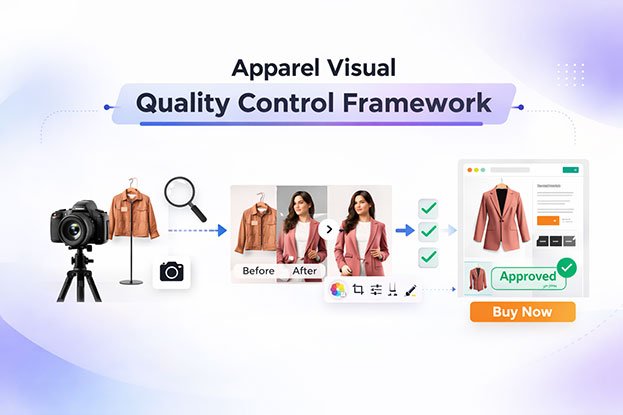
What Visual Quality Control Actually Means in Apparel eCommerce
An apparel visual quality control framework defines the standards, checkpoints, and validation processes that protect image consistency, accuracy, and brand integrity across every product published online.
Most clothing brands have product quality control.
Few have visual quality control.
And in eCommerce, visual presentation is product perception.
The Misconception: “If It Looks Good, It’s Fine”
Many brands evaluate product images subjectively.
They ask:
-
“Does this look clean?”
-
“Does this look professional?”
-
“Is the lighting okay?”
This approach works at small scale.
But as SKU volume increases, subjective review creates inconsistency.
What one editor considers “bright enough,” another considers “too flat.”
What one photographer sees as “natural,” another sees as “warm.”
Without defined standards, variation accumulates.
Variation weakens brand uniformity.
Visual Quality Control vs Basic Image Review
Basic review asks:
“Is anything obviously wrong?”
Visual quality control asks:
“Does this image meet defined brand standards?”
The difference is critical.
Basic review catches mistakes.
Quality control protects consistency.
Consistency is what customers subconsciously associate with professionalism.
Why Apparel eCommerce Requires Stricter Visual Control
Apparel has unique risk factors:
-
Color sensitivity (especially whites, blacks, pastels)
-
Fabric texture visibility
-
Shape distortion risk
-
Shadow interpretation
-
Background tone accuracy
Small deviations in apparel images create:
-
Perceived quality shifts
-
Color-related returns
-
Fit expectation gaps
-
Brand inconsistency
Unlike electronics or home goods, clothing is judged visually and emotionally.
That increases the importance of image governance.
The 5 Control Layers of Apparel Visual Quality
A proper visual quality control framework evaluates five core layers:
1️⃣ Lighting Consistency
-
Uniform exposure across SKUs
-
Controlled shadow depth
-
Consistent white balance
2️⃣ Color Accuracy
-
True-to-fabric representation
-
Cross-collection color alignment
-
No warm/cool shifts between drops
3️⃣ Garment Shape Integrity
-
Realistic silhouette
-
No over-stretched or compressed forms
-
Balanced sleeve and collar alignment
4️⃣ Texture Clarity
-
Visible stitching and weave
-
No over-smoothing
-
No artificial sharpening artifacts
5️⃣ Background Uniformity
-
Consistent brightness level
-
Clean edge transitions
-
No tonal drift between batches
Each layer must be defined, not guessed.
The Cost of Not Having Visual Governance
When brands lack a defined visual quality control system, they experience:
-
Collection-to-collection inconsistency
-
Fluctuating conversion rates
-
Increased return percentages
-
Marketing misalignment
-
Internal revision cycles
These problems appear operational.
But their root cause is visual standard instability.
Without control, growth amplifies variation.
Visual Quality Control Is Governance, Not Editing
This framework is not about creative styling.
It is about:
-
Defined thresholds
-
Measurable standards
-
Structured review processes
-
Accountability checkpoints
Editing refines images.
Quality control governs them.
That distinction matters at scale.
Strategic Foundation Takeaway
An apparel visual quality control framework is the system that ensures:
-
Every product meets brand standards
-
Every collection aligns visually
-
Growth does not introduce inconsistency
-
Performance does not fluctuate due to visual drift
At small scale, talent can carry visual output.
At growth scale, only systems can.
The 7-Step Apparel Visual Quality Control Process
A visual quality control framework only works when it becomes procedural.
That means defined checkpoints — not casual review.
Below is a structured 7-step control process apparel brands can implement to protect image consistency at scale.
Step 1: Pre-Shoot Validation Checklist
Visual quality control begins before the first photo is taken.
Every shoot should follow a standardized validation checklist:
-
Confirm lighting temperature (e.g., 5500K daylight standard)
-
Verify background brightness reference
-
Calibrate monitor and camera settings
-
Review garment preparation (steam, shaping, lint removal)
-
Confirm required shot angles per SKU
If standards are not locked at this stage, inconsistencies compound later.
This step prevents correction-heavy editing.
Step 2: Photography Execution Control
During the shoot, enforce non-negotiable rules:
-
Fixed tripod height per product category
-
Marked light placement
-
Defined framing ratio
-
Controlled shadow softness
-
No lighting variation between batches
This removes subjective adjustments mid-shoot.
Consistency must be mechanical, not interpretive.
Step 3: Editing SOP Enforcement
After capture, editing must follow documented rules.
An editing Standard Operating Procedure (SOP) should define:
-
Background brightness range (e.g., RGB 245–255 for white)
-
Color neutrality calibration
-
Texture clarity thresholds
-
Acceptable shadow retention
-
Shape correction boundaries
Editors should not decide stylistic tone.
They should execute predefined standards.
Without SOP enforcement, collections drift visually over time.
Step 4: Batch Consistency Review
This is where real quality control happens.
Instead of reviewing images individually, review in batches.
Compare:
-
30–50 SKUs side-by-side
-
Similar color garments across categories
-
New collection vs previous collection
-
Whites and blacks across batches
This identifies tonal drift early.
Single-image review rarely detects systemic inconsistency.
Batch review protects brand continuity.
Step 5: Zoom & Detail Validation
Before approval, test:
-
100% zoom clarity
-
Stitch visibility
-
Fabric texture accuracy
-
Edge sharpness
-
Artifact presence
Many inconsistencies only appear at zoom level.
Since customers zoom before purchasing, this checkpoint is critical.
Step 6: Mobile & Grid Simulation Test
Most customers browse on mobile.
Simulate:
-
Grid view comparison across 12–20 SKUs
-
Background consistency across product pages
-
Color uniformity in category view
-
Thumbnail cropping accuracy
This test reveals inconsistencies invisible in isolated review.
Visual governance must reflect customer browsing behavior.
Step 7: Pre-Publish Approval Gate
Before publishing, assign accountability.
Define:
-
Who signs off?
-
What checklist must be passed?
-
What standards trigger revision?
Without a defined approval gate, standards erode over time.
Accountability protects system integrity.
The Control Loop
Pre-Shoot Validation
→ Controlled Photography
→ Editing SOP
→ Batch Review
→ Zoom Test
→ Mobile Simulation
→ Approval Gate
This creates a closed-loop control system.
Each step reduces variation risk.
Why This Process Matters at Scale
When SKU volume grows, even small inconsistencies multiply:
-
Slight warmth shift across 200 SKUs becomes noticeable.
-
Minor brightness differences weaken grid presentation.
-
Shape distortions impact perceived fit consistency.
Without structured control, these deviations compound.
With structured control, performance stabilizes.
Takeaway
A functional apparel visual quality control framework requires:
✔ Documented standards
✔ Multi-stage review
✔ Batch comparison
✔ Defined approval authority
✔ Continuous enforcement
Quality is not preserved by talent alone.
It is preserved by systems.
How Visual Governance Impacts Conversion, Returns & Brand Stability
A visual quality control framework is not about making images “look better.”
It is about reducing variability.
And in eCommerce, variability is expensive.
When visual standards fluctuate, performance fluctuates.
When standards stabilize, performance stabilizes.
1️⃣ Conversion Stability Comes From Visual Uniformity
In fashion eCommerce, customers don’t analyze images technically.
They respond to visual coherence.
If:
-
One collection appears slightly warmer
-
Another appears flatter
-
Some whites look gray
-
Some blacks look washed
The brand begins to feel inconsistent.
That subtle inconsistency reduces confidence.
And confidence directly impacts:
-
Add-to-cart rate
-
Time on page
-
Checkout completion
A visual quality control framework removes tonal drift.
Uniformity increases perceived professionalism.
Professionalism increases trust.
Trust increases conversion.
2️⃣ Return Rate Reduction Through Expectation Alignment
Many apparel returns are not quality-related.
They are expectation-related.
Common return triggers:
-
Color looks different than expected
-
Fabric feels thinner than perceived
-
Shape appears different from product page
-
Texture clarity was misleading
When color calibration, texture visibility, and shape integrity are standardized, expectation gaps shrink.
Standardization does not eliminate returns.
But it reduces preventable returns.
Even a 3–5% return rate reduction significantly improves margin protection at scale.
👉 You may know proper guide why fashion brands loss sales.
3️⃣ Brand Perception Strengthens With Visual Discipline
As SKU volume grows, brand perception becomes fragile.
Customers scroll through collections quickly.
If images feel uneven, the brand appears:
-
Less premium
-
Less controlled
-
Less established
Visual governance creates:
-
Catalog harmony
-
Consistent grid appearance
-
Stable presentation across seasons
This supports pricing power.
Brands with disciplined visuals rarely compete on discount.
4️⃣ Operational Efficiency Improves When Revisions Decrease
Without a structured quality control system, teams experience:
-
Frequent re-edits
-
Internal disagreements
-
Marketing pushback
-
Collection re-adjustments
Each revision cycle consumes:
-
Time
-
Labor
-
Launch momentum
A defined framework reduces subjective debates.
Standards replace opinion.
This reduces friction across departments.
5️⃣ Performance Predictability Enables Smarter Scaling
When image quality is controlled:
-
Conversion variance decreases
-
ROAS becomes more stable
-
Collection performance becomes more comparable
-
Data becomes cleaner
Without visual governance, marketing performance is harder to interpret.
Is conversion down because of product demand?
Or because this batch looks darker?
Control reduces uncertainty.
Reduced uncertainty improves decision-making.
The Compounding Effect at Scale
At 20 SKUs, visual inconsistency is barely noticeable.
At 200 SKUs, it becomes visible.
At 2,000 SKUs, it becomes systemic.
Scaling without visual control amplifies variation.
Scaling with visual control compounds uniformity.
One weak batch in a high-SKU environment impacts the entire brand ecosystem.
Visual Governance as Competitive Advantage
Most apparel brands focus on:
-
Ad creatives
-
Influencer marketing
-
New drops
-
Trend forecasting
Few focus on structured visual governance.
Brands that implement formal quality control frameworks often experience:
-
Fewer visual surprises
-
Stronger cross-collection alignment
-
Improved operational clarity
-
Higher long-term customer trust
The advantage is subtle — but cumulative.
Final Strategic Takeaway
An apparel visual quality control framework is not creative restriction.
It is operational discipline.
It ensures that:
-
Growth does not introduce inconsistency
-
Teams operate within defined visual standards
-
Customers experience predictable presentation
-
Performance metrics reflect demand — not visual variation
In small brands, talent drives quality.
In scaling brands, systems preserve it.
📊 Case Study: From Inconsistent Catalog to Stabilized Performance
Brand Profile
Business Type: Mid-size online apparel brand like similar NEXT
Monthly SKU Volume: 400–600
Monthly Traffic: ~130,000 visitors
Paid Ads: Active across Meta & Google
Initial Conversion Rate: 2.2%
Return Rate: 23%
The brand wasn’t struggling with traffic.
They were struggling with unpredictability.
Some collections performed well.
Others underperformed — without clear explanation.
🚨 The Problem: Visual Drift Across Collections
When reviewing their catalog side-by-side, patterns appeared:
-
Whites slightly warmer in newer collections
-
Blacks appearing faded in certain batches
-
Background brightness inconsistent
-
Texture clarity uneven across similar fabrics
-
Grid view lacked visual harmony
Individually, no image looked “bad.”
Collectively, the catalog lacked discipline.
The marketing team noticed:
-
Conversion fluctuations between drops
-
Higher return complaints related to color
-
More internal revision cycles before launches
The root cause was not editing skill.
It was the absence of a visual quality control framework.
🔍 Internal Audit Findings
The brand discovered:
-
No documented lighting standard
-
No defined color calibration target
-
No batch review process
-
No mobile grid consistency check
-
No formal approval gate
Every collection followed slightly different execution patterns.
As SKU volume increased, variation compounded.
🔧 Implementation: Applying the Apparel Visual Quality Control Framework
They implemented the 7-step control system:
1️⃣ Pre-Shoot Validation
Locked lighting temperature and camera positioning.
2️⃣ Photography Standardization
Marked equipment placement and fixed framing rules.
3️⃣ Editing SOP Enforcement
Defined background brightness range and texture clarity thresholds.
4️⃣ Batch Consistency Review
Compared 50+ SKUs side-by-side before publishing.
5️⃣ Zoom-Level Inspection
Verified texture visibility and edge precision.
6️⃣ Mobile Grid Simulation
Tested catalog uniformity across device view.
7️⃣ Approval Gate
Assigned a final visual authority to sign off.
The key shift was documentation.
Not creativity.
Governance.
📈 Results After 4 Months
Conversion Rate:
2.2% → 2.7%
Return Rate:
23% → 17%
Internal Revision Cycles:
Reduced by 55%
Launch Delays:
Reduced by 35%
ROAS Stability:
Improved by 22%
Customer feedback improved:
“The color matches exactly.”
“The fabric looks like the photos.”
Revenue became more predictable month-to-month.
The brand didn’t redesign.
They disciplined their visual system.
🎯 Key Insight
Inconsistency rarely destroys performance overnight.
It erodes trust gradually.
A structured apparel visual quality control framework prevents that erosion.
Scaling brands don’t rely on talent alone.
They rely on standards.
❓FAQs
What is an apparel visual quality control framework?
An apparel visual quality control framework is a structured system that standardizes photography, editing, and review processes to ensure consistent product image presentation across growing SKU volumes.
Why do clothing brands experience visual inconsistency as they scale?
As SKU volume increases, small differences in lighting, color correction, and editing style accumulate. Without documented standards and batch review systems, visual drift becomes visible across collections.
How does visual consistency impact ecommerce conversion rates?
Visual consistency strengthens perceived professionalism and trust. When product images look uniform across a catalog, customers feel more confident, increasing conversion stability.
Can a visual quality control system reduce return rates?
Yes. Standardized color accuracy, realistic garment shaping, and texture clarity reduce expectation gaps, which helps lower return rates in apparel ecommerce.
When should an apparel brand implement a visual quality control framework?
Brands should implement a visual quality control framework once SKU volume increases, collections launch frequently, or visual inconsistency begins affecting performance metrics.
What are the core components of a product image quality control process?
Core components include pre-shoot validation, standardized photography execution, editing SOP enforcement, batch review, zoom inspection, mobile simulation testing, and approval gates.
🚀 Strategic CTA for Scaling Apparel Brands
If your brand is launching more SKUs each season and performance feels inconsistent, the issue may not be your marketing.
It may be visual drift.
When collections look slightly different from one another, customers feel it — even if they can’t explain it.
And at scale, that subtle inconsistency becomes expensive.
Before increasing ad spend or discounting products, evaluate your visual standards.
We help growing apparel brands:
• Define structured visual quality control systems
• Standardize editing and photography guidelines
• Improve cross-collection consistency
• Reduce performance variability
If you’re managing hundreds of SKUs and want predictable visual output, let’s review your current framework.
No sales pressure.
Just a focused evaluation of where inconsistency may be limiting your growth.
👉 Request a visual quality control assessment and see how disciplined systems support scalable fashion brands.