A clothing brand may have 150 new styles shot and ready for launch, a Shopify store waiting to go live, and a photographer who has already moved on to the next job. The raw images look close, but not quite right. Colors drift between shots, mannequins are still visible, and backgrounds need cleaning. That is usually the moment people start asking about apparel photo editing cost, and quickly discover that quotes can vary widely. One provider charges per image, another quotes per project, and a freelancer offers a rate that seems almost too low. This guide explains what actually drives pricing, how common pricing models work, and how to compare quotes so you can budget with confidence.
Why There Is No Single Price for Apparel Photo Editing
If you search for a universal price, you will find a lot of conflicting numbers. That is not because providers are hiding something. It is because apparel photo editing is not one service. It is a bundle of tasks that changes from image to image.
A plain cotton T-shirt shot flat on a white sweep may only need background cleanup, cropping, and a light color adjustment. A lace wedding dress shot on a mannequin may need detailed image masking, ghost mannequin work, wrinkle removal, color matching across angles, and a natural shadow. Both count as “one image,” but the second can take many times longer to edit well.
So the honest answer to “how much does apparel photo editing cost?” is that it typically depends on what each image needs, how many images you have, how fast you need them, and what quality standard you expect. The rest of this guide breaks those factors down.
The Main Factors That Affect Apparel Photo Editing Pricing
1. Editing Complexity
Complexity is usually the biggest price driver. Providers often group work into levels such as basic, medium, and complex, although the labels and definitions vary by company.
Complexity tends to increase with:
- Garment shape. A square tote or folded shirt has simple edges. A ruffled skirt, fur-trimmed jacket, or garment with straps and cutouts has many more edges to trace.
- Transparent or fine details. Sheer fabrics, mesh, lace, fringe, and loose threads often need image masking rather than a simple clipping path.
- Number of paths. If different parts of a garment need separate color or adjustments (for example, a jacket and its lining), multiple clipping paths may be required.
- Condition of the original photo. Poor lighting, busy backgrounds, and heavy wrinkles all add editing time.
2. Type of Apparel
Different categories of clothing carry different editing demands.
- Basics (T-shirts, polos, simple knitwear) are generally among the simpler items.
- Denim and structured garments may need extra attention to seams, stitching, and texture.
- Formalwear and occasion wear often involve delicate fabric, embellishments, and more precise color work.
- Intimates and swimwear may require careful retouching of straps, elastic, and fabric sheen.
- Outerwear can involve bulky shapes, hoods, fur, and multiple layers.
- Accessories shot with apparel (belts, scarves, jewelry) add small detailed areas.
3. Required Services
Most apparel image editing projects combine several services. Each one adds to the total time per image.
- Background removal: Replacing a studio or messy background with pure white or a brand color.
- Clipping path: Precise vector outlines around hard-edged products.
- Image masking: For soft or transparent edges such as fur, hair, or chiffon.
- Ghost mannequin (mannequin removal): Removing the mannequin and combining a neck joint or inner shot so the garment appears three-dimensional.
- Color correction and color matching: Making the product color accurate and consistent with the physical item.
- Wrinkle removal and fabric enhancement: Smoothing creases and cleaning lint, dust, and loose threads.
- Shadow creation: Adding natural shadows, drop shadows, or reflections so products do not look like they are floating.
- Model retouching: Skin cleanup, flyaway hair, and garment fit adjustments on on-model shots.
- Image cropping, resizing, and optimization: Matching marketplace or website specifications.
A project that needs only background removal will usually be priced very differently from one that needs ghost mannequin, color matching, and shadows on every file.
4. Retouching Level
Retouching depth matters. Light retouching may mean removing dust and minor wrinkles. High-end retouching may mean reshaping the garment silhouette, perfecting seams, fixing fabric pulls, and refining textures so the product looks its best while still remaining accurate.
The more detailed the retouching, the more editing time each image typically requires, which can increase the cost.
5. Image Volume
Volume affects pricing in two ways. First, more images mean a higher total bill. Second, many providers offer bulk pricing, where the per-image rate may decrease for larger batches or ongoing monthly volume.
Bulk apparel photo editing can also be more efficient for the editing team. Once a style guide is set for your brand (background color, margins, shadow style, file format), editors can repeat the same workflow across hundreds of images with fewer questions.
6. Turnaround Time
Standard turnaround gives the provider time to schedule work across its team. Rush delivery, such as same-day or overnight, often requires reprioritizing other jobs or adding staff to a shift. Because of that, faster turnaround may increase the price.
If your launch dates are predictable, planning ahead can help control costs.
7. Quality Standards and Quality Control
Two providers can quote the same service and deliver very different results. Part of that difference is quality control. A proper QC process might include a second editor reviewing each file for path accuracy, leftover mannequin parts, color consistency, and correct sizing before delivery.
Quality control takes time, and that time is part of what you pay for. Very low prices sometimes reflect a lighter QC process, which can mean more revisions on your side.
8. Revisions
Some providers include revisions in their rate. Others charge for revisions beyond a certain point, or only offer free revisions for errors on their side (not for changes in your instructions). Before you compare quotes, ask what the revision policy covers.
9. File Preparation and Delivery Requirements
Special output needs can add work, for example:
- Multiple sizes for different platforms
- Separate layered PSD files with saved paths
- Specific naming conventions
- Several background colors for the same image
- Specific color profiles or compression settings
None of these are unusual, but each can affect the final quote.
Common Apparel Photo Editing Pricing Models
Understanding how providers structure pricing makes it much easier to compare offers.
Per-Image Pricing
This is the most common model for ecommerce photo editing. You pay a set rate for each image, often based on its complexity level and the services required.
Pros: Easy to budget, predictable, simple to compare between providers.
Cons: Mixed batches (some simple, some complex) may be priced at different tiers, so the final total depends on how images are categorized.
Hourly Pricing
Some freelancers and retouchers charge by the hour. This can work well for creative campaigns, heavy model retouching, or one-off images that do not fit a standard tier.
Pros: Flexible for unusual projects.
Cons: Harder to predict the final cost, and harder to compare because editing speed varies from person to person.
Project Pricing
For defined jobs, such as a seasonal catalog of 400 images, a provider may quote a single project price.
Pros: One clear number for the whole job.
Cons: Make sure the scope is written clearly so there are no surprises if image counts or requirements change.
Bulk or Subscription Pricing
Brands with steady monthly volume may receive tiered or contract pricing. Rates often depend on committed volume and consistent requirements.
Pros: May be more cost-effective for ongoing catalogs.
Cons: Usually requires some level of commitment or minimum volume.
What Apparel Photo Editing Can Cost in Practice
Rates vary by provider, location, complexity, volume, and project requirements, so there is no reliable universal market average to quote. What you can do is understand how a real provider structures pricing and then build your own estimate.
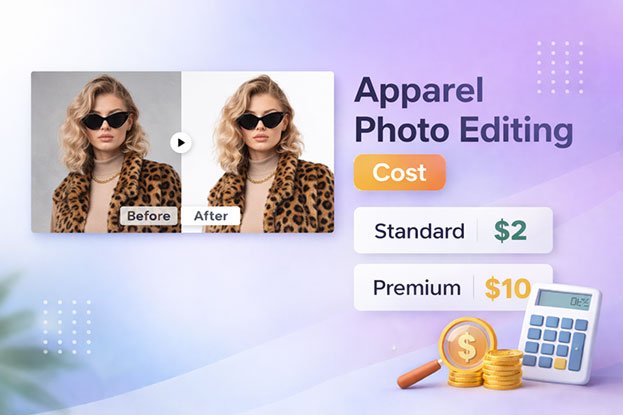
As one reference point, Clipping Area’s per-image pricing starts at $0.29 per image for simpler edits. More complex apparel work, such as ghost mannequin, detailed masking, or high-end retouching, is priced higher because it requires more editing time. Other providers set their own rates, and some AI-based tools price differently again. The only way to know what your specific images will cost is to request a quote based on your actual files.
How to Calculate Your Apparel Photo Editing Cost
Here is a simple way to estimate a budget before you request quotes.
- Count your images. Include every angle and detail shot, not just every product.
- Group images by complexity. Separate simple flat lays, medium items, and complex garments.
- List required services per group. For example, background removal only, or ghost mannequin plus shadow.
- Apply each provider’s quoted rate to each group.
- Add any extras. Rush fees, extra output sizes, or layered files.
Example Calculation (Hypothetical, Not an Industry Average)
Imagine a small fashion brand with 60 products, each shot from 3 angles, for a total of 180 images.
- 120 images are simple tops and basics needing background removal and light color correction
- 60 images are dresses shot on a mannequin needing ghost mannequin, color matching, and a natural shadow
If a provider quoted Rate A for the simple group and Rate B for the complex group, the estimate would be:
(120 × Rate A) + (60 × Rate B) + any extras = estimated project cost
The point of this example is not the numbers. It is the structure. Once you split images by complexity, you can compare quotes line by line instead of guessing.
Freelancer vs Agency vs DIY: How the Costs Compare
DIY Editing
Doing the editing yourself can look free, but it usually is not. The real costs include:
- Software subscriptions
- The time you or your team spend learning and editing
- Time taken away from sales, marketing, sourcing, and customer service
- The risk of inconsistent results across a catalog
DIY may make sense for very small catalogs or occasional simple edits. For larger volumes or complex services like ghost mannequin, the time cost can grow quickly.
Freelancers
Freelancers can be a good option for small projects or specialized creative retouching. Rates vary widely based on skill and location.
Things to consider:
- Capacity is limited to one person, which can slow large batches
- Availability can change during busy seasons
- Quality control depends on one editor checking their own work
- Consistency across hundreds of images can be harder to maintain
Photo Editing Agencies
An outsourced photo editing agency typically offers a team, a defined workflow, quality control, and the ability to handle larger volumes.
Things to consider:
- Per-image pricing is usually structured and predictable
- Larger teams can often handle bulk image editing and tighter deadlines
- Multiple editors can follow one brand style guide for consistency
- Communication and onboarding matter, so a clear brief helps
The right choice depends on your volume, deadlines, and quality expectations rather than the lowest rate alone.
Manual vs AI Photo Editing: Does It Change the Cost?
AI tools have changed parts of the editing workflow. Automated background removal, for example, can be fast and inexpensive for simple, high-contrast product shots.
However, AI tools may struggle with:
- Fine edges such as fur, lace, and mesh
- Accurate color matching to the physical garment
- Ghost mannequin assembly with inner neck joints
- Natural-looking shadows
- Brand-specific consistency rules
Many professional providers now use a hybrid approach, where automation handles repetitive steps and human editors refine details and check quality. A fully automated option may reduce cost for simple images, while complex apparel may still need manual work. When comparing, look at sample results on your own garments rather than on a provider’s best showcase image.
Cheap vs Professional Apparel Photo Editing: What You Actually Pay For
A low per-image rate can be appealing, especially for startups. But the true cost of editing includes more than the invoice.
Low-quality editing can lead to:
- Rework time: Your team spends hours sending images back for corrections.
- Inconsistent catalogs: Products look mismatched on category pages.
- Color inaccuracy: Customers receive items that look different from the photos, which can affect returns and reviews.
- Delayed launches: Missed deadlines when batches need to be redone.
Professional apparel photo editing services usually include trained editors, a documented workflow, QC checks, and clear revision terms. These can help reduce hidden costs, although no provider can guarantee a specific sales or conversion outcome from edited images.
The goal is not to pick the most expensive option. It is to find the provider whose quality, speed, and reliability match your needs at a fair price.
Ghost Mannequin Photo Editing Cost
Ghost mannequin editing deserves its own section because it is one of the most requested services for apparel ecommerce, and one of the more labor-intensive.
The process often includes:
- Removing the mannequin from the front view
- Photographing and editing the inner neck or back label area
- Combining both images so the garment looks hollow and three-dimensional
- Cleaning edges, adjusting fit, and adding a natural shadow
Costs may increase when:
- The garment has complex collars, hoods, or inner linings
- Several inner shots need to be combined
- Sleeves or hems also need to be opened up
- The original shots were not planned for ghost mannequin work
Planning your photography with ghost mannequin in mind (consistent mannequin position, separate inner shots, consistent lighting) can help keep editing more efficient.
How to Reduce Apparel Photo Editing Costs Without Hurting Quality
You can often control editing costs by improving what happens before the editing starts.
- Shoot on a clean, consistent background. Less background cleanup means less editing time.
- Steam and prep garments. Fewer wrinkles in the shot means less retouching.
- Use consistent lighting. This can make color correction and matching faster.
- Plan ghost mannequin shots. Capture inner neck shots during the shoot, not after.
- Create a style guide. Define background color, margins, alignment, shadow style, file size, and format once.
- Batch your uploads. Sending larger organized batches may qualify for bulk pricing.
- Avoid unnecessary rush orders. Plan delivery dates around your product launches.
- Test before committing. Use a free trial or sample to confirm quality before sending the full catalog.
How to Compare Apparel Photo Editing Quotes
When you receive several quotes, compare them on the same basis. Ask each provider:
- What exactly is included in the per-image price?
- How do you categorize simple vs complex images?
- Is quality control included?
- How many revisions are included, and what counts as a revision?
- What is the standard turnaround, and what does rush cost?
- Which file formats and sizes are delivered?
- Do you offer bulk or monthly volume pricing?
- Can I test with sample images before placing a full order?
- How is my data and image security handled?
A quote that looks cheaper may include fewer services. A quote that looks higher may include QC, revisions, and multiple output sizes. Line-by-line comparison shows the real difference.
Red Flags to Watch For
- Prices that are far below every other quote with no clear explanation
- No sample or trial option
- Vague service descriptions
- No written revision policy
- Portfolio images that do not match the category of products you sell
- Slow or unclear communication before the order is even placed
These are not automatic deal-breakers, but they are worth asking about before you send a large batch.
Frequently Asked Questions
How much does apparel photo editing cost per image?
It varies by provider, complexity, services, and volume. Simple edits such as background removal usually cost less than complex work like ghost mannequin or high-end retouching. For an accurate figure, send sample images and request a quote.
Why does clothing photo editing pricing vary so much?
Each image can need a different combination of services, and garments vary in shape, fabric, and detail. Providers also differ in workflow, quality control, and turnaround options, which all affect pricing.
Is outsourcing apparel photo editing cheaper than doing it in-house?
It can be, depending on your volume and internal costs. When you include software, training, and staff time, outsourcing may be more cost-effective for larger or recurring catalogs. Smaller or occasional projects may work fine in-house.
Does bulk apparel photo editing cost less?
Many providers offer bulk or volume-based pricing, so the per-image rate may decrease as volume increases. Terms differ between providers.
Is AI editing good enough for clothing images?
AI can handle some simple tasks well, especially basic background removal. Complex garments, fine edges, accurate color matching, and ghost mannequin work often still benefit from skilled manual editing and human quality checks.
How can I get an accurate quote?
Share a few representative images, list the services you need, state your expected volume and deadline, and include any style guide. A free trial or sample edit is the most reliable way to check both price and quality.
Final Thoughts
There is no single number that answers every apparel photo editing cost question, and any source that offers one should be treated with caution. What you can control is how clearly you understand your needs. Count your images, group them by complexity, define the services and output requirements, and compare providers on the full scope of work rather than the headline rate.
The best value usually comes from a provider that delivers accurate, consistent images on time, with clear communication and fair revision terms.
Ready to price your project? Clipping Area has provided professional apparel photo editing services since 2014, including clipping path, background removal, ghost mannequin, color correction, and ecommerce retouching, with pricing starting at $0.29 per image. Send two images for a free trial edit and receive a quote based on your actual garments and requirements.