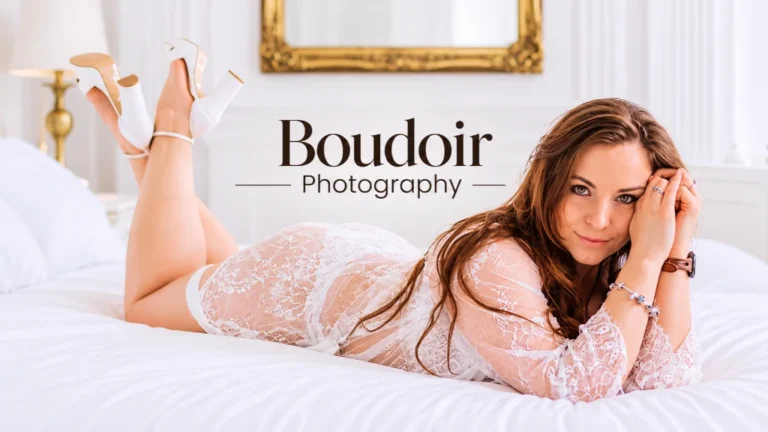
Boudoir photography is a style of portrait photography that shows a person in an intimate, confident, and often playful way. The photos are usually taken in a private space, like a bedroom, a studio, or a hotel suite. The goal is not to shock anyone. The goal is to help a person see themselves as beautiful, strong, and comfortable in their own skin.
People book a boudoir session for many reasons. Some want a confidence boost. Some want a gift for a partner. Others want to mark a big life moment, like a wedding, a birthday, or a fresh start.
This guide walks you through the whole process. You will learn what boudoir means, where it came from, the main styles, how to plan a shoot, easy poses, lighting, camera gear, editing, privacy, and cost. It is written for photographers who want to offer boudoir and for anyone thinking about booking a session.
Quick answer: Boudoir photography is tasteful, intimate portrait photography of an adult, usually in lingerie, a robe, or light clothing, taken in a private setting. It focuses on confidence and self-expression, not explicit content.
What Is Boudoir Photography? A Simple Definition
The word “boudoir” comes from French. It means a woman’s private room, such as a dressing room or bedroom. That idea of a private, personal space is the heart of the style.
Boudoir photos are suggestive, not explicit. They hint rather than show. A client might wear lingerie, an oversized shirt, a silk robe, a sweater, or simply wrap up in a bed sheet. Some clients choose implied nude images, where nothing explicit is visible.
Here are the key traits of boudoir photography:
- Intimate setting: Bedrooms, studios, hotel rooms, or soft outdoor spots.
- Soft, flattering light: Usually window light or gentle studio light.
- Emotion first: The photos show mood, confidence, and personality.
- Client control: The client decides what they wear and how much they show.
- Private use: Most images are kept for the client or a partner, not shared publicly.
All boudoir clients must be adults. Professional boudoir photographers check ID and only work with people aged 18 or older.
A Short History of Boudoir Photography
Boudoir has deep roots. Painters have created intimate, relaxed portraits for centuries. Photographers picked up the idea in the late 1800s and early 1900s, especially in Paris.
The style became famous during the pin-up era of the 1940s. Pin-up photos of film stars like Betty Grable were hugely popular, especially with soldiers during World War II. These images were flirty and fun but rarely explicit. That playful, tasteful mood still shapes boudoir today.
Modern boudoir photography grew fast in the 2000s. Digital cameras made shoots easier and cheaper. The body positivity movement pushed the idea that every body deserves to be celebrated. Social media helped photographers share client-approved work and reach new clients.
Today, boudoir is for everyone. Photographers work with women, men, couples, brides, moms-to-be, plus-size clients, and people in their 50s, 60s, and beyond.
Why Do People Book a Boudoir Photo Shoot?
Every client has a personal reason. Knowing that reason helps a photographer plan a better shoot. Here are the most common ones:
- Self-confidence: Many clients want to feel good about their body and see themselves through kinder eyes.
- A gift for a partner: Boudoir albums are popular wedding, anniversary, and Valentine’s Day gifts.
- A life milestone: A big birthday, a career win, recovering from an illness, or a new chapter after a breakup.
- Celebrating change: After pregnancy, weight loss, weight gain, or simply getting older.
- Memories: Some people just want beautiful photos of who they are right now.
Many clients say the same thing after their session: they felt nervous at first, then surprised by how confident they felt by the end.
Popular Types of Boudoir Photography
Boudoir is not one single look. Each photographer develops a style, and clients choose the one that fits them best.
| Style | Look and Mood | Best For |
|---|---|---|
| Light and airy | Bright, soft, and romantic, with white tones | First-time clients, natural looks |
| Dark and moody | Deep shadows, rich tones, dramatic light | Bold, editorial, artistic feel |
| Bridal boudoir | Veils, white lingerie, wedding details | Gifts for a future spouse |
| Maternity boudoir | Soft fabrics, focus on the bump | Celebrating pregnancy |
| Couples boudoir | Two people, close and connected | Anniversaries, relationship milestones |
| Plus-size boudoir | Body-positive posing and styling | Celebrating every body type |
| Male boudoir (“dudoir”) | Masculine, relaxed, often moody | Gifts or personal confidence |
| Fine art boudoir | Black and white, shapes, implied nude | Gallery-style, timeless images |
| Outdoor boudoir | Fields, beaches, forests, golden hour | Nature lovers, free-spirited clients |
Boudoir vs Glamour vs Nude Photography
These styles are often confused. Here is a quick way to tell them apart.
| Feature | Boudoir | Glamour | Nude Art |
|---|---|---|---|
| Main goal | Confidence and intimacy | Polished beauty and fashion | Form, shape, and art |
| Clothing | Lingerie, robes, implied nude | Gowns, fashion, swimwear | Little or no clothing |
| Typical client | Everyday people | Models, influencers | Art models, fine art clients |
| Usual use | Private albums and gifts | Portfolios, ads, magazines | Galleries and art books |
In short, boudoir is about the client’s story. Glamour is about polish. Nude art is about form.
Best Locations for a Boudoir Shoot
The right location sets the mood. Each option has pros and cons.
Photography Studio
A studio gives full control over light, privacy, and props. Many boudoir photographers build a studio with a bed, a chair, large windows, and a few backdrops. It is the most consistent choice.
The Client’s Home
Shooting at home feels personal and relaxed. The client is in a familiar space, which helps nerves. The downside is that light and clutter can be hard to manage.
Hotel Room or Rental
A nice hotel suite or rental apartment feels special. Look for big windows, white bedding, and simple decor. Always check the property rules before booking.
Outdoors
Outdoor boudoir can look stunning at golden hour. Choose a private spot and get permission if needed. Weather, bugs, and passersby are real risks, so have a backup plan.
How to Plan a Boudoir Session: Step by Step
Good planning is what makes a boudoir session feel safe and smooth. Here is a simple workflow many professional boudoir photographers follow.
Step 1: Hold a Consultation
Talk with the client before the shoot. Ask why they are booking, what they love about themselves, and what they feel unsure about. Ask about comfort limits and any physical issues, like back pain or past injuries. Confirm the client’s age with ID.
Step 2: Sign a Clear Contract
The contract should cover the session fee, products, payment, cancellations, and privacy. It must state that no image will be shared online or in marketing without the client’s written permission. A separate model release is best for any images the client agrees to share.
Step 3: Send a Style Guide
A simple PDF guide helps the client prepare. Include what to wear, what to bring, hair and makeup tips, and what to expect on the day.
Step 4: Book Hair and Makeup
Professional hair and makeup make a huge difference. They also give the client time to relax before the camera comes out.
Step 5: Build a Mood Board
Share sample images, colors, and poses. This keeps both of you on the same page about the look and feel.
Step 6: Run the Session
Start with easy, fully clothed poses to warm up. Show the client a few great shots on the back of the camera early on. That moment often turns nerves into excitement. Check in often and remind the client they can pause or stop at any time.
Step 7: Do a Reveal and Ordering Session
Many photographers show the edited images in person or on a private video call. The client then picks their favorites for an album, prints, or digital files.
What Should Clients Wear to a Boudoir Shoot?
The best outfit is one that makes the client feel good. Here are some easy ideas:
- Matching lingerie sets in two or three colors
- A bodysuit or a lace bralette
- A partner’s button-up shirt or a cozy oversized sweater
- A silk or satin robe
- Thigh-high socks or stockings
- A sports jersey or a personal item with meaning
- Simple jewelry, like small earrings or a necklace
- Heels, even for photos taken lying down, since they help with leg shape
Avoid tight clothes for a few hours before the shoot. Elastic and straps can leave marks on the skin. Bring outfits on hangers so they stay smooth.
Easy Boudoir Poses That Flatter Everyone
Posing is where many new boudoir photographers struggle. The secret is to guide gently and keep things simple. Use soft prompts like “take a slow breath and look at the window” instead of stiff commands.
Basic Posing Rules
- Create space: Move arms slightly away from the body to show the waist.
- Soft hands: Hands should rest lightly, never press or grip.
- Chin forward and slightly down: This defines the jawline.
- Gentle arch: A small arch in the lower back adds curve and shape.
- Bend what bends: Bent knees, wrists, and elbows look more natural.
- Point the toes: This lengthens the legs.
Simple Poses to Start With
- Edge of the bed: Sitting with knees together and turned slightly to the side.
- Over the shoulder: Back to the camera, looking back softly.
- Lying on the stomach: Feet up and crossed, chin resting on hands.
- Lying on the back: Hair spread out, shot from above.
- Window light standing: Leaning on the frame, eyes toward the light.
- Chair pose: Sitting backward on a chair, arms folded on top.
- Detail shots: Hands on lace, a shoulder, lips, jewelry, or tattoos.
Couples Poses
For couples, focus on connection. Try forehead touches, a hand on the cheek, a hug from behind, or both people lying close with eyes closed. Keep it natural and let real moments happen.
Always ask the client about body areas they love and areas they would rather not highlight. Then pose with that in mind.
Lighting Tips for Boudoir Photography
Light shapes the whole mood of a boudoir image.
- Window light: Large windows give soft, flattering light. It is the most popular choice for a reason.
- Sheer curtains: These act like a giant softbox and smooth out harsh sun.
- Side light: Light from the side shows curves, shape, and texture. It works well for moody images.
- Reflector: A white reflector fills in shadows under the eyes and chin.
- One softbox: If you shoot at night or in a dark room, one large softbox is often enough.
- Avoid overhead light: Ceiling lights create unflattering shadows on the face.
For light and airy work, keep the light soft and expose a little on the bright side. For dark and moody work, use one light source and let the shadows fall.
Best Camera Gear for Boudoir Photography
You do not need expensive gear to shoot great boudoir. But the right tools help, especially in low light.
Cameras
A full-frame mirrorless camera handles dim rooms well and gives a soft, blurred background. Popular choices include the Canon EOS R6 Mark II, Sony A7 IV, and Nikon Z6 III. A crop-sensor camera still works fine if you are just starting out. A silent shutter is a big plus, since it makes the session feel calmer.
Lenses
| Lens | Why It Works |
|---|---|
| 35mm | Wide enough for room shots and full-body images |
| 50mm f/1.8 or f/1.4 | Affordable, sharp, great all-rounder |
| 85mm f/1.8 | Flattering for portraits and close-ups |
| 24-70mm f/2.8 | Flexible zoom for busy sessions |
Starting Camera Settings
- Aperture: Use f/1.8 to f/2.8 for soft backgrounds.
- Shutter speed: Use 1/160 or faster to avoid blur.
- ISO: Keep it as low as the light allows.
- Focus: Turn on eye autofocus.
- File type: Shoot RAW for the most editing control.
Editing and Retouching Boudoir Photos
Editing turns good boudoir photos into great ones. The best boudoir retouching looks natural. Clients want to look like themselves on their best day, not like a different person.
A Simple Boudoir Editing Workflow
- Cull: Pick the strongest images and remove blinks and repeats.
- Basic edits: Fix exposure, white balance, and contrast.
- Color grade: Apply a consistent look across the whole gallery.
- Skin retouching: Soften temporary blemishes and redness while keeping skin texture.
- Clean up: Remove stray hairs, lint, bruises, strap marks, and fabric wrinkles.
- Background fixes: Remove clutter, outlets, or distracting objects.
- Final check: Make sure skin tones match from image to image.
Retouching Ethics
Never reshape a client’s body without asking first. Some clients want light smoothing. Others want no changes at all. Ask during the consultation and write it down. Keep permanent features, like scars, freckles, and tattoos, unless the client asks you to soften them.
Editing a full boudoir gallery can take many hours. That is why many busy photographers outsource part of the work.
Need Help With Editing? Meet Clipping Area
Clipping Area: Premium Post-Production and Photo Retouching Agency
Clipping Area is a premium post-production agency that has been delivering professional image editing since 2014. Photographers, studios, ecommerce brands, and real estate agencies around the world trust Clipping Area as a complete image editing solution provider.
Core services include:
- Clipping Path
- Background Removal
- Image Masking
- Ghost Mannequin Effect
- Ecommerce Image Editing
- Real Estate Photo Editing
- Jewelry Retouching
- Product Retouching
- Portrait and Skin Retouching
- Color Correction
- Shadow Creation
- Video Editing, 3D Rendering, and AI Creative Services
Why photographers outsource to Clipping Area:
- Save hours of editing time every week and focus on shooting and clients.
- Get natural, consistent retouching across every image in a gallery.
- Enjoy fast turnaround, even on large batches.
- Work with a skilled team that follows your style notes closely.
- Ask about confidential file handling for private sessions.
Ready to try it? Visit clippingarea.com and send a few test images to see the quality for yourself.
How Much Does Boudoir Photography Cost?
Boudoir pricing varies a lot. A session can cost anywhere from a few hundred dollars to several thousand. The price depends on:
- The photographer’s experience and reputation
- Your city or region
- Whether hair and makeup are included
- Session length and number of outfits
- Products, such as albums, prints, and digital files
Many boudoir photographers charge a session fee first, then sell albums and prints at the reveal. Others offer all-inclusive packages. Always ask exactly what is included before you book.
Privacy, Consent, and Safety in Boudoir Photography
Trust is everything in boudoir. Clients share something very personal. A professional boudoir photographer protects that trust at every step.
- Adults only: Check ID and work only with clients aged 18 or older.
- Written consent: Never post, share, or enter images in contests without signed permission.
- Secure storage: Use password-protected galleries and safe backups.
- Clear limits: Agree on clothing and poses before the shoot, and never push past them.
- Freedom to stop: The client can pause or end the session at any time.
- A support person: Let clients bring a trusted friend if it helps them feel safe.
- Proven track record: Show real reviews and a clear privacy policy so clients can trust you.
Tips for Clients: How to Feel Confident on Shoot Day
- Get a good night’s sleep and drink plenty of water.
- Eat a light meal before the session.
- Bring a playlist that makes you feel great.
- Wear loose clothes on the way there to avoid marks.
- Trust your photographer’s posing. A pose may feel odd but look amazing on camera.
- Remember why you booked. This is about you.
Key Takeaways
- Boudoir photography is intimate, tasteful portrait photography for adults, focused on confidence.
- Popular styles include light and airy, dark and moody, bridal, maternity, couples, plus-size, and male boudoir.
- Good planning, clear contracts, and consent make every session safe.
- Soft light, simple poses, and a 50mm or 85mm lens cover most needs.
- Natural retouching matters, and outsourcing to a team like Clipping Area saves time.
Frequently Asked Questions About Boudoir Photography
Is boudoir photography nude?
Not usually. Most boudoir photos show lingerie, robes, or casual clothing. Some clients choose implied nude images, where nothing explicit is shown. The client always decides.
Who can do a boudoir photo shoot?
Any adult aged 18 or older can book a session. Boudoir is for every body type, gender, and age group, and for couples too.
How long does a boudoir session take?
Most sessions take 2 to 3 hours. That includes about an hour for hair and makeup and 1 to 2 hours of shooting.
What should I bring to my boudoir session?
Bring two to four outfits, simple jewelry, heels, a robe, and any meaningful items, like a partner’s shirt or a jersey.
Can I bring a friend to my boudoir shoot?
Most photographers say yes. A trusted friend can help you relax. Just check with your photographer first.
Will my boudoir photos be posted online?
Not without your written permission. A professional boudoir photographer keeps your images private unless you agree in writing to share them.
Is boudoir photography only for women?
No. Many men book boudoir sessions, which are often called “dudoir.” Couples boudoir is popular too.
What is the best lens for boudoir photography?
A 50mm prime is a favorite for small rooms. An 85mm prime gives the most flattering close-ups when you have space to step back.
How long does boudoir editing take?
Most photographers deliver final images in 2 to 4 weeks. Outsourcing retouching can shorten that time.
Final Thoughts
Boudoir photography is about more than pretty pictures. It is about confidence, self-love, and seeing yourself in a new way. For clients, a boudoir shoot can be a powerful and joyful experience. For photographers, it is a chance to build deep trust and create images that truly matter to people.
Plan carefully, respect every boundary, use soft light, and keep your editing natural. And when the editing load gets heavy, a trusted post-production partner like Clipping Area can help you deliver beautiful, consistent galleries on time.