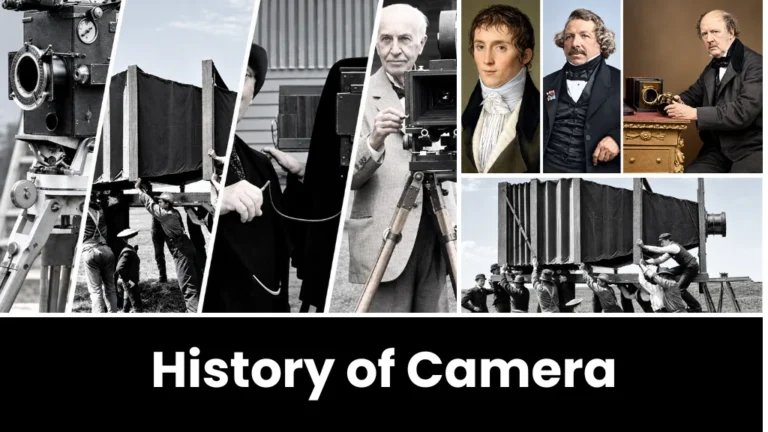
When were cameras invented? The honest answer depends on what you count as a camera. If you mean a dark space that projects an image of the outside world, people were describing one more than 2,000 years ago. If you mean a device that records a picture that lasts, the answer is the 1820s. If you mean something an ordinary person could buy and use, it’s 1888. And if you mean a camera with no film at all, it’s 1975.
Most articles pick one of those dates and treat it as the whole story, which is how the same question gets five different answers. This guide keeps all of them, explains why they differ, and walks through the inventors, the chemistry, and the machines in order, so you can answer “when were cameras invented?” with confidence, whichever kind of camera you have in mind.
The Short Answer
Keep this table handy. Everything below explains the gaps between the rows.
What Do We Mean by “First Camera”?
There are three reasonable definitions, and each gives a different date.
- A device that projects an image. This is the camera obscura, whose name means “dark chamber” in Latin. It shows a picture but can’t keep it. By this definition, the first camera is ancient.
- A device that records an image, even briefly. Once someone found a material that changes when light hits it, a camera could record a scene. By this definition, we’re in the early 1800s.
- A device that gives you a durable photograph. Here the date narrows to the 1820s and 1830s, when the chemistry finally held up.
There’s also a fourth question that comes up in modern times: what if the recording medium isn’t chemical at all? That leads to the digital camera, and we’ll get there.
The Camera Obscura: A Room with a Hole in the Wall
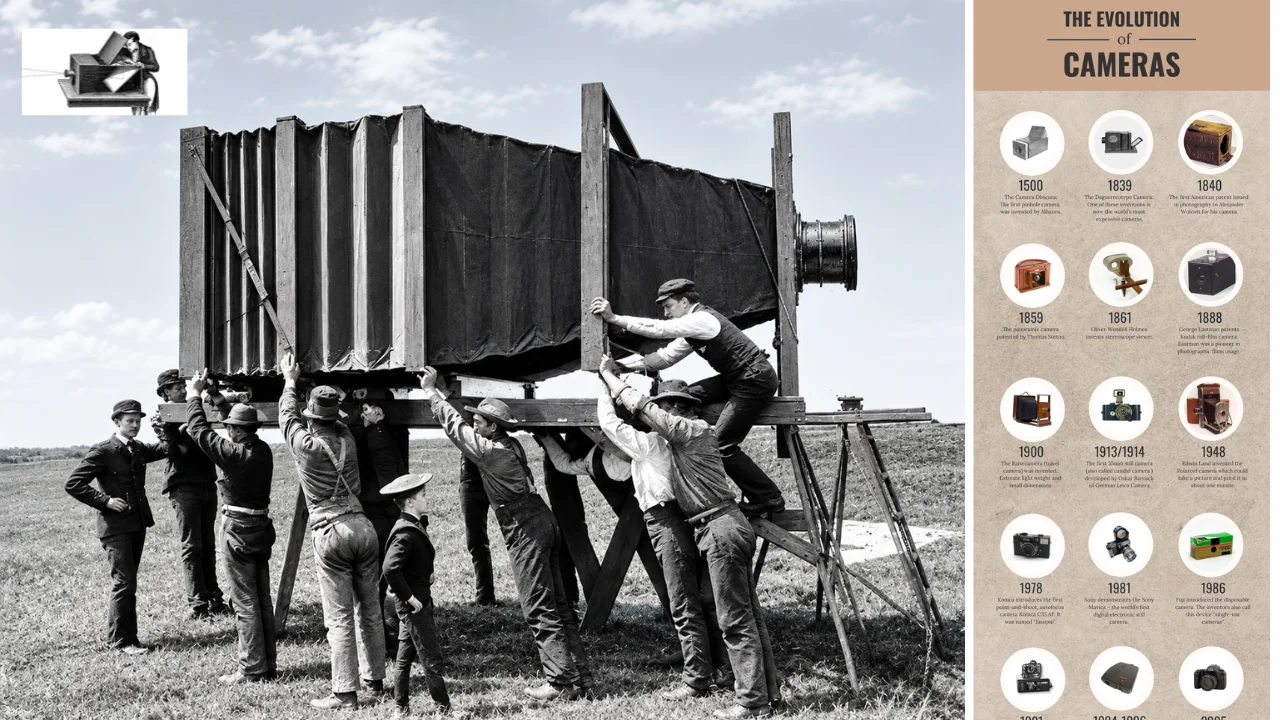
Here’s the basic idea. Light travels in straight lines. If you make a small opening in one wall of a dark room, light from outside passes through it and forms an image on the opposite wall. The image is upside down and reversed, because rays crossing at the hole swap top and bottom.
The earliest written records of this effect are from China. The philosopher Mozi, who lived around the fifth century BC, wrote about an inverted image formed by light through a small hole. In the fourth century BC, Aristotle noticed that gaps between leaves cast small crescent shapes on the ground during a partial solar eclipse, each one an image of the partly covered sun.
The real leap came in the Islamic world. Ibn al-Haytham, also known as Alhazen, wrote his Book of Optics in the early eleventh century, and it is one of the most important works in the history of science. He ran controlled experiments with light passing through small openings, and he explained the physics of why the image is inverted. Many historians consider him a founder of modern optics, and this is why his name appears in any serious answer to “who invented the camera obscura?”
From there the idea spread across Europe.
- In 1545, Gemma Frisius published a widely reproduced illustration of a camera obscura being used to watch a solar eclipse safely.
- In the 1500s, Giambattista della Porta wrote about using it as a drawing aid, and Daniele Barbaro suggested adding a lens to make the image sharper and brighter.
- In 1604, Johannes Kepler used the term camera obscura, the name that stuck.
- In 1685, Johann Zahn described a compact design with a mirror that reflected the image onto a viewing surface, a concept that later helped inspire reflex cameras.
Artists used these boxes to trace scenes. You’ll sometimes read that Vermeer worked this way. It’s a popular theory, but it’s debated among art historians, so treat it as a possibility and not a fact.
The limitation was obvious. You could watch the image and trace it, but you couldn’t keep it. For that, someone needed chemistry.
The Missing Ingredient: Light-Sensitive Chemistry
For centuries, the camera existed without the thing that would make it useful for photography. What was missing was a material that permanently changes when exposed to light.
A key clue arrived in 1717, when the German scientist Johann Heinrich Schulze found that a mixture containing silver salts turned dark in sunlight. Around 1800, Thomas Wedgwood and the chemist Humphry Davy made images by placing objects on leather or paper treated with silver compounds. The images were real, but they kept darkening until they vanished, because nobody yet knew how to stop the reaction.
So the pieces were on the table: a camera that formed an image, and chemicals that responded to light. The challenge was getting them to work together and then making the result last.
Nicéphore Niépce and the First Surviving Photograph
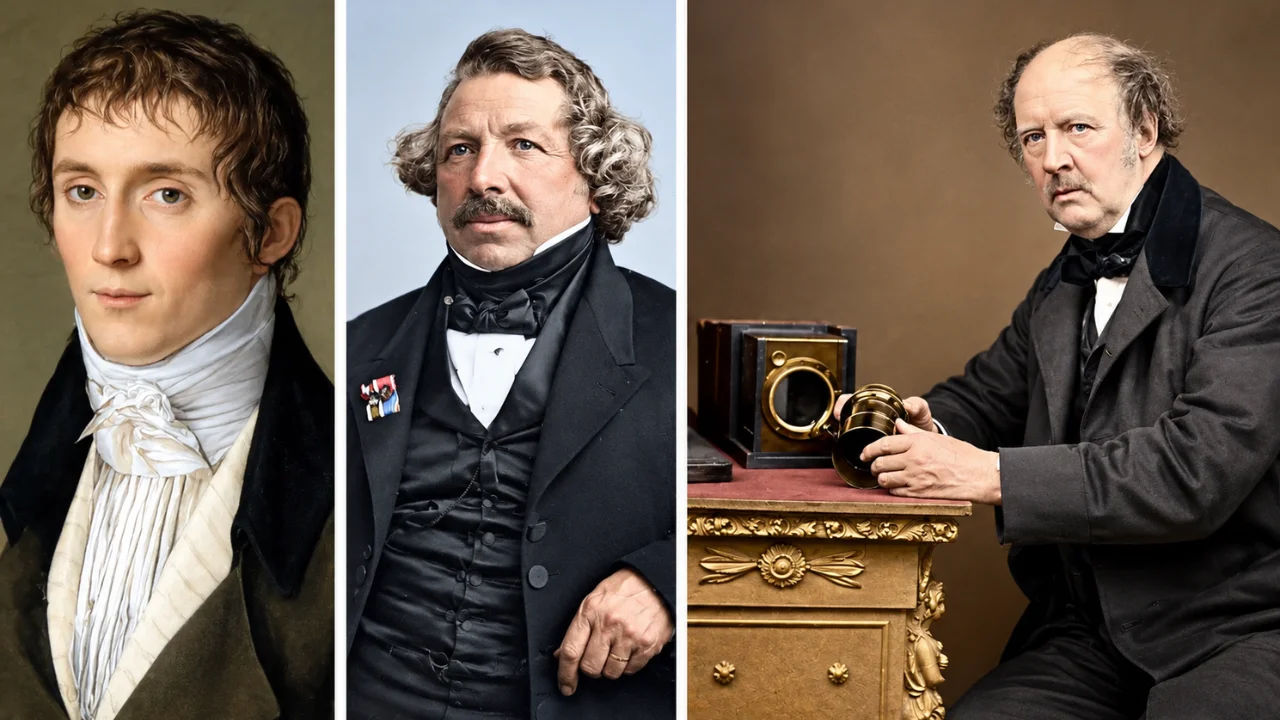
Joseph Nicéphore Niépce, a French inventor, is the figure most often credited with the first photograph.
In 1816, he made small negative images inside a camera using paper coated with silver chloride. They were remarkable for the time, but he couldn’t fix them, so they didn’t last. He kept experimenting.
His breakthrough came with a different material: bitumen of Judea, a type of asphalt that hardens when exposed to light. He coated a pewter plate with it, placed it in a camera obscura pointed out of an upstairs window, and left it exposed for a very long time. The unhardened bitumen was then washed away, leaving a permanent image. Niépce called the process heliography, meaning “sun writing.”
The result, made around 1826 or 1827, is known today as View from the Window at Le Gras. It’s the oldest surviving camera photograph, and it’s held by the Harry Ransom Center at the University of Texas at Austin. The image is murky, a blur of rooftops and light. The exposure is often given as about eight hours, though estimates vary, and it may have taken far longer. Nobody would call it beautiful. But it was permanent, and that changed everything.
This is why the date question gets tangled. Niépce’s 1816 experiments came first, but the surviving photograph comes a decade later. Both dates are correct, for different reasons.
Daguerre and the First Commercial Process
Niépce was cautious and secretive, and his process needed many hours of light. In 1829, he entered a partnership with Louis Daguerre, a Paris artist and showman who ran a popular theatrical attraction called the Diorama. Niépce died in 1833 and never saw the results of their combined work.
Daguerre continued alone and made a crucial discovery: a silver-coated copper plate, sensitized with iodine vapour, could capture a latent image in a much shorter exposure. The image was then made visible with mercury vapour and fixed with a chemical bath. The result was the daguerreotype, a sharp, mirror-like picture on a metal plate.
It was announced in 1839, and the French government bought the rights and gave the process to the world, with the exception of England, where Daguerre had taken out a patent. Exposures at first lasted minutes, which is why early portraits show people stiff and unsmiling. Improvements soon brought them down to seconds.
Daguerreotypes had a drawback too: each one was a unique object, and copies couldn’t be made from it. That’s where the next inventor comes in.
Talbot, Bayard, and the Idea of the Negative
While Daguerre was refining his process in France, William Henry Fox Talbot in England was working on a very different approach. His method produced a paper negative from which you could print as many positive copies as you liked. He announced his early work in 1839 and patented the improved calotype in 1841.
The calotype was softer and less detailed than the daguerreotype, but it had the huge advantage of reproducibility. Almost all later film photography grew from the negative-positive idea, not the one-of-a-kind plate.
Other pioneers were working at the same time, and they often get left out.
- Hippolyte Bayard, a French inventor, made direct positive paper images in 1839, and staged an unusual self-portrait as a drowned man to protest that he’d been overlooked.
- Hercules Florence, a Frenchman living in Brazil, experimented with light-sensitive processes in the early 1830s and is said to have used the word photographie.
- Anna Atkins used the cyanotype process, invented by John Herschel in 1842, to make Photographs of British Algae in 1843, widely considered the first book illustrated with photographic images.
- Alexander Wolcott patented a camera in 1840 that used a concave mirror instead of a lens to gather more light, helping to open the first portrait studios in New York.
Photography didn’t come from one lone genius. It was a race, with many people arriving at similar ideas independently.
From Glass Plates to Roll Film
In 1851, Frederick Scott Archer introduced the wet collodion process, which used glass plates coated with a sticky solution. It produced sharp negatives with short exposures, but the plate had to be coated, exposed, and developed while still wet. Photographers hauled portable darkrooms behind them.
Then came the gelatin dry plate, described by Richard Leach Maddox in 1871 and improved in the years after. These plates could be prepared in advance and stored, and they were far more sensitive to light. Exposure times dropped to a fraction of a second, which made action, candid moments, and handheld cameras possible for the first time.
George Eastman and the Kodak
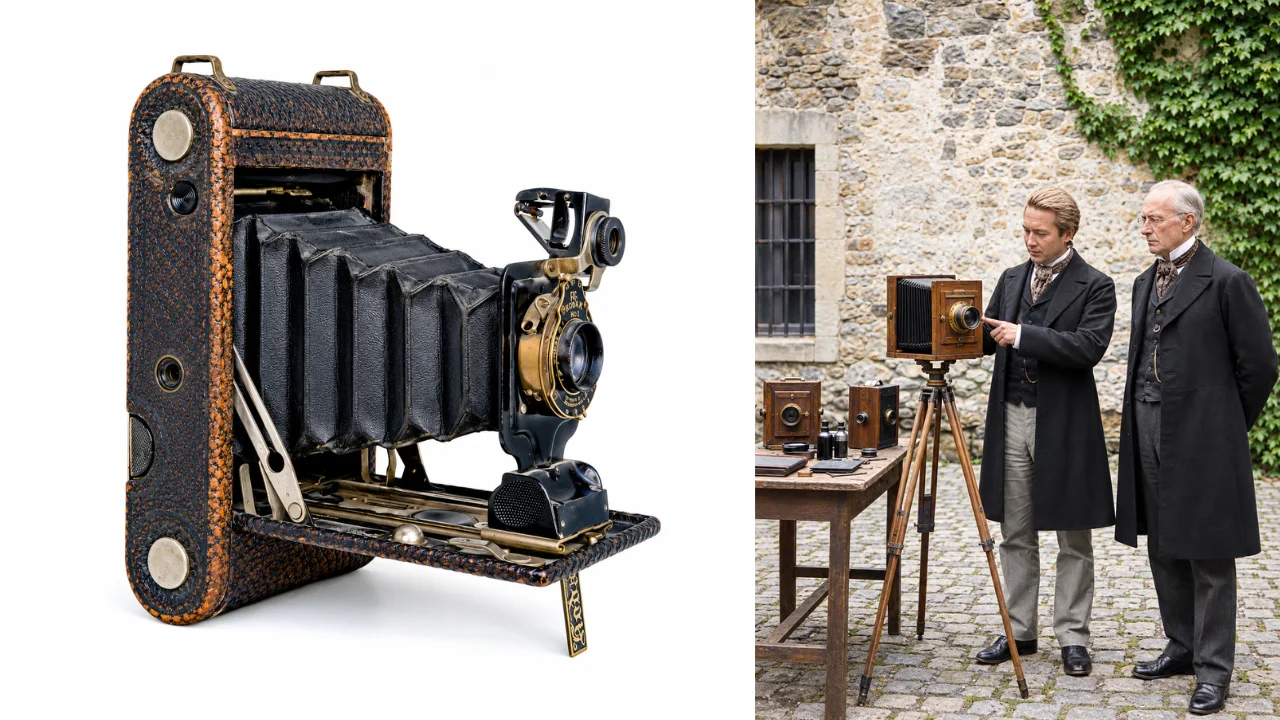
The camera stayed a specialist’s tool until George Eastman changed that. In 1888, he launched the Kodak camera, a simple box preloaded with enough film for 100 exposures. The slogan was “You press the button, we do the rest.” When the roll was finished, you mailed the whole camera back to his company in Rochester, New York, where the film was developed and printed, and the camera was reloaded and returned.
The camera cost $25 at the time, with an extra $10 for developing and reloading. It was expensive, but it turned photography from a craft into a pastime. In 1889, Eastman moved to transparent celluloid film, and in 1900, he introduced the Brownie, a cardboard box camera that sold for one dollar. That’s the point when ordinary families started owning cameras.
The 20th Century: 35mm, Reflex Cameras, and Colour
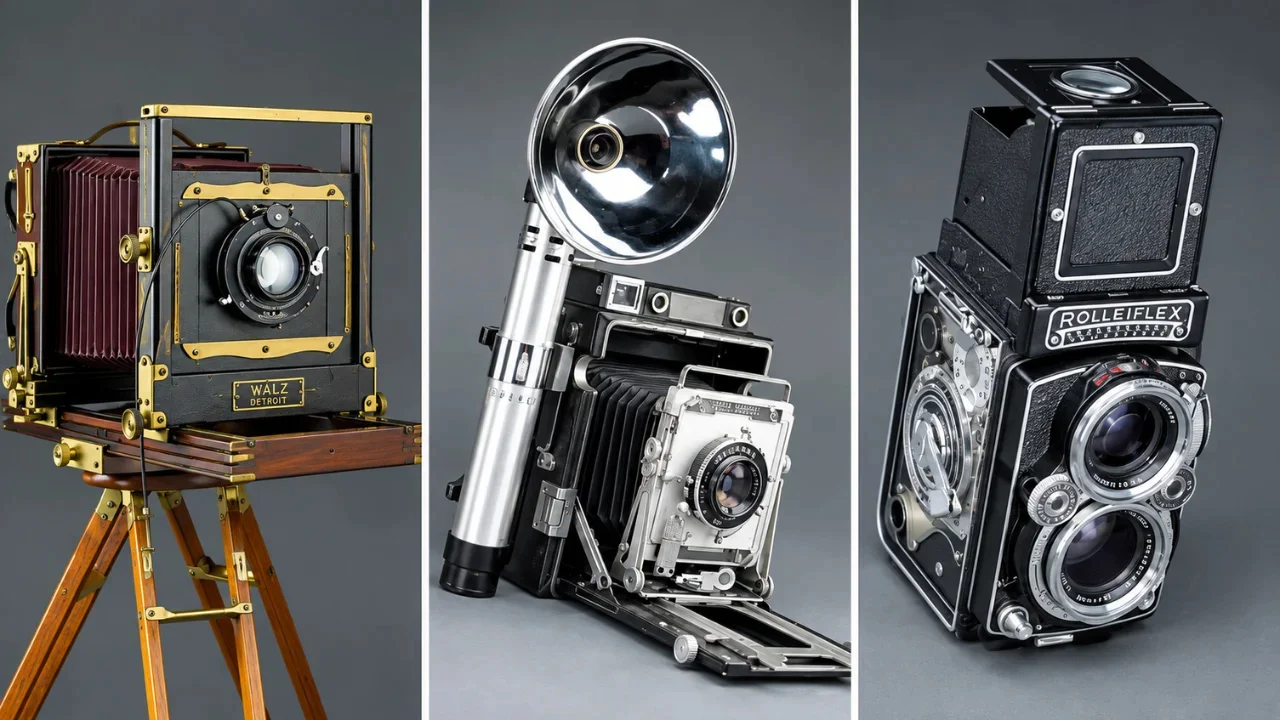
35mm. Oskar Barnack, an engineer at Leitz in Germany, built a small camera around 1913-1914 that used 35mm movie film. It went on sale as the Leica in 1925. Small, light, and fast, it changed the way photographers worked and made street and reportage photography practical.
Reflex cameras. A reflex design uses a mirror to show you what the lens sees. The Rolleiflex twin-lens reflex, from Franke & Heidecke in 1929, became a classic. Single-lens reflex (SLR) cameras followed, and the Contax S in 1949 was among the first to use a pentaprism, which shows an upright, correctly oriented image in the viewfinder.
Colour. James Clerk Maxwell demonstrated three-colour photography in 1861. The Lumière brothers brought a practical colour process, Autochrome, to market in 1907. Kodachrome film followed in 1935 and gave slides their famous saturated look. Colour became truly common in family snapshots in the decades after the Second World War.
Instant photography. Edwin Land announced his instant process in 1947, and the first Polaroid camera went on sale in 1948. You took a picture and watched it develop in a minute.
The Motion Picture Camera
Cameras that record movement developed in parallel. In 1878, Eadweard Muybridge used a row of cameras to capture a galloping horse in sequence. In 1882, Étienne-Jules Marey built a “chronophotographic gun” that recorded multiple frames on a single plate.
Louis Le Prince filmed short scenes in Leeds in 1888, including Roundhay Garden Scene, before disappearing mysteriously in 1890. Thomas Edison and his assistant William Kennedy Laurie Dickson developed the Kinetograph camera in the early 1890s. The Lumière brothers patented their Cinematographer in 1895 and held their first public screenings that year. Who “invented” cinema depends on whom you credit, and historians still argue about it.
The Digital Camera
In 1975, a young engineer at Kodak named Steve Sasson built a working digital camera. It was a bulky prototype that weighed about eight pounds, used a CCD image sensor, and recorded a black-and-white image of 0.01 megapixels onto a cassette tape. Each photo took about 23 seconds to record, and you needed a separate device to view it on a TV screen.
Kodak filed the patent but didn’t push the technology into the market, worried it would hurt its film business. That decision looks costly in hindsight.
What followed is a series of steps:
- 1991: Kodak’s DCS 100, built on a Nikon F3 body, was one of the first digital SLRs sold to professionals. It was extremely expensive.
- 1999: The Nikon D1 gave working photographers a digital SLR that was practical and comparatively affordable. This is often given as the “first DSLR,” but it’s more accurate to call it the moment DSLRs became mainstream.
- c. 1999-2000: The first camera phones appeared in Japan.
- 2004: The Epson R-D1 is often credited as the first digital mirrorless camera with interchangeable lenses. In 2008, Panasonic’s Lumix G1 launched the mirrorless category into the mainstream.
- 2007 onward: The iPhone and its competitors put a camera in nearly every pocket.
Today, smartphones use computational photography, combining multiple frames and using software to improve detail, colour, and low-light shots. In a sense, the software now does as much as the lens.
What Hasn’t Changed in 2,000 Years
Step back and the surprise is how little the basic idea has changed. A camera is still a light-tight box with an opening that lets in light and a surface that responds to it.
The lens got sharper, the surface got faster, and the box got smaller, but the logic is the same as in Ibn al-Haytham’s dark room.
Try It Yourself: Make a Pinhole Camera
You can see the principle for yourself in about ten minutes.
- Take a cardboard box or a shoebox with a lid, and paint the inside black, or line it with black paper.
- Cut a small square hole in one end and tape a piece of aluminium foil over it.
- Poke a tiny hole in the foil with a pin.
- Cut a rectangular window on the opposite end and tape tracing paper or baking parchment over it as a screen.
- Point the pinhole end at a bright window or outdoor scene, and put a dark cloth over your head and the screen end.
You’ll see a faint, upside-down image. Smaller holes give sharper but dimmer pictures, which is exactly the trade-off early scientists worked out. For a real photo, replace the tracing paper with photographic paper in a darkroom, though that takes more preparation.
Common Myths About Camera History
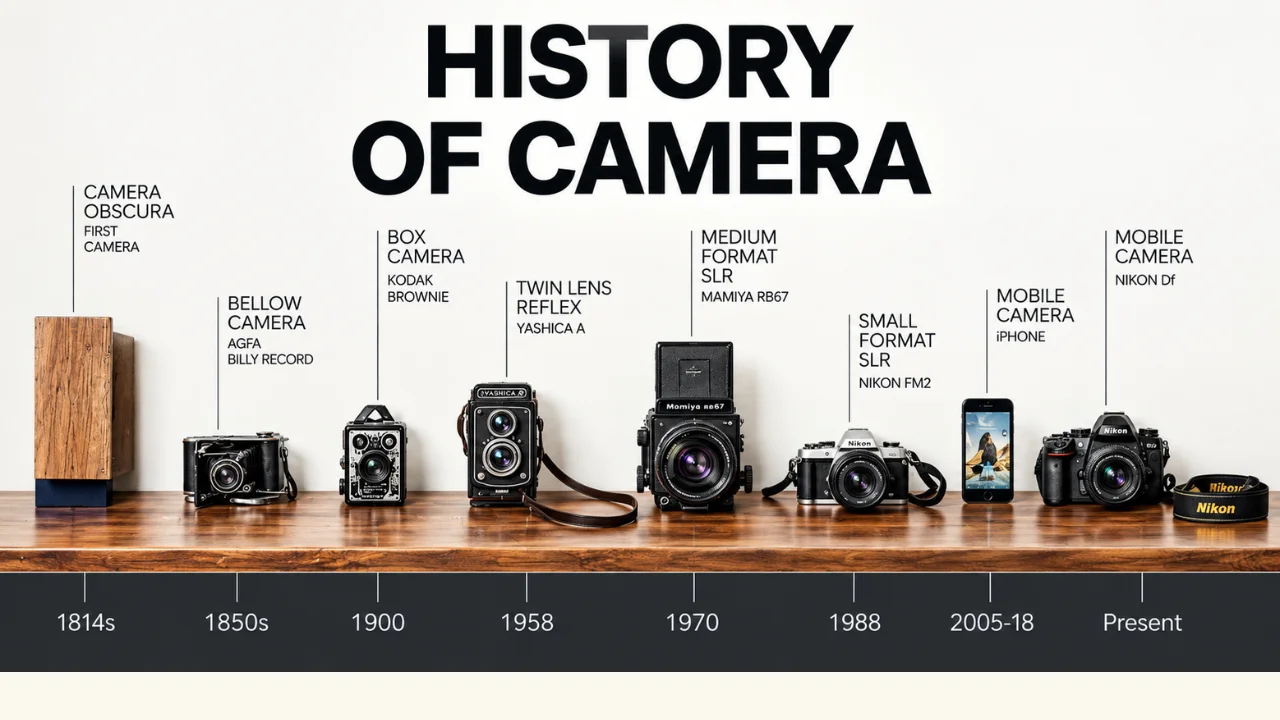
“Niépce invented the camera.” No. Cameras existed long before him. What he achieved was the first surviving photograph made with one.
“Daguerre invented photography by himself.” He built on Niépce’s work and was one of several people working on the problem at the same time.
“The daguerreotype and calotype are basically the same.” They’re different in nearly every way. One is a unique metal plate, the other a paper negative that can be printed many times.
“Kodak invented the digital camera and ignored it.” Half true. Kodak’s engineer built the first prototype, but the company hesitated to bring it to market.
“The first DSLR came out in 1999.” It depends on the definition. Digital SLRs existed earlier, and 1999 is when they became practical for many professionals.
“Ancient people took photographs.” No. They saw projected images. Recording them came thousands of years later.
Why This History Still Matters
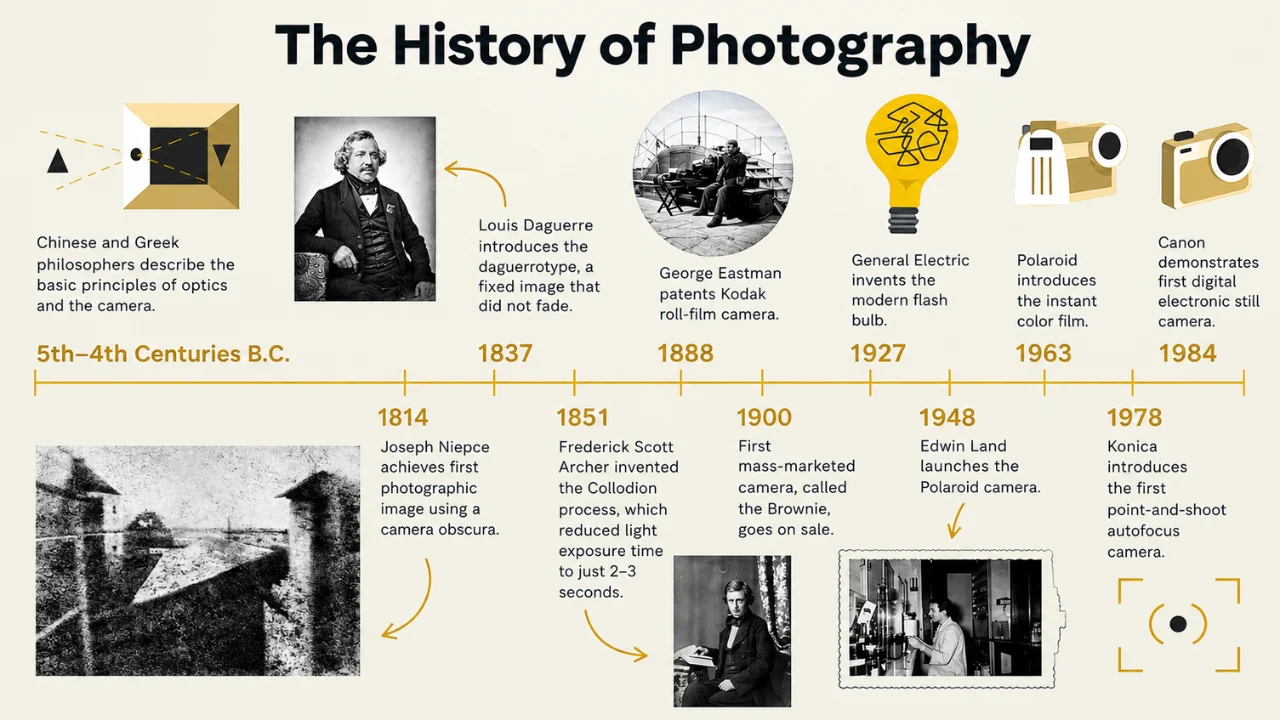
Understanding where cameras came from helps you use them. Lens, aperture, exposure, and sensor are the same ideas that have been in play since the pinhole. And the tension between capturing an image and shaping it started early too. Photographers have always retouched, from cutting and painting negatives in the 1800s to editing files today.
That remains true in modern commercial photography. A sharp camera gets you a good starting file, but online sellers usually still need clean backgrounds, consistent colour, and polished detail before an image is ready for a store or marketplace. If you’d rather leave that step to specialists, Clipping Area provides product photo editing for apparel, jewelry, and Amazon listings, so your images look right on any platform.
Frequently Asked Questions
When was the first camera invented?
It depends on the definition. The camera obscura idea goes back over 2,000 years. The first surviving photograph made with a camera dates to about 1826-1827, by Nicéphore Niépce. The first commercially successful photographic process was the daguerreotype, announced in 1839.
Who invented the first camera?
No single person invented it. Mozi and Aristotle described the principle, Ibn al-Haytham explained it scientifically, and Niépce and Daguerre turned it into photography.
What was the first photograph ever taken?
The oldest surviving photograph is Niépce’s View from the Window at Le Gras, made around 1826-1827 on a pewter plate. It’s held at the Harry Ransom Center at the University of Texas at Austin.
What is a camera obscura?
A dark room or box with a small hole that projects an inverted image of the outside scene onto a surface. It doesn’t record the image. It was used by astronomers to watch eclipses and by artists as a drawing aid.
What was the first camera sold to the public?
The Kodak camera, launched by George Eastman in 1888. It came preloaded with film and was returned to the company for processing. The Brownie in 1900 made cameras affordable for most families.
When was the first digital camera invented?
In 1975, by Steve Sasson at Eastman Kodak. It weighed about eight pounds and took roughly 23 seconds to record a 0.01-megapixel black-and-white image.
When did smartphones start having cameras?
Camera phones appeared around 1999-2000, mostly in Japan. Cameras became a core feature of smartphones with the arrival of the iPhone and its competitors from 2007.
How is a daguerreotype different from a photograph today?
A daguerreotype is a one-off image on a silver-coated copper plate, with a mirror-like surface. Modern photographs are printed or displayed from a film negative or digital file, which can be copied endlessly.
What was the first motion picture camera?
It’s debated. Louis Le Prince filmed in 1888, Edison and Dickson developed the Kinetograph in the early 1890s, and the Lumière brothers patented the Cinematographer in 1895.
Did Leonardo da Vinci invent the camera?
No, but he wrote about the camera obscura in his notebooks, including how it relates to the eye. He described the principle, not a photographic device.
Final Thoughts
So, when were cameras invented? The idea is more than 2,000 years old, the first permanent photograph is from the 1820s, the first consumer camera is from 1888, and the first digital camera is from 1975.
What makes the story satisfying is that no single moment counts as the invention. It was a relay, passed from scholars in China and the Islamic world, to Renaissance artists, to French and English chemists, to an American entrepreneur, to an engineer at Kodak. Each added something the next needed.
The next time you take a photo on your phone, you’re using an idea that started with a hole in a wall.