What Is Glare in Sunglasses Product Photography?
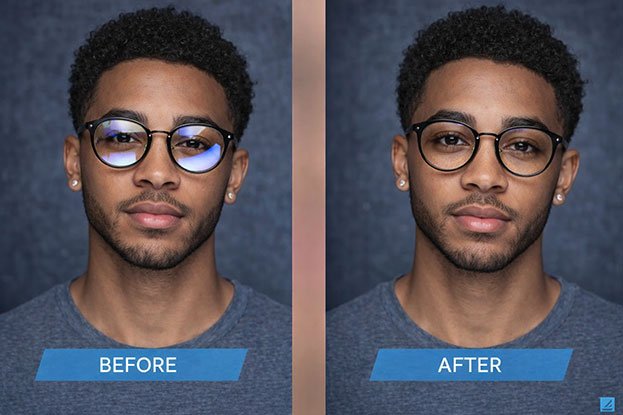
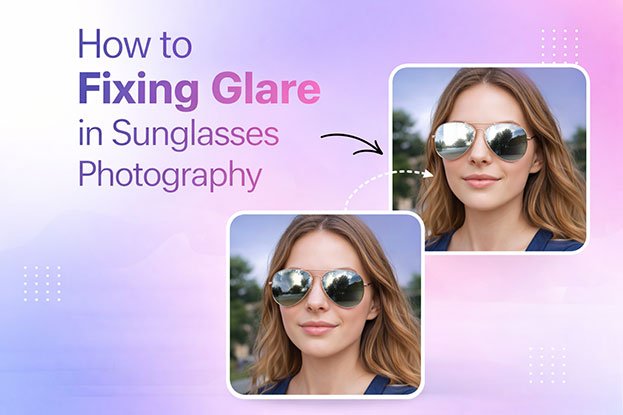
Glare occurs when light reflects directly off the curved lens surface and enters the camera at a sharp angle.
Because sunglasses lenses are:
-
Smooth
-
Curved
-
Often coated with reflective or polarized layers
They behave like small mirrors under studio lighting.
Even in a controlled photography setup, lenses can reflect:
-
Softboxes
-
Studio ceilings
-
Windows
-
Camera equipment
-
Background surfaces
This creates bright white patches or uneven reflections that distract from the product’s true appearance.
Why Sunglasses Are More Difficult Than Regular Eyeglasses
Clear prescription glasses primarily require transparency control.
Sunglasses are different.
They often include:
-
Gradient tints
-
Mirrored coatings
-
Dark polarization
-
High-gloss surfaces
These elements increase reflection intensity and make glare more noticeable.
In darker lenses, glare appears even more prominent because it contrasts sharply against the tint.
This is why sunglasses glare removal requires a specialized editing workflow rather than basic brightness adjustments.
The Hidden Business Impact of Glare
Many brands underestimate how much glare affects sales.
When customers see:
-
Uneven lens brightness
-
Harsh reflection lines
-
White hotspots
-
Washed-out gradients
They subconsciously associate the product with lower quality.
On marketplaces like Amazon, where buyers compare thumbnails instantly, glare can reduce click-through rate significantly.
On ecommerce platforms such as Shopify, poor lens presentation can lower conversion because customers cannot clearly evaluate tint depth.
Clean lens presentation builds trust.
Glare creates doubt.
Why Studio Lighting Alone Cannot Eliminate Glare
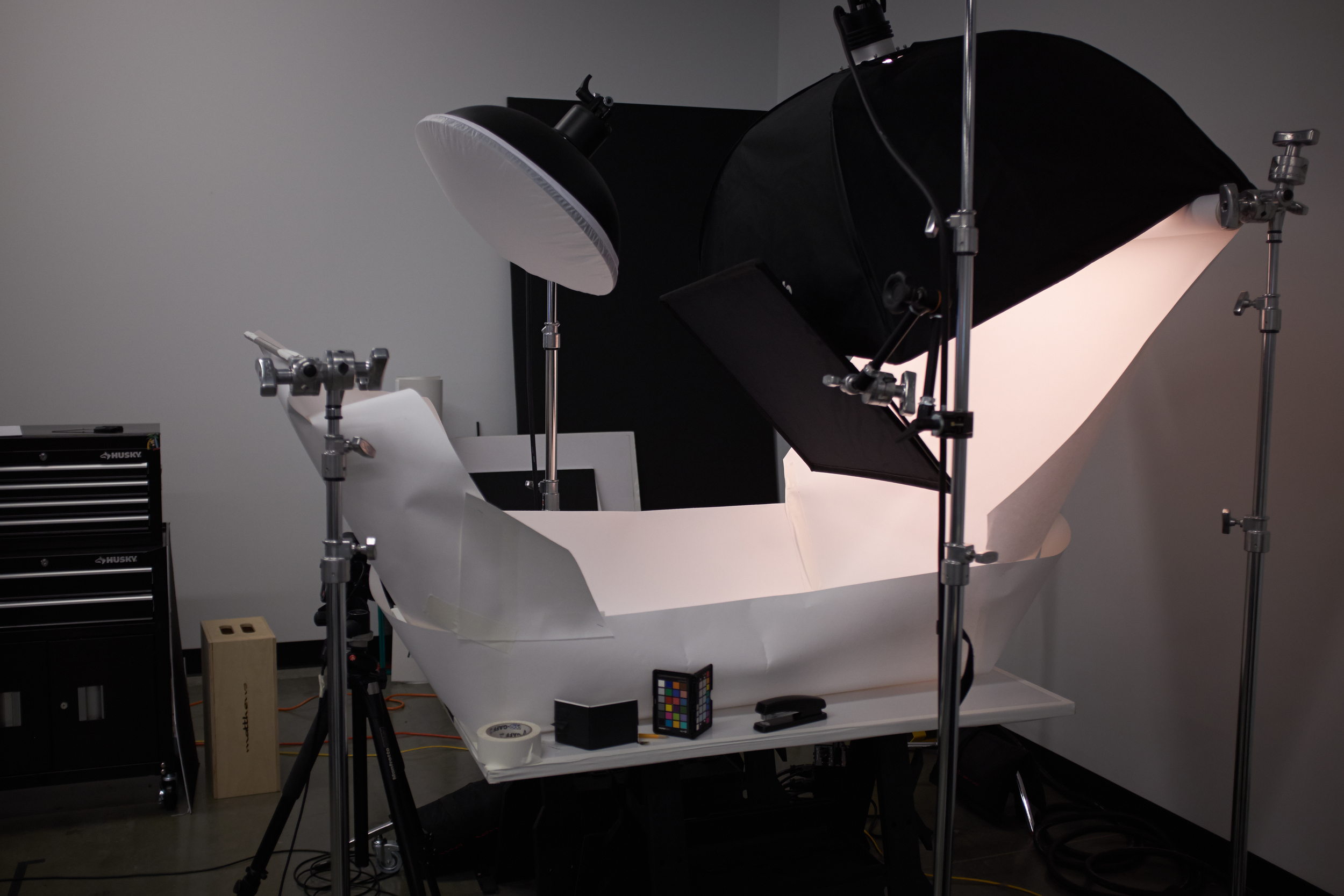
Many ecommerce brands assume glare is purely a photography mistake.
In reality, even experienced photographers using expensive equipment struggle to fully eliminate lens reflections.
The reason is physics.
1️⃣ The Science Behind Lens Reflection
Sunglasses lenses are:
-
Curved surfaces
-
Coated with anti-scratch layers
-
Often treated with polarized or mirrored finishes
-
Highly smooth and reflective
Curved reflective surfaces scatter light differently than flat objects.
When studio lights hit a curved lens, they reflect at multiple angles. Some of that reflected light enters the camera directly, creating visible hotspots.
Even small adjustments in camera angle can create new reflections.
This is why glare shifts between shots.
2️⃣ Why Softboxes and Diffusers Are Not Enough
Professional photographers use:
-
Softboxes
-
Diffusers
-
Light tents
-
Polarizing filters
These tools reduce harsh reflections but cannot eliminate them completely.
Why?
Because:
-
Lenses behave like mirrors
-
Polarized coatings intensify certain reflections
-
Gradient lenses show uneven light absorption
-
Multi-light setups create layered reflections
In some cases, reducing glare during shooting can flatten the image and remove desirable highlights.
Photography can minimize glare.
Editing is required to control it.
3️⃣ The Mistake Brands Make: Over-Editing
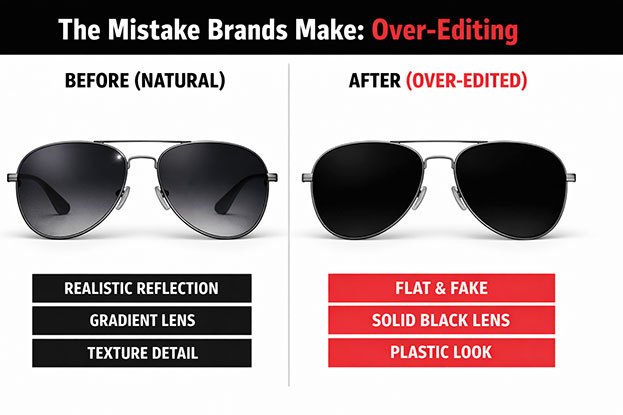
When brands attempt quick fixes, they often:
-
Completely erase reflections
-
Blur lens surfaces
-
Reduce contrast too much
-
Over-smooth gradients
This creates lenses that look:
-
Flat
-
Artificial
-
Plastic-like
-
Unrealistic
Professional editing does not eliminate reflections entirely.
It controls them.
Luxury eyewear brands maintain subtle highlights to preserve realism and material authenticity.
The goal is balance.
4️⃣ Why Sunglasses Are More Sensitive Than Other Products
Unlike clothing or shoes, sunglasses have:
-
Dual lenses that must match perfectly
-
Symmetry requirements
-
High-contrast surfaces
-
Small detail visibility in zoom
If one lens has slightly more glare than the other, customers notice immediately.
On ecommerce platforms such as Amazon, inconsistent lens brightness between angles can reduce listing quality perception.
On branded stores built with Shopify, glare inconsistencies become obvious during variant comparisons.
Even minor imbalance reduces perceived precision.
Precision is essential in eyewear.
5️⃣ Why Post-Production Is the Real Solution
Professional sunglasses editing includes:
-
Selective highlight reduction
-
Controlled gradient rebuilding
-
Micro-contrast restoration
-
Lens symmetry correction
This workflow ensures:
-
Natural highlight retention
-
Even tint distribution
-
Balanced brightness between lenses
-
Realistic material depth
Post-production does not replace photography.
It refines it.
Together, controlled lighting and professional retouching create premium ecommerce visuals.
The Professional Glare Removal Workflow for Ecommerce Sunglasses
Professional glare removal is not a quick brightness adjustment.
It is a controlled, multi-step process designed to preserve realism while eliminating distractions.
Here’s how it works.
Step 1: Exposure and Highlight Recovery
Before removing glare, the base image must be balanced.
This includes:
-
Correcting overexposed highlights
-
Restoring shadow detail
-
Adjusting white balance
-
Normalizing lens brightness
If the base exposure is incorrect, glare removal will look artificial.
Professional retouchers start by recovering detail inside bright lens areas without flattening the image.
Step 2: Selective Reflection Reduction
The key principle:
Reduce harsh glare, keep natural reflection.
Using layer masking and precision selection, retouchers:
-
Target only the brightest hotspots
-
Soften sharp white patches
-
Blend reflections gradually into lens tint
-
Maintain subtle highlight realism
Completely removing reflection creates a fake, plastic appearance.
Controlled reduction preserves premium feel.
Step 3: Lens Gradient Reconstruction
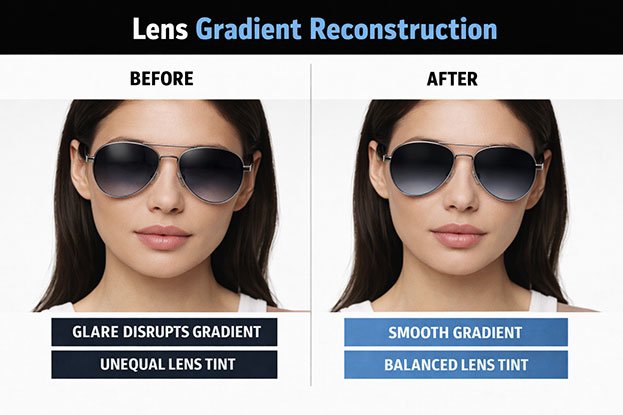
Many sunglasses use gradient tint.
Glare often disrupts the smooth transition between dark and light areas.
Professional editing rebuilds the gradient by:
-
Correcting uneven contrast
-
Restoring smooth tonal transitions
-
Matching left and right lens symmetry
-
Enhancing tint richness without oversaturation
This step ensures both lenses look balanced and consistent.
Symmetry is critical in eyewear.
Step 4: Micro-Detail Restoration
When glare is reduced, surface texture must remain intact.
Professional retouchers:
-
Restore micro contrast
-
Enhance edge clarity
-
Preserve coating texture
-
Maintain realistic depth
Over-smoothed lenses lose material authenticity.
Precision editing keeps the product believable.
Step 5: Final Symmetry Check
Both lenses must:
-
Match in brightness
-
Match in tint depth
-
Have consistent highlight intensity
-
Maintain equal clarity
Even small mismatches create subconscious doubt in buyers.
Professional quality control ensures visual balance before export.
The Business Impact of Proper Glare Control
When glare is professionally managed:
-
Thumbnails look cleaner on marketplaces like Amazon
-
Product pages built on Shopify appear more premium
-
Customers see true lens color
-
Zoom clarity improves
-
Perceived brand value increases
Clean lens presentation reduces friction in the buying decision.
Less friction means:
-
Higher click-through rate
-
Better conversion rate
-
Lower return rate
Bulk Sunglasses Editing: Why Consistency Matters
For brands managing hundreds or thousands of SKUs, glare control must follow a consistent standard.
Without defined editing guidelines:
-
Some lenses look darker
-
Others appear flatter
-
Highlights vary between collections
-
Catalog looks inconsistent
Professional bulk editing ensures:
-
Uniform reflection intensity
-
Balanced tint across variants
-
Consistent shadow placement
-
Stable background brightness
Consistency builds brand authority.
Final Takeaway
Glare in sunglasses photography is inevitable.
But uncontrolled glare is optional.
Professional glare removal:
-
Controls highlights
-
Preserves realism
-
Enhances lens depth
-
Maintains symmetry
-
Supports ecommerce performance
For sunglasses brands competing in crowded marketplaces, precision editing is not cosmetic. Professional sunglasses glare removal is not about eliminating reflections completely. It is about controlling lens highlights, preserving tint depth, and ensuring realistic product presentation that drives ecommerce conversions.
❓ Frequently Asked Questions About Sunglasses Glare Removal
1. Why do sunglasses product photos always have glare?
Sunglasses lenses are curved and reflective. Studio lights, softboxes, and surrounding surfaces reflect directly onto the lens surface, creating visible hotspots and glare patches.
Even professional photography setups cannot eliminate glare entirely due to lens geometry and coating properties.
2. Can glare be completely removed from sunglasses?
Technically yes, but it should not be.
Completely removing all reflections makes lenses look flat and unrealistic. Professional editing reduces harsh glare while preserving subtle highlights for natural depth.
3. Is glare removal done during photography or editing?
Glare can be minimized during photography using controlled lighting, diffusers, and polarizing filters.
However, full glare control requires post-production editing to soften hotspots, rebuild gradients, and balance lens symmetry.
4. Does glare affect ecommerce conversion rates?
Yes.
Harsh glare reduces perceived product clarity and quality. On marketplaces like Amazon and ecommerce platforms such as Shopify, clean thumbnails significantly impact click-through rate and conversion performance.
5. How long does professional sunglasses glare removal take?
For standard ecommerce images, glare removal typically takes 24–48 hours depending on volume and complexity.
Bulk projects follow structured workflows to ensure consistency across large catalogs.
6. Can you fix glare on gradient or mirrored lenses?
Yes.
Professional retouching includes:
-
Gradient reconstruction
-
Mirror surface refinement
-
Tint depth enhancement
-
Symmetry correction
Each lens type requires slightly different techniques.
7. Will glare removal change the original lens color?
No.
Professional glare removal enhances clarity while maintaining accurate color representation. The goal is realistic correction, not artificial alteration.
8. Do you offer bulk sunglasses glare correction for large catalogs?
Yes.
We provide bulk sunglasses image editing for ecommerce brands managing hundreds or thousands of SKUs with consistent glare control standards.
🎯 Ready to Fix Glare in Your Sunglasses Product Photos?
If your sunglasses images show:
-
Harsh white hotspots
-
Uneven lens brightness
-
Washed-out gradients
-
Distracting studio reflections
-
Inconsistent glare across angles
You are likely losing clicks and conversions.
Professional sunglasses glare removal ensures:
-
Controlled, realistic reflections
-
Balanced lens tint depth
-
Symmetrical brightness
-
Clean marketplace-ready images
-
Premium product presentation
📩 Get a Free Sunglasses Glare Removal Test
Send us 1–2 raw product images and receive:
-
Professional glare correction
-
Lens gradient enhancement
-
Background refinement
-
Shadow optimization
Delivered within 24 hours.
No commitment.
No obligation.
Just proof of quality.
Clean lenses build trust.
Trust builds sales.