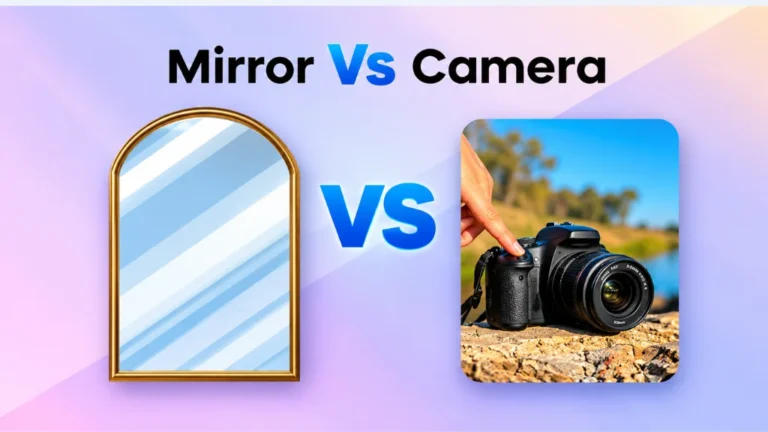
You check your face in the mirror and feel good. Then a friend takes a photo, and you think, “Is that really me?” So, what is more accurate, mirror or camera? It is one of the most common questions people ask about their looks. The short answer: a good camera is usually more accurate than a mirror. But the full answer is more interesting than that.
At Clipping Area, we have edited a huge number of photos since 2014. Portraits, product shots, fashion images, real estate photos. Every day, our retouchers see how lenses, light, and angles change the way a face or a product looks. In this guide, we share what we have learned, in plain words.
By the end, you will know why you look different in photos, which one shows how others see you, and how to take pictures that look like the real you.
Quick Answer
A camera is more accurate than a mirror for showing how other people see you. A mirror flips your face left to right. A camera does not (unless it is a selfie preview). But a camera can still distort your face if the lens is too wide, the camera is too close, or the light is poor. A photo taken from about 1.5 to 2 meters away with a normal lens is the closest thing to the true you.
How a Mirror Shows You
A mirror is simple. Light bounces off your face, hits the glass, and comes straight back to your eyes. There is no lens and no software. That sounds very accurate, and in some ways, it is.
What a Mirror Gets Right
- Real size and depth. You see yourself in 3D, with natural depth. Your nose, cheeks, and jaw have shape.
- Live movement. You see your face moving, blinking, and smiling in real time. Faces look better in motion.
- True color (mostly). A clean, good quality mirror shows colors close to real life, as long as the room light is good.
- No lens distortion. There is no wide angle lens stretching your nose or shrinking your ears.
What a Mirror Gets Wrong
The big problem is that a mirror flips you left to right. Raise your right hand, and the person in the mirror raises the hand on their left side. This is called a mirror image or a reversed image.
No face is perfectly symmetrical. One eyebrow sits a bit higher. Your smile might lean to one side. Your hair parting falls one way. In the mirror, all of this is flipped. Nobody else in the world sees you this way. Only you do.
There is also a habit factor. You look in the mirror at your best angle, with good posture and a relaxed face. You tilt your head the way you like. You rarely catch yourself mid-sneeze in a mirror. A camera does not give you that control.
The Mirror Feels Right Because You Know It
There is a well known idea in psychology called the mere exposure effect. In simple words, we tend to like things more when we see them often. You have seen your mirror face thousands of times. So your brain treats that flipped version as “the real me.” When you see an unflipped photo, it feels a little off, even when it is accurate.
Your friends feel the opposite. They know your real, unflipped face. So they usually prefer the photo version of you.
How a Camera Captures You
A camera works in a very different way. Light passes through a lens, lands on a sensor, and turns into data. Then software processes that data into a photo. Each of these steps can change how you look.
What a Camera Gets Right
- No flipping. A normal photo shows your face the way others see it. Your hair parting, your smile, and your moles are on the correct side.
- An outside view. The camera sees you from a fixed point, just like another person standing in front of you.
- Honest detail. A good camera catches skin texture, small marks, and fine lines that you may not notice in a mirror.
What a Camera Gets Wrong
A camera is only as accurate as the way it is used. Here are the main things that change your face in photos.
1. Lens distortion and focal length. Phone cameras, especially front cameras, use wide angle lenses. When a wide lens is close to your face, things nearer to the lens look bigger. Your nose looks larger. Your ears seem to shrink back. Your face looks longer. This is why selfies held at arm’s length often look “wrong.”
2. Distance. The closer the camera is, the stronger this effect. Portrait photographers usually stand back and use a longer lens (around 50mm to 85mm on a full frame camera). This keeps the face in natural proportion.
3. Angle. A camera placed below your chin adds weight to your jaw. A camera placed above makes your forehead look bigger. Eye level is the most neutral.
4. Light. Hard overhead light makes deep shadows under your eyes. Flat front light can make your face look wide and flat. Soft side light shows real shape.
5. Software processing. Many phones smooth skin, sharpen edges, brighten faces, and boost colors on their own. Some selfie cameras add beauty filters by default. The photo may look nice, but it is not the true you.
6. Frozen moments. A photo catches a split second. Half-closed eyes or an odd mouth shape in that moment can look strange. In real life, nobody notices it, because your face keeps moving.
What About the Selfie Preview?
Most phones show the front camera preview flipped, like a mirror. This feels comfortable because it matches what you know. Then, after you take the shot, many phones save it unflipped. That is why your selfie can look different the second it is saved. Some phones let you turn “mirror front camera” on or off in the camera settings.
Why Do I Look Different in Photos Than in the Mirror?
This is the question behind the whole debate. If you have ever wondered “why do I look worse in photos than in the mirror,” you are not alone. Here are the five main reasons, put simply.
- The flip. The mirror shows you reversed. The photo shows you unreversed. Your brain notices every small difference in symmetry.
- 2D vs 3D. A mirror gives you depth. A photo is flat. Without depth, faces can look wider and less shaped.
- Lens and distance. A phone held close distorts your features. A mirror has no lens, so it does not.
- Movement vs a frozen frame. In the mirror you see a living face. A photo picks one moment, and not always the best one.
- Control. In the mirror you choose your angle and expression without thinking. In a photo, someone else (or a timer) decides.
There is also one more reason that people rarely talk about: we are our own harshest critics. Studies on self-perception suggest people judge their own photos more harshly than strangers do. A friend sees a nice picture. You see a nose you never noticed before.
So when a photo looks “off,” it is often a mix of real distortion and simple unfamiliarity. The trick is to remove the distortion, so you are only left with the unfamiliar (but accurate) view.
Mirror vs Camera: Side by Side Comparison
Here is a simple look at how a mirror and a camera compare on the things that matter most.
| Factor | Mirror | Camera |
|---|---|---|
| Left and right | Flipped (reversed) | True (not flipped), except selfie preview |
| Depth | 3D, natural depth | 2D, flat image |
| Lens distortion | None | Yes, if too close or too wide |
| Movement | Live and moving | One frozen moment |
| Color | Depends on room light | Depends on light and camera settings |
| Software changes | None | Often (smoothing, sharpening, filters) |
| How others see you | Not quite | Closer, if taken well |
| Familiarity | Very familiar to you | Familiar to everyone else |
The verdict: The mirror wins on depth and has no lens distortion. The camera wins on showing your true, unflipped face. When it is used correctly, the camera is the more accurate tool for showing how you really look to the world.
Which One Shows How Others See You?
If your real question is “how do others see my face,” the answer is a well-taken photo. But let’s be honest. No single tool shows exactly what another person sees. Here is why.
People do not look at you through a lens. They see you with two eyes, in 3D, while you move, talk, and laugh. They also see you from many angles during the day. A mirror gets the 3D part right but flips you. A photo gets the direction right but flattens you. Real life sits somewhere in between.
The “True Mirror” Test
There is a special kind of mirror called a true mirror (or non-reversing mirror). It uses two mirrors set at a right angle, so the image is flipped twice. The result shows you the way others see you, live and in 3D.
People who try one often feel surprised. Their smile looks a little different. Their face seems “wrong” at first. That reaction proves the point: you are used to your flipped self.
You can do a quick version at home. Take a well-lit photo of yourself, then flip it horizontally in any photo app. The flipped version will probably feel more like “you.” The unflipped one is what your friends see.
So, Which Is More Accurate?
For direction and how the world sees you, the camera is more accurate. For depth and live shape, the mirror is more natural. For the most honest single picture, use a camera at a proper distance, eye level, with soft light and no filters.
How to Take an Accurate Photo of Yourself
Want a photo that looks like the real you? These tips come straight from what our retouching team sees in thousands of portraits every year.
- Step back and zoom in. Do not hold the phone close. Stand 1.5 to 2 meters away and use the 2x or 3x lens if your phone has one. This gives a more natural face shape.
- Use the back camera. The rear camera on most phones has a better sensor and a less extreme lens than the front one. Use a tripod or ask a friend.
- Keep the camera at eye level. Not below the chin, not high above. Eye level is the most honest angle.
- Find soft, even light. Stand facing a window on a cloudy day or in open shade. Avoid harsh midday sun and single overhead bulbs.
- Turn off beauty filters. Check your camera settings for “beauty,” “portrait enhance,” or “face smoothing” and switch them off.
- Shoot in burst mode. Take several shots in a row. Then pick the one where your eyes are open and your face is relaxed.
- Check white balance. If skin looks too orange or too blue, the colors are off. Set white balance to match your light, or fix it later.
- Relax your face. Breathe out, drop your shoulders, and think of something that makes you smile. Stiff faces never look natural.
Quick Checklist
- Camera 1.5 to 2 m away
- Eye level angle
- Soft, even light
- Filters off
- Burst mode on
Where Photo Retouching Fits In
Even a perfect shoot does not always give a perfect result. Light can be a bit warm. A lens can add a small bend at the edges. A phone can over-sharpen skin. This is where professional post-production helps. The goal is not to make someone look like a different person. The goal is to make the photo match real life.
At Clipping Area, accuracy is the heart of our work. Here is how good retouching brings a photo closer to the truth.
Natural Portrait Retouching
We remove temporary things, like a small spot, a stray hair, or under-eye shadows from bad light. We keep the things that make a face real: skin texture, freckles, laugh lines. Over-smoothed “plastic” skin is just as inaccurate as a distorted selfie.
Color Correction
Skin tones can shift green, orange, or blue because of mixed lighting. Our color correction team balances white point and skin tones, so the photo shows your true color. This matters a lot for headshots, wedding photos, and family portraits.
Lens Distortion Correction
Wide lenses curve straight lines and stretch features near the edge of the frame. We fix this with careful perspective and lens correction. It is common in real estate photos, group shots, and wide portraits.
Why Accuracy Matters for Ecommerce
The mirror vs camera question is not only about faces. It also matters for products. If a jacket looks navy online and turns up black, the customer returns it. Product photo editing, ghost mannequin work, and color matching help ecommerce brands show items exactly as they are. True-to-life images build trust and cut returns.
Our Editing Rule
Every edit should make the image more honest, not less. That is the standard we have kept since 2014, for photographers, fashion labels, online stores, and agencies around the world.
Frequently Asked Questions
Is the mirror or camera more accurate?
The camera is more accurate for showing how others see you, because it does not flip your face. The mirror is better at showing depth. For the truest result, use a camera at eye level, about 1.5 to 2 meters away, with soft light and no filters.
Why do I look better in the mirror than in photos?
You are used to your mirror face, so it feels right. A mirror also shows you in 3D and in motion. Photos are flat, unflipped, and can be distorted by close, wide lenses. Together, this makes many people prefer their mirror look.
Does the front camera distort your face?
Yes, often. Front cameras use wide lenses, and they are held close to the face. This makes the nose look bigger and the face look longer. Stepping back or using the rear camera with a 2x lens helps a lot.
Is a flipped selfie how others see me?
No. A flipped selfie looks like your mirror image. Others see the unflipped version, which is how most phones save the final photo.
How do others really see my face?
They see you unflipped, in 3D, and in motion. The closest single view is a true mirror or a well-taken photo from a normal distance with a normal lens.
Can photo editing make a picture more accurate?
Yes. Professional color correction, lens correction, and natural retouching can remove distortion and color casts. Good editing brings a photo closer to real life instead of changing who you are.
What focal length is best for accurate portraits?
Photographers often use 50mm to 85mm (full frame equivalent) for portraits. On phones, the 2x or 3x lens is usually closer to this range than the main wide lens.
Conclusion
So, what is more accurate, mirror or camera? A camera, used the right way, shows the truest version of how you look to other people. A mirror shows you a flipped face that only you see, but it gets depth and movement right. Neither one is perfect on its own.
The good news is that you can close the gap. Step back, shoot at eye level, use soft light, and turn off the filters. Then let careful editing handle what the camera could not, like color casts and lens bend.
And remember: the face that feels “off” in photos is often just the face your friends already know and like.
Need photos that look true to life? Clipping Area offers natural portrait retouching, color correction, and ecommerce photo editing for photographers and brands worldwide. Send us a few images and see the difference accurate editing makes.