If you have scrolled through ASOS, Zara, or any major fashion ecommerce site recently, you have already seen ghost mannequin photography in action. The garments look like they are being worn by an invisible person, with full shape, depth, and structure, but no model in sight.
This is not a trend. It is the industry standard. According to recent industry data, 57.2% of leading apparel brands consistently use ghost mannequin photography, and 76.1% of top fashion ecommerce brands use at least two distinct photography styles to present their products (with ghost mannequin almost always being one of them).
In this guide, you will get two things. First, a clear breakdown of what ghost mannequin photography actually is and why it converts so well. Second, 15 real fashion brands using this technique brilliantly, with specific notes on what makes each one work. Whether you run a small Shopify boutique or manage a 5,000-SKU catalog, you will walk away knowing exactly how to apply this technique to your own products.
Table of Contents
- What Is Ghost Mannequin Photography?
- Why Ghost Mannequin Photos Convert Better Than Flat Lays
- How Ghost Mannequin Photography Works (The Process)
- 15 Fashion Brands Using Ghost Mannequin Photography Perfectly
- Common Mistakes to Avoid
- Should You DIY or Outsource?
- Frequently Asked Questions
What Is Ghost Mannequin Photography?
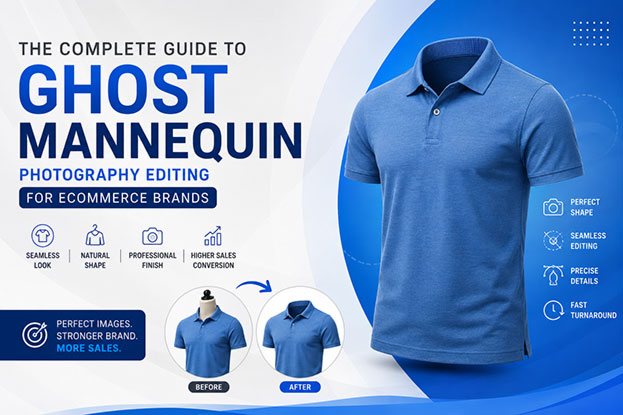
Ghost mannequin photography (also called invisible mannequin photography or the hollow man effect) is a product photography technique where clothing is photographed on a mannequin, and then the mannequin is digitally removed in post-production. The result is a 3D, “floating” garment that shows shape, fit, and structure without any human model or visible mannequin parts.
The technique typically requires:
- A front and back photo of the garment on a mannequin
- A separate shot of the garment’s interior (collar, neckline, inner hem)
- Skilled retouching to seamlessly combine the layers and remove the mannequin
When done well, the final image looks like the clothing is being worn by an invisible person, giving shoppers a clear view of fit and proportion.
Why Ghost Mannequin Photos Convert Better Than Flat Lays
Flat lay photos work for social media. Ghost mannequin photos work for selling.
Here is why fashion brands keep choosing this technique for their product detail pages:
1. They show real fit and drape. Shoppers cannot try clothes on online. A flat lay is two-dimensional and gives no sense of how a shirt actually sits on a body. A ghost mannequin image fills out the garment naturally, so customers see how it hangs, where it cinches, and how the fabric flows.
2. They reduce returns. When customers can clearly see the shape of a garment before they buy, they are less likely to be surprised when it arrives. Fewer surprises means fewer returns, which directly protects your margins.
3. They scale better than model shoots. Hiring models, stylists, and a full crew for every new product is expensive and slow. Ghost mannequin photography lets you shoot dozens of SKUs in a day with consistent results.
4. They meet marketplace requirements. Amazon, Shopify, and most major marketplaces prefer (or require) clean white backgrounds for primary product images. Ghost mannequin shots meet these specs naturally.
5. They build catalog consistency. When every product photo on your store follows the same style, the entire brand looks more polished and trustworthy. Inconsistent product images signal “amateur” to shoppers in milliseconds.
How Ghost Mannequin Photography Works (The Process)
Here is the basic workflow most professional studios follow:
Step 1: Prep the garment. Iron or steam every wrinkle. Use fashion tape to hold collar points and seams in place. Stuff sleeves or shoulders lightly if needed to maintain shape.
Step 2: Shoot the main image. Dress the garment on a ghost mannequin (one with detachable arms and torso pieces). Use two softbox lights at 45-degree angles for even, shadow-free lighting. Shoot front, back, and ideally a 3/4 angle.
Step 3: Shoot the interior. Remove the garment from the mannequin and photograph the inside of the collar, neckline, or any visible inner area when worn.
Step 4: Edit in Photoshop. A retoucher layers the interior shot behind the main shot, then carefully masks out the mannequin. The result is a clean, hollow garment that looks worn by an invisible body.
Step 5: Color correct and finalize. Adjust whites, balance colors, and ensure the background is pure white (RGB 255, 255, 255) for marketplace compliance.
If you do not have an in-house retoucher, this final stage is usually outsourced to a specialized photo editing service for a few dollars per image.
15 Fashion Brands Using Ghost Mannequin Photography Perfectly
Here are 15 brands across luxury, mass market, activewear, and indie fashion that demonstrate how powerful this technique can be when executed well.
1. ASOS
ASOS is the textbook example. With over 850 brands and tens of thousands of SKUs, they need photography that scales. Their ghost mannequin shots are clean, consistent, and shot at exactly the same angle across the entire catalog. Their secret: they pair ghost mannequin product images with on-model shots and 360-degree video, giving shoppers a complete view.
What makes it work: Total consistency. Every garment is shot at the same eye level, with the same lighting, on the same white background.
2. Zara
Zara uses a hybrid approach: lifestyle and on-model shots for the hero image, then ghost mannequin or flat lay shots for product detail. The ghost mannequin images on Zara show garment structure with crisp shadows that hint at depth without distracting.
What makes it work: Subtle natural shadows. Most beginner ghost mannequin shots look flat. Zara’s retouching keeps soft shadows that make garments feel three-dimensional.
3. H&M
H&M uses ghost mannequin extensively for basics and core pieces. They are particularly strong with knitwear and outerwear, where showing the silhouette matters most to the customer decision.
What makes it work: Excellent fabric texture preservation. Even cable knits and chunky sweaters retain every detail.
4. Girlfriend Collective
This sustainable activewear brand uses ghost mannequin photography to show off the construction of leggings, sports bras, and bodysuits. They even use ghost mannequin shots to reveal interior details like racerback lining, which would be impossible with a live model.
What makes it work: Strategic interior reveals. They use the ghost effect to show structural details customers care about.
5. REI
REI’s outdoor apparel benefits enormously from ghost mannequin photography. Technical jackets, fleeces, and rain shells need to show their cut, hood structure, and pocket placement. Every product on REI follows the same ghost mannequin format for the main image.
What makes it work: Catalog uniformity that makes browsing effortless across thousands of technical garments.
6. House of Aama
This Los Angeles-based independent fashion label uses ghost mannequin photography on Instagram and their website to introduce new collection drops. The hollow garment effect lets the rich fabrics and prints take center stage.
What makes it work: Ghost mannequin used as a storytelling tool, not just a product page utility.
7. Everlane
Everlane built its brand on transparency and clean design. Their ghost mannequin photography reflects that ethos: minimal, precise, and focused entirely on the garment. No distractions, no clutter.
What makes it work: Brand alignment. The minimal photography style matches their minimalist brand identity.
8. Uniqlo
Uniqlo uses ghost mannequin photography for almost every product category, from HEATTECH base layers to oversized outerwear. Their shots emphasize the garment’s intended silhouette with subtle interior shadows.
What makes it work: Functional clarity. You can see exactly how the garment is constructed.
9. Reformation
Reformation specializes in feminine, drapey silhouettes. Their ghost mannequin photography captures the way fabric falls, which is critical for selling dresses and blouses online. Every drape looks intentional.
What makes it work: Movement and drape captured in a still image, which is harder than it sounds.
10. Lululemon
Lululemon uses ghost mannequin shots to highlight the technical construction of leggings, jackets, and performance tops. The ghost effect lets shoppers focus on seams, pockets, and waistbands without a model in the way.
What makes it work: Technical detail emphasis perfect for premium activewear pricing.
11. ASKET
This Swedish menswear brand specializes in “permanent collection” essentials. Their ghost mannequin photography is some of the cleanest on the web, with every shirt and sweater showing flawless symmetry and zero distractions.
What makes it work: Surgical precision in edge cleanup and symmetry.
12. Mango
Mango leans heavily on ghost mannequin photography for their product detail pages, especially for tailored pieces like blazers and trousers. The structured nature of these garments shows beautifully with the hollow effect.
What makes it work: Strong structural emphasis for tailored garments where fit drives the sale.
13. SSENSE
The luxury multi-brand retailer SSENSE uses ghost mannequin photography for many designer pieces, paired with editorial on-model shots. The contrast lets shoppers study craftsmanship up close, then see how the piece looks styled.
What makes it work: Pairing with editorial photography to serve both rational and emotional buying decisions.
14. COS
COS, the H&M-owned minimalist brand, produces ghost mannequin photography that feels almost sculptural. Their shots emphasize architectural cuts and unusual silhouettes that define the brand.
What makes it work: Photography that elevates the garment into an art object.
15. Boden
The British family fashion brand Boden uses ghost mannequin photography for their core categories alongside lifestyle imagery. The hollow garment effect helps showcase their signature prints and patterns clearly.
What makes it work: Print and pattern clarity that flat lays often distort.
Common Mistakes to Avoid
Even brands that invest in ghost mannequin photography make these mistakes:
Inconsistent lighting between shots. If your front and back shots have different lighting, the catalog looks unprofessional. Lock your lighting setup before shooting and do not adjust it between products.
Visible mannequin remnants. Sloppy editing leaves bits of the mannequin showing at collar edges or sleeve openings. Always zoom to 200% and check edges during retouching.
Flat, lifeless results. A ghost mannequin shot with zero shadows looks like a paper cutout. Add subtle drop shadows or interior shadows to maintain depth.
Inconsistent angles across the catalog. If one shirt is shot from chest height and another from below, your product grid looks chaotic. Use tripod markings to keep the camera in the exact same position for every product.
Wrong background white. Using off-white or slightly gray backgrounds breaks marketplace compliance and makes images look dingy. Always finish with RGB 255, 255, 255 for the background.
Skipping the 3/4 angle. Front and back are not enough for many garments. A 3/4 angle gives shoppers a much better sense of shape and is proven to lift conversion rates.
Should You DIY or Outsource Ghost Mannequin Photography?
Honestly, it depends on your scale.
DIY makes sense if:
- You have fewer than 20 SKUs per month
- You already own a mannequin, lights, and camera
- You or someone on your team is competent in Photoshop
- You enjoy the process
Outsourcing makes sense if:
- You have 50+ SKUs per month
- You need a 24 to 48 hour turnaround
- You want consistent quality across every shot
- Your time is better spent on marketing, sourcing, or growth
Professional ghost mannequin editing services typically charge between $1 and $5 per image, depending on garment complexity and turnaround speed. For most growing brands, outsourcing pays for itself in time savings alone.
Frequently Asked Questions
How much does ghost mannequin photography cost?
DIY costs range from $500 to $2,000 for initial equipment (mannequin, lights, backdrop, camera). Outsourced editing typically costs $1 to $5 per image. Full-service photography studios charge $15 to $50 per image including shooting and editing.
How long does ghost mannequin editing take?
A skilled retoucher can complete a standard ghost mannequin edit in 10 to 20 minutes per image. Complex garments (heavy textures, intricate details, transparent fabrics) take longer.
Can AI replace traditional ghost mannequin photography?
AI tools can generate ghost mannequin effects in seconds, and the quality is improving rapidly. For high-volume catalogs and product listing pages, AI is often good enough. For hero images, marketing campaigns, and luxury products, professional retouching still wins on quality.
What is the difference between ghost mannequin and flat lay photography?
Flat lay photos show clothing laid flat on a surface, photographed from above. Ghost mannequin photos show clothing as if worn by an invisible body, giving the garment three-dimensional shape. Ghost mannequin converts better on product pages; flat lay works better for social content.
Does ghost mannequin photography work for all garment types?
It works best for structured garments: shirts, blazers, jackets, dresses, and outerwear. It is less effective for accessories, footwear, and very soft garments like loose t-shirts, which can look shapeless without a model.
Ready to Upgrade Your Product Photography?
Ghost mannequin photography is one of the highest-ROI investments a fashion brand can make. It boosts conversions, reduces returns, scales easily, and elevates your entire brand presentation in one move.
If you are looking for professional ghost mannequin editing for your catalog, Clipping Area provides high-quality ghost mannequin retouching with fast turnaround for fashion ecommerce brands worldwide. We handle the entire post-production process so you can focus on building your brand.
Want a free sample? Send us a test image and we will return a fully retouched ghost mannequin version within 24 hours, no obligation.