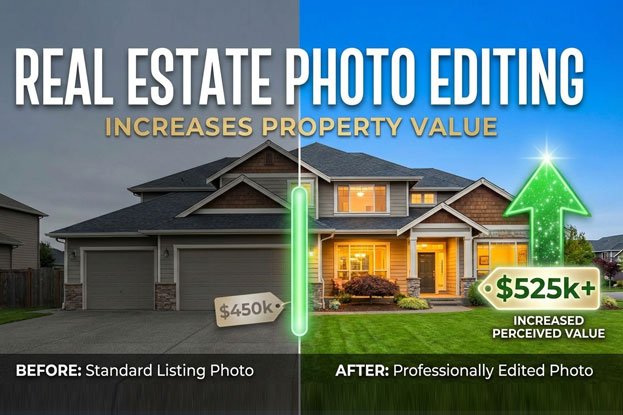
A buyer scrolls through twenty listings on a Sunday evening. Most of the homes are in the same price range and the same neighborhood. One listing shows a dim living room with a yellow cast and a tilted doorway. The next shows a bright, balanced room where the flooring, windows, and trim are easy to see. Before visiting either home, the buyer has already formed an opinion. That is where real estate photo editing matters. Professional editing improves how existing features appear on screen, and that presentation can shape how valuable, well kept, and spacious a property seems. But perceived value is not the same as market value, and good editing works on presentation only.
What Is Property Value Perception?
Property value perception is how valuable, attractive, and well maintained a property appears to a buyer, based on the information they have. It sits alongside actual value, but it is not the same thing.
Actual Property Value
Actual value is the economic or market value of a property. Real-world factors shape it, including:
- Location and neighborhood
- Property size and layout
- Physical condition and features
- Comparable sales nearby
- Local demand and market conditions
- Timing and pricing strategy
No photograph changes any of these factors.
Perceived Property Value
Perceived value is the impression a buyer forms about a property’s quality, condition, space, and appeal. Online, that impression comes mostly from listing photos, the description, and the price.
Images influence perceived value because they are often the first and most detailed evidence a buyer sees. A clear image lets a buyer judge the home fairly. A poor image can hide real strengths, making a good home look worse than it is.
How Real Estate Photo Editing Can Influence Buyer Perception
Real estate photo editing influences buyer perception by making existing property features easier to see and evaluate. It does not add value to the building. It removes technical problems that get in the way of an accurate impression.
Professional property photo editing typically produces:
- Brighter interiors that show rooms as they look in person
- Balanced colors instead of yellow, blue, or green casts
- Straight architectural lines that look stable and well built
- Better visibility of flooring, cabinets, fixtures, and finishes
- Reduced distractions from temporary objects
- More natural lighting across the frame
- Consistent images across the whole listing
- Cleaner exterior presentation with realistic skies and balanced shadows
The goal is not to make a property look like something it is not. The goal is to present the real property clearly and professionally, so buyers can judge it on its actual merits.
Why First Impressions Matter in Real Estate Listings
Buyers rarely study one listing at a time. They compare. In an online property search, a thumbnail may get a second or two of attention before the buyer moves on.
Poor images can make a property appear:
- Dark or gloomy
- Smaller than it is
- Dated
- Untidy
- Poorly maintained
- Listed by someone who did not take the sale seriously
Each of these impressions can be false. A dark photo of a sunny room is a camera limitation, not a property flaw. Yet the buyer only sees the photo.
Balanced, accurate listing photos make the property easier to evaluate. They will not decide a purchase on their own. Price, location, and the in-person visit carry far more weight. But strong images help a listing earn the click and the viewing where those other factors come into play.
How Brightness and Exposure Affect Perceived Property Value
Exposure correction improves perceived value by revealing details that the camera captured too dark or too bright.
Cameras struggle with real estate interiors. A typical room has bright windows and darker corners at the same time. The camera cannot hold both, so something gets lost. Common problems include:
- Underexposed interiors that look cave-like
- Windows blown out to pure white
- Uneven exposure from one side of the room to the other
- Heavy shadows under cabinets, stairs, and furniture
- Exteriors that are too dark on the shaded side of the house
Consider a living room with oak flooring, crown molding, and a textured feature wall. In a dark photo, all three disappear into shadow. After exposure correction, the flooring grain, the molding, and the wall texture become visible. Nothing new was added. The editor simply revealed what was already there.
That is the right purpose of exposure correction: show existing details, never invent features.
How Color Correction Creates a More Professional Property Presentation
Color correction makes a property look clean, consistent, and true to life by removing color casts and fixing white balance.
Indoor photos pick up color from light sources and surroundings. Common issues include:
- Yellow casts from warm bulbs, which can make white walls look aged
- Blue casts from daylight or shade
- Green casts from some fluorescent lights or reflections from lawns
- Dull colors that make a home feel flat
- Oversaturation that looks artificial
- Mixed white balance within one room
- Inconsistent color from room to room
A white kitchen with a yellow cast can look dirty or dated. Neutral white balance restores it to how it looks in person.
Color correction has a clear limit. It should never misrepresent:
- Wall paint colors
- Flooring materials and tones
- Countertops
- Exterior siding, brick, or roofing
- Permanent fixtures
If a buyer arrives and the kitchen cabinets are a different color than the photos, trust drops immediately.
How HDR Real Estate Editing Affects Property Perception
HDR editing combines several exposures of the same scene so both bright and dark areas show detail. A photographer shoots bracketed frames (dark, normal, and bright), and the editor blends them.
HDR helps with:
- Bright windows next to dark interiors
- High-contrast rooms
- Scenes where the outdoor view and interior both need detail
- Rooms with deep shadows and strong direct light
Done well, HDR real estate photo editing produces a room that looks like what the eye sees: a readable interior and a visible view through the window.
Excessive HDR causes problems:
- Halos around windows and furniture edges
- Overprocessed look with gritty textures
- Unrealistic colors, often oversaturated
- Flat shadows that remove depth
- Artificial lighting that no real room has
Buyers may not know the term HDR, but they notice when an image looks fake. Balanced HDR supports trust. Heavy HDR can make buyers wonder what else has been manipulated.
How Perspective Correction Can Make a Property Look More Professional
Perspective correction straightens vertical lines so walls, doors, and windows look upright and natural.
When a camera tilts up or down even slightly, vertical lines converge. Wide-angle lenses, which are standard in interior photography, make this worse. Common issues include:
- Walls that lean inward or outward
- Door frames that look tilted
- Tall exteriors that appear to fall backward
- Barrel or edge distortion from wide lenses
Crooked lines make a home feel unstable, even though the buyer knows the walls are straight. Straight verticals read as professional and well built.
Perspective correction should only fix camera distortion. It should never:
- Move walls
- Enlarge rooms
- Change room dimensions
- Alter the actual layout
How Sky Replacement Can Affect Exterior Property Perception
Sky replacement swaps a dull or distracting sky for a natural-looking one, improving the mood of exterior photos.
It can be appropriate when:
- The shoot happened on a gray, overcast day
- The sky is washed out to white
- The exterior looks flat and lifeless
- The sky contains distractions such as power line clutter at the top edge
Realistic sky replacement depends on:
- Matching light direction so shadows agree with the sun
- Natural color rather than an electric blue
- Correct horizon placement
- Proper cloud scale relative to the house
- Realistic reflections in windows, pools, and wet surfaces
- Appropriate brightness for the scene
- Clean blending around rooflines, trees, and chimneys
Not every property needs a dramatic blue sky. Sometimes a soft, lightly clouded sky fits better. What matters most is that the house, the yard, and the surroundings still look exactly like the real property.
How Window View Enhancement Works
Window view enhancement restores detail in overexposed windows so buyers can see what is outside.
When the interior is exposed correctly, windows often turn white. Editors fix this by blending a darker exposure of the window area into the image. The process covers:
- Recovering blown-out windows
- Showing the actual outdoor view
- Balancing interior and exterior brightness
- Managing reflections on glass
- Blending edges so the window looks natural
The ethical boundary is simple. Show the real view. Do not replace it. A window facing a brick wall should not suddenly face a park or a lake. If the view is part of what a buyer is paying for, faking it is misrepresentation.
How Object Removal Can Improve Property Presentation
Object removal cleans up temporary distractions so buyers can focus on the property itself.
Reasonable items to remove include:
- Trash bins at the curb
- Small clutter on counters
- Loose cables and chargers
- Photographer equipment such as tripod legs or lights
- Temporary personal items like a towel over a chair
- A parked car that blocks the front elevation
These items are not part of the property. Removing them does not change what the buyer receives.
What should not be removed just to make the property look better:
- Permanent defects
- Structural damage or cracks
- Major stains or water damage
- Important fixtures, including utility boxes and meters
- Safety issues
- Permanent neighboring features such as power lines or cell towers when they affect the property
Transparency protects everyone. A buyer who finds hidden damage at a viewing loses trust in the listing, the agent, and every other photo.
How Clean and Consistent Images Can Influence Perceived Quality
A listing is a set of images, not one photo. When the set looks uneven, the listing feels disorganized.
Consistency covers:
- Similar brightness across rooms
- Matching color balance
- Consistent cropping and framing
- Similar perspective standards
- Uniform image dimensions
- One visual style throughout
Picture a listing where the kitchen is warm and bright, the bedroom is cool and dark, and the bathroom is oversaturated. Each image may be acceptable on its own. Together, they suggest carelessness. Professional real estate image editing brings the set into line so the listing reads as one well-presented property.
How Interior Photo Editing Can Improve Property Presentation
Living Rooms
Living rooms usually contain the biggest windows and the most furniture. Editing focuses on balanced brightness, natural color, straight verticals, and removing small clutter like remote controls and cables.
Kitchens
Kitchens sell details. Countertops, cabinets, backsplashes, and appliances must show their true color and finish. Editors correct mixed lighting from under-cabinet LEDs and windows, and reduce harsh reflections on stainless steel.
Bathrooms
Bathrooms are small, reflective, and often poorly lit. Editing balances exposure, controls glare on mirrors and tiles, neutralizes color casts, and removes the photographer’s reflection when it appears.
Bedrooms
Bedrooms should feel calm and restful. Editing lifts shadows, softens harsh window light, and keeps wall and bedding colors natural.
Dining Areas
Dining areas often sit between the kitchen and living room. Editing balances exposure across these open spaces and keeps the composition clean around the table and lighting fixture.
Hallways
Hallways are narrow and prone to distortion. Perspective correction and even brightness from end to end make them look natural rather than tunnel-like.
How Exterior Photo Editing Can Improve Property Presentation
Exterior images set the first impression, and they often become the main listing thumbnail. Key areas include:
- Front elevation: straight verticals, balanced exposure, realistic sky
- Backyard and garden: natural greens, controlled shadows
- Driveway: removal of temporary vehicles or bins
- Patio and balcony: balanced light between shade and sun
- Pool: accurate water color and natural reflections
- Commercial properties: clean facades, corrected perspective on tall buildings, consistent signage visibility
Editing tools for exteriors include exposure correction, color correction, sky enhancement, perspective correction, shadow balancing, and minor distraction removal. None of these should change the property’s real condition. A lawn with dead patches should not become a perfect green carpet.
Real Estate Photo Editing vs Property Misrepresentation
This is the most important boundary in real estate photography editing.
Enhancement improves how an existing feature is presented.
Misrepresentation makes the property appear materially different from reality.
| Acceptable Enhancement | Potentially Misleading Editing |
|---|---|
| Correcting white balance | Making rooms appear much larger |
| Balancing exposure | Removing permanent damage |
| Straightening vertical lines | Changing permanent wall colors without disclosure |
| Removing temporary distractions | Adding features that do not exist |
| Reducing sensor noise | Changing the property layout |
| Improving image consistency | Creating unrealistic or fake views |
| Recovering window detail | Hiding major defects |
A useful test: If a buyer walks in and feels misled by what they see, the edit went too far. Local advertising rules and listing platform policies may also restrict certain edits, and virtual staging or major changes often require disclosure. Agents should check the rules that apply in their market.
Does Better Real Estate Photo Editing Actually Increase Property Value?
No. Professional photo editing does not directly increase the physical or market value of a property.
What it can do is improve how the property is visually presented. That presentation may influence how buyers perceive its condition, quality, and appeal.
The distinction is simple:
- Property value comes from physical and market factors: location, size, condition, layout, comparables, and demand.
- Value perception comes from presentation and buyer expectations: how clearly and professionally the property is shown.
Good editing helps a property be seen fairly. It cannot promise a higher selling price, a faster sale, or any particular result.
Before-and-After Examples: What Should Change?
The following are illustrative scenarios, not measured sales results.
Example 1: Dark Living Room
Before: Underexposed, yellow cast from ceiling bulbs, flooring and trim hard to see.
After: Balanced exposure, neutral white balance, existing floor grain and molding clearly visible.
Example 2: Exterior With Gray Sky
Before: Flat white sky, dull light, the house blends into its surroundings.
After: Realistic sky with soft clouds, better-balanced exposure, shadows that match the light.
Example 3: Crooked Interior
Before: Walls lean inward because the camera tilted down.
After: Vertical lines straightened, room shape unchanged.
Example 4: Distracting Temporary Objects
Before: Phone charger on the counter, trash bin by the door, tripod leg in the corner.
After: Cleaner presentation with the same room, fixtures, and finishes.
In every case, the property stays the same. Only the presentation improves.
Real Estate Photo Editing Workflow
A professional workflow keeps results accurate and repeatable:
- Receive original images (ideally RAW or bracketed files)
- Review image quality for focus, bracketing, and missing shots
- Identify editing requirements based on the client brief
- Correct exposure
- Correct color and white balance
- Apply HDR where the scene needs it
- Correct perspective
- Perform masking for windows, skies, and fine edges
- Apply sky or window adjustments if required
- Remove appropriate temporary distractions
- Refine details such as noise, sharpness, and edges
- Quality control against a checklist
- Export at the required size and format
- Final client review and revisions
Quality control matters because small errors add up. One halo, one crooked wall, or one mismatched sky can undermine an otherwise strong listing. A second check before delivery catches what the editor missed.
DIY Real Estate Photo Editing vs Professional Editing
Neither option is right for everyone.
| DIY Editing | Professional Editing | |
|---|---|---|
| Advantages | Lower direct cost, full creative control, fine for occasional projects, good for skilled photographers | Handles volume, consistent results, predictable turnaround, advanced masking, frees time for shooting |
| Challenges | Time-consuming, learning curve, inconsistent results, difficult masking and HDR balancing, hard to scale | Ongoing cost, requires clear instructions, needs a reliable partner |
Professional editing tends to make sense when:
- There are many listing images each week
- Consistency across listings is important
- Turnaround time affects listing dates
- Advanced masking or window work is needed
- The photographer wants to focus on shooting and clients
- An agency manages multiple listings at once
A photographer shooting two homes a month may prefer to edit in-house. A team shooting twenty may find outsourcing more practical.
How Much Does Real Estate Photo Editing Cost?
Pricing varies widely, so it is better to understand the factors than to rely on a single number.
Factors that affect cost:
- Number of images
- Editing complexity
- HDR blending
- Sky replacement
- Window view editing
- Object removal
- Perspective correction
- Retouching level
- Turnaround time
- Order volume
- Revision requirements
- Quality-control standards
Common pricing models:
- Per image: simple and common for standard edits
- Per project: a set price for a full listing
- Bulk pricing: lower rates for larger volumes
- Monthly workflow: ongoing arrangements for agencies and busy photographers
Hypothetical example: a listing with 30 standard interiors may cost less per image than a listing with 10 images that each need sky replacement, window pulls, and object removal. Complexity often matters more than image count.
How to Choose a Real Estate Photo Editing Company
Use this checklist before committing:
- Editing quality: Are results natural or overprocessed?
- Sample work: Do they show real before-and-after examples?
- Real estate experience: Do they understand verticals, windows, and ethical limits?
- Consistency: Do batches look uniform?
- Communication: Are they responsive and clear?
- File handling: Do they accept RAW and bracketed files?
- Turnaround expectations: Are timelines stated clearly?
- Revision policy: How are corrections handled?
- Quality control: Is there a review step before delivery?
- Pricing transparency: Are costs clear upfront?
- Data and file security: How are client files stored and shared?
- Bulk capacity: Can they handle busy periods?
The simplest step is to request a small free sample using your own photos before sending a large project.
Clipping Area: Real Estate Photo Editing and Post-Production
Clipping Area is a post-production photo retouching agency that has provided professional image editing since 2014. The team works with real estate photographers, agents, brokers, property developers, and marketing agencies that need reliable, consistent listing images.
Relevant services include:
- Real estate photo editing
- HDR real estate photo editing
- Color correction
- Perspective correction
- Sky replacement
- Window view enhancement
- Object removal
- Photo retouching
- Exposure correction and image enhancement
- Bulk photo editing
A structured post-production workflow helps photographers and agencies keep every listing on the same visual standard, even across many properties and shoots. Clients can share a style guide, and edits follow the same exposure, color, and perspective rules every time, within realistic and ethical limits.
Get a Free Sample. Have a batch of property photos that need consistent professional editing? Send Clipping Area a small sample and request a free sample or quote.
How to Create a Consistent Real Estate Image Style
An editing style guide keeps results uniform, whether you edit yourself or work with an outside team. Define:
- Exposure preference: bright and airy or more natural
- White balance: neutral, slightly warm, or slightly cool
- Contrast: soft or crisp
- Saturation: natural levels, no oversaturation
- Shadow level: how much to lift dark areas
- HDR intensity: subtle blending standards
- Sky replacement rules: when allowed and what style
- Perspective standards: always straight verticals
- Crop ratios: such as 3:2 or 16:9
- Image dimensions: matching platform requirements
- Object-removal rules: what can and cannot be removed
A written guide makes every listing look like it came from the same professional source, which strengthens brand recognition over time.
Real Estate Photo Editing Quality-Control Checklist
Run each finished image through these questions:
- Is exposure balanced?
- Are colors realistic?
- Is white balance accurate?
- Are vertical lines straight?
- Are rooms represented naturally?
- Are shadows realistic?
- Is HDR subtle, with no halos?
- Does the sky match the lighting?
- Are window views real and natural?
- Were temporary objects removed appropriately?
- Are permanent features untouched?
- Is the image sharp?
- Is the listing visually consistent?
- Does the final image accurately represent the property?
If the answer to the last question is no, the image is not ready.
Frequently Asked Questions
1. Does real estate photo editing increase property value?
No. Editing does not change a property’s market value. It improves visual presentation, which can influence how buyers perceive the home’s quality and condition.
2. How does real estate photo editing affect buyer perception?
It makes existing features clearer. Balanced light, accurate color, and straight lines help buyers judge a property fairly and see it as well presented.
3. Can edited property photos make a home look more valuable?
Yes, in terms of perception. Clear, professional images can make a home appear better maintained and more appealing, but they do not change its actual value.
4. What is included in professional real estate photo editing?
Typically exposure correction, color correction, HDR blending, perspective correction, window view enhancement, sky replacement, and removal of temporary distractions.
5. Does HDR editing make a property look better?
Balanced HDR usually does. It shows detail in both bright windows and dark corners. Heavy HDR can look fake and reduce trust.
6. Is sky replacement acceptable in real estate photography?
Generally yes, when it looks natural and does not change the property. Some markets or platforms may have specific rules, so check local guidelines.
7. Can photo editing make a room look bigger?
It should not. Editing can make a room look brighter and clearer, but changing its apparent size or dimensions is misrepresentation.
8. What is the difference between photo enhancement and property misrepresentation?
Enhancement improves how real features are shown. Misrepresentation makes the property look materially different, such as hiding damage or adding features.
9. How much does real estate photo editing cost?
It depends on image count, complexity, turnaround, and services like HDR or sky replacement. Common models are per image, per project, bulk, or monthly.
10. Should real estate photographers outsource editing?
It depends on volume. Outsourcing often suits photographers with many listings, tight deadlines, or complex editing needs. Low-volume photographers may prefer editing in-house.
11. What should I look for in a real estate photo editing company?
Natural results, real estate experience, consistency, clear pricing, revision policy, file security, and a willingness to edit a free sample first.
12. Can professional editing improve consistency across property listings?
Yes. Editing to a shared style guide keeps brightness, color, and framing uniform, so every listing looks organized and professional.
Conclusion
Good real estate photography creates the foundation. Professional editing builds on it by revealing detail, correcting color, and straightening lines so the property is shown clearly. That better presentation can influence how buyers perceive a home’s quality and value.
Editing should stay realistic and ethical. The home a buyer sees online should match the home they walk into. Actual property value will always depend on location, condition, size, and the market, not on photographs.
If you want your listing images to look consistent and professional without spending hours editing, send Clipping Area a small batch and request a free sample.