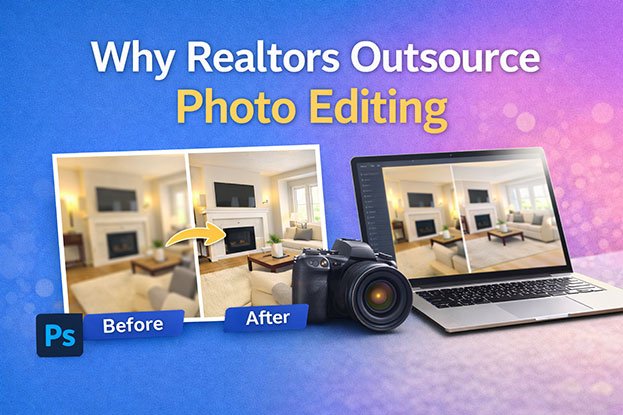
It’s 7 p.m. on a Tuesday. You’ve just wrapped a showing across town, and a folder of 42 photos from this morning’s shoot is waiting on your laptop. The sellers expect the listing live by Thursday. Several shots have blown-out windows, a few interiors look yellow, and one exterior has a trash bin sitting in the driveway. This is where real estate photo editing stops being a creative task and becomes a time problem.
So the real question is simple: should you spend your evenings in Lightroom, or hand the work to a specialist? For many agents, outsourcing is a practical business decision, especially once editing becomes repetitive, slow, or hard to manage across several listings at once.
Why Realtors Are Outsourcing Photo Editing
A decade ago, a listing might have gone live with a dozen photos. Today, buyers expect far more. A typical property listing now includes 25 to 50 images, and many agents also need cropped versions for social media, vertical formats for Reels and Stories, featured images for their website, and print-ready files for brochures.
That volume adds up quickly when you’re handling more than one property. Three listings in a week can mean well over 100 images, each needing some level of correction before it’s ready for the MLS.
At the same time, the expectations around speed have tightened. Sellers want their home on the market fast. Brokerages want consistent branding. Buyers scroll quickly and judge a property in seconds, often before they read a single line of the description.
Meanwhile, the core of a Realtor’s job hasn’t changed. Your days are still filled with:
- Client communication and follow-ups
- Property showings and open houses
- Listing preparation and pricing discussions
- Negotiations and transaction management
- Lead generation and networking
- Marketing and brand building
Photo editing sits awkwardly in that list. It’s important because listing photos shape first impressions, but it’s also repetitive, technical, and time-consuming. For many agents, it turns into one more operational task competing for attention with work that directly moves deals forward. That tension is the main reason real estate photo editing outsourcing has become so common.
What Does Real Estate Photo Editing Include?
Professional real estate photo editing is the post-production work that turns raw property photos into clean, accurate, market-ready images. The goal isn’t to make a home look like something it isn’t. It’s to make the photos reflect what the property actually looks like in person, which cameras often fail to capture on their own.
Common services include:
- Exposure correction: Balancing dark rooms and overly bright areas so the whole space is visible.
- Color correction and white balance: Removing yellow, blue, or green casts caused by mixed lighting (daylight from windows combined with warm indoor bulbs is a common culprit).
- HDR processing: Blending multiple bracketed exposures into one image with detail in both shadows and highlights.
- Perspective correction: Straightening vertical lines so walls don’t appear to lean or tilt.
- Window view enhancement: Recovering the outdoor view through windows so they don’t appear as white rectangles.
- Sky replacement: Swapping a dull gray sky for a clear one on exterior shots.
- Object removal: Removing temporary distractions such as cords, trash bins, cars, or personal items.
- Shadow enhancement: Lifting harsh shadows in corners and under furniture.
- Sharpening and noise reduction: Improving clarity, especially in low-light interiors.
- Cropping and resizing: Preparing files for MLS requirements, websites, and social platforms.
- Basic retouching: Cleaning small marks, scuffs, or lens dust spots.
Not every photo needs every service. A bright, well-shot condo might only need light color correction and straightening. A dim older house with small windows might need full HDR blending, window pulls, and perspective work. Good real estate photo editing services adjust the level of work to the property and to the client’s instructions.
The Biggest Reason: Realtors Need Their Time for Higher-Value Work
The most common argument for outsourcing isn’t about software or skill. It’s about time.
Economists call this opportunity cost: the value of what you give up when you choose to do one thing instead of another. For a Realtor, every hour spent editing photos is an hour not spent on activities that directly influence income.
Here’s a hypothetical example to illustrate the idea:
Suppose an agent spends around 3 hours editing photos for each new listing. With 4 listings in a month, that’s roughly 12 hours of editing. Those 12 hours could instead go toward:
- Following up with warm leads
- Meeting prospective sellers for listing presentations
- Showing properties to active buyers
- Preparing negotiation strategy
- Networking with other agents and referral partners
- Planning marketing campaigns
The numbers above are illustrative, not industry averages. Your own figures may be higher or lower depending on your skill level, the number of images, and the complexity of the properties.
The point is that the business question isn’t only:
“How much does editing cost?”
It’s also:
“What could I do with the time I’d spend editing?”
If editing time is genuinely spare time that wouldn’t be used for client work anyway, doing it yourself may make sense. But if it pushes follow-ups to the next day, delays listings, or eats into evenings you’d otherwise use for prospecting, the hidden cost of DIY editing can be larger than the invoice from an editor.
Editing Skill Takes Longer to Learn Than Most Agents Expect
Basic phone filters and one-click presets can brighten a photo. They rarely produce professional results on real estate images, which have a few difficult characteristics:
- Bright windows next to dark interior walls
- Mixed light sources creating color casts
- Wide-angle lenses that distort vertical lines
- White walls and ceilings that show every color shift
Handling these properly usually means working with tools such as Adobe Lightroom and Photoshop, understanding layer masking, learning exposure blending, and developing a consistent eye for color. That learning curve takes weeks or months, not an afternoon.
Then there’s ongoing cost: software subscriptions, a capable computer, a calibrated monitor for accurate color, and time spent keeping up with new tools and techniques.
Some agents enjoy this process and build real skill. Others find that DIY editing produces images that look overprocessed (glowing halos, oversaturated grass, surreal HDR) or underprocessed (dark rooms, crooked walls). Neither helps a listing. Professional property photo editing services exist largely because this craft is genuinely specialized.
Consistency Matters More Than a Single Great Photo
One beautifully edited photo doesn’t make a strong listing. A set of 35 images that all feel like they belong together does.
Consistency problems are easy to spot once you look for them:
- The living room looks warm while the kitchen looks cold and blue
- Some rooms are bright and airy while others look dim
- Vertical lines are straight in one image and tilted in the next
- Exterior skies change color from photo to photo
Buyers may not identify these issues by name, but inconsistency makes a listing feel less polished. For brokerages and teams, it also weakens brand presentation when listings from different agents look completely different.
A professional real estate photo editing company typically works from defined style guidelines. Once your preferences are set (brightness level, color temperature, sky style, crop ratio), editors apply the same standard across every property. That kind of image consistency is hard to maintain when editing is squeezed in late at night between other tasks.
Listing Deadlines and Turnaround Time
In real estate, timing matters. A seller who signed on Monday usually wants to see the listing live within days. Delays can frustrate clients and push a property’s launch past a planned weekend open house.
When you edit in-house, turnaround depends on your own schedule. A busy week of showings or a closing that needs attention can easily push editing back by a day or two.
Outsourced editing teams often work in shifts, sometimes across time zones. For many agents, that means photos sent in the evening can come back edited by the next morning. Many real estate photo editing services offer standard turnaround windows (often 12 to 24 hours) and faster options for urgent jobs, though exact timelines vary by provider and order size.
This predictability is valuable. When you know edited photos will be back by a certain time, you can plan listing launches, schedule marketing, and set clearer expectations with sellers.
Bulk Editing and Business Scalability
Editing one listing a month is manageable for almost anyone. Editing ten listings a week is a different situation entirely.
As an agent’s business grows, editing workload grows with it, usually in direct proportion. That creates a ceiling. Either the agent spends more and more hours on post-production, or quality and speed begin to slip.
Outsourcing changes that relationship. An external editing team can handle 30 images or 300 without the agent needing to find more hours in the day. This matters especially for:
- High-volume agents with multiple active listings
- Real estate teams sharing marketing resources
- Brokerages managing listings across several offices
- Property management firms updating rental photos regularly
- Seasonal spikes when many sellers list at once
Bulk photo editing is where outsourcing tends to show its clearest operational advantage. Your editing capacity scales with demand instead of competing with your client work.
Why Property Photographers Outsource Too
Many Realtors don’t shoot their own photos. They hire professional real estate photographers, and many of those photographers outsource their own editing.
The reasoning is similar. A photographer who shoots four homes a day might spend as long editing as shooting. By outsourcing real estate photography post-production, they can:
- Book more shoots per week
- Deliver faster to agents
- Keep a consistent editing style across a growing client base
- Reduce late-night editing sessions
For Realtors, this matters in two ways. First, if your photographer outsources editing, you’re already benefiting from the model indirectly. Second, if you currently receive unedited or lightly edited photos from a photographer, outsourcing the editing yourself may be a way to raise quality without changing photographers.
Understanding this photographer-editor workflow can also help you ask better questions: who edits your photos, what’s included, and how revisions are handled.
The Real Cost Comparison: DIY vs. In-House vs. Outsourced
“Outsourcing saves money” is too simple. The honest answer depends on what you’re comparing and what you count.
Here are the main cost categories to consider:
| Cost Factor | DIY (Agent Edits) | In-House Editor | Outsourced Editing |
|---|---|---|---|
| Direct labor | Your time | Salary or wages, benefits | Per-image or per-listing fee |
| Software | Subscriptions | Subscriptions per seat | Included |
| Equipment | Computer, monitor | Workstation per editor | Included |
| Training | Your learning time | Onboarding, skill development | Handled by provider |
| Quality control | Self-review | Manager review time | Provider QC plus your review |
| Management | None | Scheduling, supervision | Communication and instructions |
| Scalability | Limited by your hours | Limited by staff capacity | Scales with order volume |
| Opportunity cost | High if time pulls from sales | Moderate | Low |
How much does real estate photo editing outsourcing cost? Most providers charge per image, with prices depending on the type of work. Basic color and exposure correction usually costs less than HDR blending, sky replacement, or object removal, and advanced work such as virtual staging or day-to-dusk conversion typically costs more. Prices vary widely between companies and regions, so compare actual quotes rather than relying on published averages.
A useful exercise is to calculate your own numbers. Estimate the hours you spend editing each month, assign a reasonable value to that time, add your software and equipment costs, and compare the total with quotes from two or three editing providers. For some agents, the outsourced option clearly wins. For others, especially low-volume agents with editing skills, the difference may be small.
When In-House or DIY Editing Makes Sense
Outsourcing isn’t the right fit for everyone. In-house editing can be a reasonable choice in several situations:
- Low listing volume. If you list a few properties per year, the editing workload may be small enough to handle yourself.
- Strong existing skills. Some agents are experienced photographers and editors who produce excellent results efficiently.
- Very tight creative control. Luxury agents or teams with a distinctive visual brand may prefer a dedicated in-house editor who works closely with them daily.
- Large, steady volume. Big brokerages with constant, predictable workloads sometimes find a full-time in-house editor cost-effective, particularly when that person also handles other marketing tasks.
- Same-hour needs. If you frequently need edits within an hour or two of a shoot, an in-house editor sitting nearby can be faster than any external provider.
A hybrid approach is also common. Some teams edit simple listings internally and outsource complex jobs, overflow volume, or busy-season spikes.
The Risks of Outsourcing (And How to Manage Them)
Outsourcing solves many problems, but it introduces a few of its own. Being aware of them helps you choose better and set up a smoother process.
Inconsistent quality between providers. Not every editing company delivers the same standard. Test with a small batch before committing.
Communication gaps. Vague instructions lead to results you didn’t expect. Clear written guidelines and sample reference images solve most of this.
Time zone delays on revisions. Fast overnight turnaround is helpful, but a revision request may also wait overnight. Ask about revision policies upfront.
Over-editing. Some editors push saturation, brightness, or HDR effects too far. Specify that you want natural, realistic results.
Data and file security. You’re sending images of clients’ homes. Choose providers that use secure file transfer and have clear confidentiality practices.
Dependence on one supplier. If your provider has an outage or capacity issue during your busiest week, you need a backup plan.
None of these are reasons to avoid outsourcing. They’re reasons to set it up carefully.
Accuracy and Ethical Editing
There’s an important line between enhancing a photo and misrepresenting a property.
Correcting exposure, fixing color casts, straightening walls, and removing a temporary trash bin all help the photos reflect reality more accurately. Removing permanent features, such as power lines, a neighboring building, cracks in a foundation, or water stains, can mislead buyers and may conflict with MLS rules or local regulations.
Virtual staging and heavy sky replacement also deserve care. Many MLS systems and brokerages require disclosure when images are digitally staged or significantly altered.
Before sending work to any real estate photo retouching provider, make your expectations clear: the goal is accurate, attractive images, not a different property. A reputable company will follow those instructions and flag requests that could create problems.
How to Outsource Real Estate Photo Editing: A Simple Workflow
If you’ve decided outsourcing fits your business, a clear workflow makes the difference between a smooth process and constant back-and-forth.
1. Define your editing standards. Decide on brightness, color temperature, sky style, window treatment, and crop sizes. Collect three to five reference photos that show the look you want.
2. Run a test order. Send a small batch, ideally including a mix of easy and difficult images (bright rooms, dark rooms, exteriors, a few with bright windows). This reveals quality far better than a sales page.
3. Set up file transfer. Most providers use cloud folders, FTP, or their own upload portals. Agree on file naming so edited images are easy to match with originals.
4. Write clear instructions per order. Note the property address or ID, the number of images, any special requests (object removal, sky swap), and your deadline.
5. Review before publishing. Check every delivered image for accuracy, consistency, and compliance with your MLS requirements.
6. Give specific feedback. “Kitchen is too warm, please cool slightly” is far more useful than “colors look off.” Good feedback helps editors learn your style quickly.
7. Refine and standardize. After a few orders, your provider should know your preferences well enough that most jobs need little or no revision.
This workflow works whether you’re a solo agent, a team lead, or a photographer outsourcing for multiple Realtor clients.
How to Choose a Real Estate Photo Editing Company
When comparing providers, look beyond the lowest price per image. The cheapest option can become expensive if every order needs revisions.
Consider these factors:
- Real estate specialization. Editing property photos requires specific skills. Look for portfolios with real interiors and exteriors, not just product or portrait work.
- Before-and-after samples. Ask for examples similar to the properties you list.
- Turnaround options. Check standard delivery time and whether rush service is available.
- Revision policy. Find out how many revisions are included and how quickly they’re handled.
- Pricing transparency. Clear per-image pricing for each service helps you forecast costs.
- Communication. Responsive support matters when you’re working against listing deadlines.
- Security practices. Ask how files are stored, transferred, and deleted.
- Volume capacity. Make sure they can handle your busiest weeks, not just your average ones.
- Free trial. Many companies offer a few free test edits, which is the easiest way to judge real quality.
So, Should Realtors Outsource Photo Editing?
It depends on your volume, your skills, and how you value your time.
Outsourcing tends to make business sense when editing takes hours you’d rather spend with clients, when your listing volume is growing, when image consistency is slipping, or when deadlines are regularly tight. It turns an unpredictable, time-heavy task into a managed process with clear costs and turnaround times.
In-house or DIY editing can still work well for low-volume agents, skilled editors, or teams that need very tight creative control.
The best approach is to measure it. Track how long editing actually takes you, estimate what that time is worth, run a small test with a professional provider, and compare the results side by side. Your decision should be based on your own numbers, not on general claims either way.
Frequently Asked Questions
Why do real estate agents outsource photo editing?
Mainly to save time, maintain consistent image quality, meet listing deadlines, and handle larger volumes without adding more hours to their workload.
Is outsourcing real estate photo editing expensive?
Costs vary by provider and service type. Basic corrections are usually priced lower than HDR blending, object removal, or virtual staging. Compare the total cost with the value of the time you’d otherwise spend editing.
How fast is outsourced real estate photo editing?
Many providers offer standard delivery within 12 to 24 hours, with rush options available. Exact turnaround depends on the company and order size.
Can I outsource only some of my editing?
Yes. Many agents and teams edit simple jobs themselves and outsource complex properties or overflow volume during busy periods.
Is it acceptable to edit real estate photos heavily?
Enhancement that reflects the property accurately is generally fine. Removing permanent features or hiding defects can mislead buyers and may violate MLS rules. Virtual staging often requires disclosure.
What should I send to a photo editing company?
Original high-resolution files (RAW or bracketed exposures if you have them), clear written instructions, reference images showing your preferred style, and your deadline.