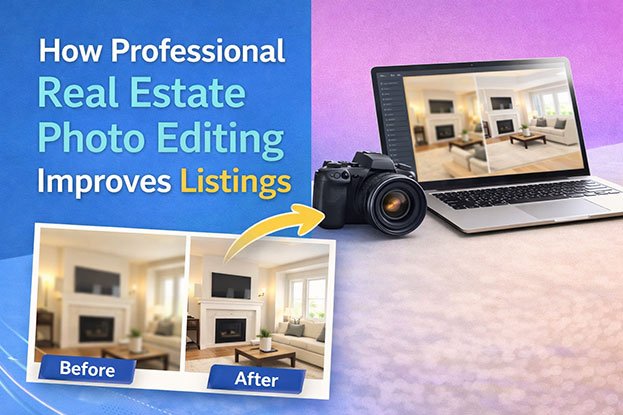
A buyer scrolling through listings on a Sunday evening might look at fifteen homes in twenty minutes. Most of those homes they will never visit. The ones they do visit are often chosen from photos alone. If a living room looks dim, the kitchen has a yellow tint, and the exterior sits under a flat gray sky, that property may not be shown as clearly as it deserves. This is where professional real estate photo editing becomes useful. It helps Realtors and property sellers present what a property already offers, with accurate light, true color, and straight lines. Good editing improves presentation. It should never mislead buyers about what they will find when they walk through the door.
What Is Professional Real Estate Photo Editing?
Professional real estate photo editing is the post-production work done on property photographs after they are taken. Its purpose is to correct technical problems and prepare images for listings and marketing, so the property is shown clearly and accurately.
Even skilled property photographers deal with difficult conditions. Interiors are often darker than windows. Artificial lights create color casts. Wide-angle lenses bend straight lines. Weather does not always cooperate. Editing addresses these issues.
Common tasks include:
- Exposure correction to balance dark and bright areas
- Color correction and white balance to remove unnatural tints
- HDR processing to blend multiple exposures of the same scene
- Perspective correction to straighten vertical and horizontal lines
- Sky replacement for exteriors shot under dull skies
- Window view enhancement to recover the outdoor view through bright windows
- Object removal for temporary distractions such as cables, bins, or personal items
- Shadow adjustment, noise reduction, and sharpening to improve clarity
- Cropping and resizing for listing platforms and marketing channels
- Image consistency so every photo in a set shares the same look
Basic Enhancement vs Professional Post-Production
Basic enhancement usually means applying a filter or moving a few sliders on a phone app. It can brighten an image, but it often treats every photo the same way, which can produce uneven results.
Professional post-production is more deliberate. An editor evaluates each image, corrects problems area by area, blends exposures carefully, checks color against realistic references, and makes sure the full set looks consistent. The goal is not a dramatic image. The goal is a clean, natural, accurate one.
Why Property Photos Matter Before a Buyer Visits
For many buyers, the first contact with a property is a set of listing photos. Before they read the description in detail or call an agent, they look at images.
Photos help buyers do several things:
- Form a first impression of the property’s condition and style
- Browse efficiently when viewing many online property listings
- Compare options side by side
- Understand the layout and how rooms connect
- See specific features such as flooring, fixtures, outdoor space, or views
- Assess the overall presentation of the listing
When photos are dark or distorted, buyers have less useful information to work with. Clear images help them understand what is actually there.
That said, photos have limits. They cannot replace an in-person inspection, a property survey, or a professional appraisal. Buyers still need to visit, ask questions, and verify details. Professional images support that process by giving an accurate starting point. They do not guarantee more buyers, more showings, or a faster sale, because those outcomes depend on price, location, condition, demand, and market timing.
Benefits of Professional Real Estate Photo Editing for Realtors
Realtors, brokers, property managers, and real estate marketing teams handle images constantly. Here is how professional editing can support their work.
More Professional Listing Presentation
A listing is often the first piece of work a potential client sees from an agent. Clean, balanced, well-composed images show care and attention to detail. This helps present both the property and the agent’s marketing standards in a professional way.
Less Editing Work
Editing property photos takes time. A single listing can include 25 to 50 images, and each may need exposure blending, color correction, and perspective adjustment. Outsourcing to real estate photo editing services allows agents and photographers to spend that time on client communication, showings, and negotiations instead.
More Consistent Listings
Consistency is one of the most overlooked parts of property marketing. Professional editors can standardize:
- Exposure so rooms do not jump between bright and dark
- Color so walls and floors look the same from photo to photo
- Cropping so framing feels deliberate
- Perspective so vertical lines stay straight throughout
- Image dimensions so every photo fits listing platform requirements
A consistent set is easier for buyers to view and understand.
Easier Listing Preparation
A structured editing workflow makes preparation more predictable. Photos are shot, uploaded, edited to agreed specifications, and returned ready for use. Many real estate photo editing companies offer set turnaround times, which helps agents plan launch dates for listings.
Scalable Workflow
An agent handling two listings a month can often manage editing alone. An agency handling twenty cannot easily do the same. Outsourcing can help teams manage higher volumes without hiring in-house editors, and it allows capacity to adjust during busy and slow seasons.
Better Brand Consistency
When every listing follows the same visual standards (natural light, true color, straight lines, consistent cropping), an agency’s marketing develops a recognizable style. Over time, this consistency can support a more professional brand image across websites, portals, and social media.
Benefits of Professional Property Photo Editing for Sellers
Homeowners, investors, developers, landlords, and commercial property sellers also benefit from well-edited images, even when an agent handles the marketing.
Better Visual Presentation
Editing helps show existing features clearly. A bright kitchen should look bright. A spacious living room should not look cramped because of lens distortion. Hardwood floors should look like hardwood, not muddy brown. Editing helps the property’s real strengths come through.
Improved Image Consistency
When one photo is warm, another is cool, and a third is overexposed, the listing feels disjointed. A consistent image set makes it easier for buyers or tenants to follow the property from room to room.
Better Visibility of Property Features
Correct exposure reveals details hidden in shadows. Accurate color shows real materials. Controlled sharpening brings out texture in stone, tile, and wood. These adjustments help buyers see features that already exist.
Reduced Visual Distractions
Appropriate object removal can clear away temporary items that pull attention from the property, such as:
- Trash bins at the curb
- Power cords on the floor
- Personal photos and toiletries
- Parked cars in the driveway
- Small clutter on counters
This is different from hiding defects. Removing a garden hose is reasonable. Removing a crack in the wall, water damage, or a nearby power line is not.
More Professional Marketing Materials
Edited images can be used across many channels:
- Property listing websites and portals
- Agency websites
- Printed brochures and flyers
- Social media posts
- Email marketing campaigns
- Digital advertisements
Sellers should still provide accurate property information. Good photos support honest marketing. They do not replace disclosure.
How Exposure Correction Improves Property Photos
Lighting is one of the biggest challenges in real estate photography. Common exposure problems include:
- Dark interiors in rooms with limited natural light
- Bright windows that turn pure white
- Underexposed rooms where furniture and finishes disappear into shadow
- Uneven lighting with bright spots near lamps and dark corners elsewhere
- Deep shadows under cabinets, stairs, and furniture
Professional exposure correction balances these areas so existing detail becomes visible. Shadows are lifted carefully, highlights are brought down, and the room reads as it would to a person standing inside it.
The key word is realistic. A north-facing room with modest daylight should not be edited to look like a sunlit atrium. Overbrightening can create false expectations and disappoint buyers during a viewing. The aim is to show the room as the human eye sees it, not brighter than reality.
How Color Correction Improves Property Presentation
Cameras record color differently from the human eye, especially under mixed lighting. Typical issues include:
- Yellow casts from warm indoor bulbs
- Blue casts from shade or cool daylight
- Green casts from some fluorescent lights or reflections off grass and foliage
- Incorrect white balance that makes white walls look cream, gray, or blue
- Dull colors from flat lighting
- Over-saturation from aggressive editing
Color correction adjusts white balance and neutralizes unwanted casts so materials look true to life.
Realistic color matters because buyers make judgments based on finishes. If a buyer expects white cabinets and finds cream ones, or expects gray flooring and finds beige, trust suffers.
For that reason, professional editors should not change:
- Wall colors
- Flooring colors
- Cabinet colors
- Countertops
- Permanent fixtures
The exception is when a client specifically requests a disclosed marketing change, such as a clearly labeled “suggested paint color” visualization. Otherwise, color correction should restore accuracy, not invent a new look.
How HDR Editing Helps Real Estate Images
HDR stands for high dynamic range. In simple terms, the photographer takes several shots of the same scene at different brightness levels. One captures the dark areas, another captures the middle tones, and another captures the bright windows. The editor then blends them into one balanced image.
HDR editing is helpful for:
- Bright windows next to dim interiors
- Dark interiors that need detail without losing the view outside
- High-contrast rooms with both strong sunlight and deep shadow
- Exterior lighting at dusk, when the sky and interior lights need balance
When done well, HDR reveals detail across the whole scene while keeping it natural.
When done poorly, HDR causes obvious problems:
- Halos around windows, rooflines, and furniture
- Strange colors such as purple shadows or neon greens
- Flat images with no sense of depth
- An overprocessed look that feels artificial
- Unrealistic lighting where every part of the room is equally bright
Many buyers now recognize heavy HDR instantly, and it can make a listing feel less trustworthy. Professional real estate image editing aims for a natural result, often combining automated blending with manual masking and refinement.
How Perspective Correction Improves Architectural Photos
Architecture relies on straight lines. When lines lean or bend, rooms look off-balance. Common causes include:
- Crooked vertical lines when the camera is tilted up or down
- Camera tilt that makes walls and door frames lean
- Wide-angle distortion that stretches corners or curves straight edges
- Uneven framing where the horizon or ceiling line sits at an angle
Perspective correction straightens verticals, levels horizons, and reduces lens distortion. The result is a cleaner, more architectural presentation that feels stable and easy to read.
Perspective correction has clear limits. It should not:
- Move walls
- Enlarge rooms
- Change room dimensions
- Alter the actual layout of the property
It corrects how the camera recorded the space. It does not change the space itself.
How Sky Replacement Can Improve Exterior Images
Exterior photos are often scheduled around availability rather than weather. Sky replacement can help when shoots happen under:
- Gray skies that make the exterior look gloomy
- Overcast weather with no color in the sky
- Flat exterior lighting that hides architectural detail
- Dull outdoor images where the sky is a blank white area
A realistic sky replacement considers:
- Lighting direction so shadows on the building match the sun’s position in the new sky
- Horizon alignment so the sky sits naturally behind rooftops and trees
- Cloud scale so clouds look proportionate to the property
- Color temperature so the sky and the building share the same warmth or coolness
- Brightness so the sky does not overpower the house
- Reflections in windows, pools, and glossy surfaces that should reflect the new sky
Dramatic skies are not always the right choice. A fiery sunset over a modest suburban home can look staged. A clean blue sky with soft clouds usually suits most listings. The sky should support the property, not compete with it. It should also never be used to hide nearby structures, weather damage, or environmental features that buyers would reasonably want to know about.
How Window View Enhancement Works
When a camera exposes correctly for an interior, the windows often turn completely white. The view outside, which may be a garden, a street, or a skyline, disappears.
Window view enhancement (sometimes called window pulling or window masking) blends a darker exposure of the window area into the interior image. The real outdoor view is restored while the room stays properly lit.
This matters because views can be a meaningful part of a property’s appeal. A balcony overlooking a park or a kitchen window facing a garden is worth showing.
The view should be the actual view from that window. Inserting a different or more attractive scene misrepresents the property. If the window faces a parking lot, the parking lot should remain.
How Object Removal Should Be Used Responsibly
Object removal is one of the most useful and most sensitive editing services. Used correctly, it removes temporary distractions. Used incorrectly, it misleads.
Generally appropriate removals include:
- Cables, chargers, and cords
- Trash bins and recycling containers
- Personal items such as family photos or toiletries
- Cars, garden tools, and hoses
- Photographer reflections in mirrors or glass
Removals that are generally inappropriate include:
- Cracks, stains, or water damage
- Utility poles, power lines, or cell towers near the property
- Neighboring buildings
- Permanent fixtures that will stay with the property
- Anything a buyer would reasonably consider material to their decision
A simple test is to ask whether the item will still be there when the buyer visits. If it will be gone, removing it is usually reasonable. If it will still be there, it should stay in the photo.
Presentation, Perceived Value, and Actual Value
It helps to separate three ideas that are often confused.
Property presentation is how clearly and professionally the property is shown through images. Editing has a direct effect here.
Perceived value is how attractive, well maintained, spacious, or bright a property may appear based on the visual information available. Better presentation can influence perception, because buyers form opinions from what they see.
Actual property value is the market value, shaped by location, size, condition, layout, local market conditions, comparable properties, demand, pricing, timing, and specific features. Editing does not physically change the property, and it does not determine market value.
Professional real estate photo editing works in the first two areas. It can help a property be seen more clearly and understood more accurately. Whether that leads to a particular sale price or timeline depends on factors well beyond the photos.
DIY Editing vs Professional Real Estate Photo Editing
Some agents and sellers edit their own photos, and for a single listing this can work. There are practical differences, though.
DIY editing is low cost and immediate, but it often relies on presets that treat every image the same. Results can be inconsistent, and complex tasks like exposure blending, window masking, or sky replacement take skill and time to do well.
Professional editing costs money, but it brings experience with difficult lighting, consistent standards across large image sets, and predictable turnaround. For Realtors managing several listings, or sellers who want a polished result without learning editing software, outsourcing is often the more practical option.
How to Choose a Real Estate Photo Editing Company
If you are considering real estate photo editing services, look for:
- Natural editing style. Review before and after samples and check for halos, oversaturation, and unrealistic brightness.
- Accuracy standards. Ask how the company handles color, perspective, and object removal, and whether it follows ethical editing guidelines.
- Consistency. Ask whether a full image set is edited to a single standard.
- Turnaround time. Confirm realistic delivery windows, including rush options.
- Revision policy. Check how corrections are handled if something does not match your needs.
- Custom instructions. A good provider will follow your brand style guide and specific requests.
- Free trial. Many companies offer a small free test so you can judge quality before committing.
- Data security. Make sure your files and client property images are handled securely.
Frequently Asked Questions
Does professional real estate photo editing help sell a property faster?
It can improve how the property is presented online, which helps buyers understand what is available. Sale speed depends on price, location, condition, demand, and market conditions, so editing alone cannot guarantee a faster sale.
Is real estate photo editing misleading?
It should not be. Ethical editing corrects technical problems such as exposure, color, and lens distortion, and removes temporary distractions. It should not hide defects, change permanent features, or alter the size or layout of the property.
What is the difference between HDR editing and regular editing?
HDR editing blends several exposures of the same scene to balance very bright and very dark areas. Regular editing adjusts a single image. HDR is especially useful in rooms with bright windows.
Can I ask an editor to change wall or floor colors?
Only as a clearly disclosed marketing visualization, such as a labeled paint suggestion. Standard listing photos should show the real colors of permanent surfaces.
How many photos should a property listing have?
It varies by property size and platform, but most listings include enough images to show every main room, the exterior, and key features. Consistency across the set matters as much as the number of photos.
Is sky replacement acceptable in listing photos?
Generally yes, when it replaces a dull sky with a realistic one and does not hide anything about the property or its surroundings. Some platforms and regions have their own rules, so check local guidelines.
Final Thoughts
Listing photos are often where a buyer’s relationship with a property begins. When those images are dark, tinted, crooked, or cluttered, the property is harder to understand. When they are balanced, accurate, and consistent, buyers can see what the property actually offers.
For Realtors, professional real estate photo editing can reduce workload, support consistent listing standards, and strengthen a professional marketing style across many properties. For sellers, it helps existing features come through clearly across listings, brochures, social media, and advertising.
The most important principle is honesty. Good editing improves presentation and can influence how a property is perceived, but it does not change the property itself or decide its market value. Edited with care and accuracy, property photos give buyers a clear, trustworthy first look, and that is the best foundation for everything that follows.