A shopper can’t touch your jacket. They can’t try it on or feel the fabric. All they have is the photo. So the way you shoot that jacket carries a lot of weight.
That’s why the ghost mannequin vs flat lay photography question comes up so often. Both styles are clean and affordable, and both are everywhere in fashion ecommerce. But they tell the customer different things about your product.
We’ve edited apparel images for brands, retailers, and photographers since 2014. In that time, we’ve seen both styles help sales, and we’ve seen both hurt them when used in the wrong place.
This guide won’t tell you one style always wins. That claim would be false. Instead, you’ll learn what each style does well, where it falls short, what it costs, and how to pick the right one for your products, platform, and goals.
The Quick Answer
If you only have a minute, here it is.
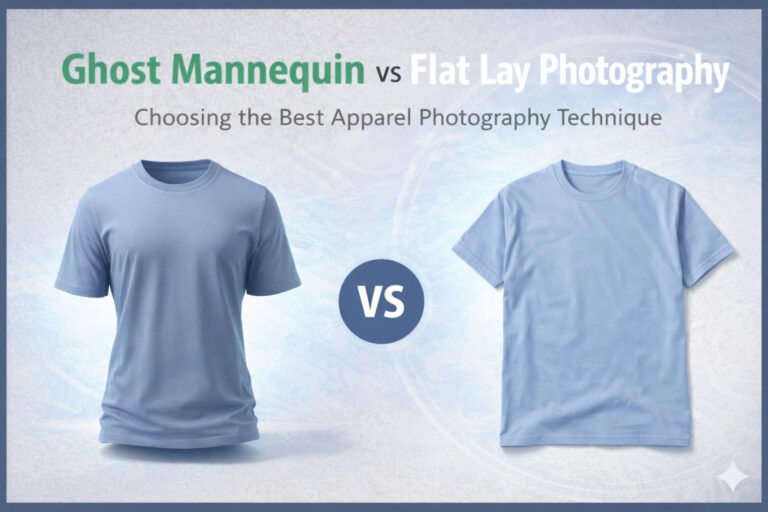
Ghost mannequin photography usually works better when shape and fit drive the sale. Think shirts, jackets, dresses, suits, and structured tops. It shows the garment as a 3D form without a model or a visible mannequin.
Flat lay photography usually works better when style, mood, or outfit ideas drive the sale. Think kids’ clothing, casual basics, accessories, bundles, and social media content. It shows the item laid flat from above, often styled with other pieces.
Many strong apparel stores use both. Ghost mannequin images do the product page work. Flat lays do the storytelling work.
The best choice depends on six things: product type, sales platform, audience, brand style, budget, and goal. We’ll cover each one below.
What Is Ghost Mannequin Photography?
Ghost mannequin photography, also called invisible mannequin photography, shows clothing as if an invisible person is wearing it.
Here’s how it works. The photographer puts the garment on a mannequin and shoots it from the front and back. Then they shoot the inside parts, like the neck label and inner back, often with the garment turned inside out or placed on a flat surface.
In post-production, an editor removes the mannequin and blends the shots together. The inside neck area gets added back in. The result is a hollow, 3D-looking garment floating on a clean background. This final step is what people call the invisible mannequin effect.
Why brands use it
Ghost mannequin images show the natural shape of the garment. The shoulders sit right. The collar stands up. The sleeves have volume. Buyers get a clear idea of how the piece looks on a body, without being distracted by a model.
It also keeps a catalog consistent. Every shirt has the same angle, the same size in the frame, and the same background. That clean, uniform look is common on major fashion sites and marketplaces.
Where it falls short
Ghost mannequin photography takes more work. You need a mannequin with removable parts, careful styling, and more than one shot per view. The editing is also more detailed than a simple background removal.
It also doesn’t show lifestyle or personality. It shows the product, and that’s it. For some brands, that feels too plain.
What Is Flat Lay Photography?
Flat lay photography shows clothing laid flat on a surface and shot from directly above.
The garment is smoothed, folded, or arranged on a table, floor, or backdrop. It can be shot alone on white, or styled with shoes, bags, jewelry, or props to create a full look.
Why brands use it
Flat lay apparel photography is quick to set up. You don’t need a mannequin or model. A good surface, soft lighting, and a camera mounted overhead are enough to start.
It’s also great for styling. You can show a full outfit in one frame. That helps shoppers picture how pieces go together, which can encourage them to buy more than one item.
Flat lay product images also fit social media well. Square and vertical crops work naturally, and the top-down view has a relaxed, editorial feel.
Where it falls short
Flat lays don’t show real shape. A shirt laid flat looks wider than it does on a body. Fitted pieces lose their curves. Structured items like blazers can look shapeless.
That can make it harder for shoppers to judge fit. And fit is one of the biggest worries people have when buying clothes online.
Ghost Mannequin vs Flat Lay Photography: Side-by-Side Comparison
Here’s how the two styles stack up on the points that matter most for ecommerce.
| Factor | Ghost Mannequin | Flat Lay |
|---|---|---|
| Shows garment shape and fit | Strong | Limited |
| Setup time | Longer | Shorter |
| Equipment needed | Mannequin, lights, camera | Surface, overhead mount, lights, camera |
| Editing complexity | Higher (image blending, neck joint) | Lower to medium (cleanup, shape fixing) |
| Styling and mood | Minimal | Strong |
| Catalog consistency | Very high | High if well controlled |
| Marketplace friendly | Very friendly | Friendly, depends on rules |
| Social media appeal | Moderate | High |
| Best for | Tops, outerwear, dresses, formal wear | Kids’ wear, basics, accessories, outfit sets |
Neither column is “better.” Each one fits a different job.
How Photo Style Affects Buying Decisions
To understand which style may convert better, it helps to think about what a shopper needs before they click “Add to Cart.”
1. Can I picture wearing this?
This is the big one. Shoppers want to know how the item will look on them. Ghost mannequin images help here because they show the garment’s real form. The buyer’s brain fills in the rest.
Flat lays ask the buyer to imagine more. For simple items like a T-shirt, that’s easy. For a tailored dress, it’s much harder.
2. Do I trust this store?
Clean, consistent product pages look professional. When every image matches in angle, lighting, and background, the store feels organized and reliable. Both styles can deliver this, but only if they’re shot and edited with care.
Messy images hurt trust fast. Wrinkles, dust, uneven colors, and mismatched crops make a store look careless, no matter which style you use.
3. Is the color accurate?
Wrong colors are a common reason for returns. If the navy sweater arrives looking black, the customer feels misled. Good clothing photo editing includes color correction so the image matches the real product. This matters equally for both styles.
4. Does this fit my style?
Here, flat lays often have the edge. A styled flat lay shows the item as part of a look. It answers the question, “What would I wear this with?” That can make a product feel more desirable, especially to younger or trend-focused shoppers.
5. Can I see the details?
Buyers want to see buttons, stitching, fabric texture, and labels. Both styles need close-up shots to cover this. The main image rarely does all the work alone.
Which Converts Better? It Depends on These 6 Factors
There’s no universal winner. Conversion depends on how well the image matches what your buyer needs at that moment. Here’s how to think it through.
Factor 1: Product type
This is usually the deciding factor.
Structured and fitted items tend to benefit from ghost mannequin photography. The 3D shape helps buyers judge cut and fit. Soft, simple, or small items often look fine as flat lays, because shape matters less.
We break this down by category in the next section.
Factor 2: Sales platform
Where you sell shapes what works.
Marketplaces like Amazon have strict image rules. Amazon’s apparel guidelines generally don’t allow visible mannequins in main images, which is one reason the invisible mannequin effect is so widely used there. Always check the latest style guide for your category, since rules change.
Your own Shopify or WooCommerce store gives you more freedom. You can mix styles and use flat lays as secondary images.
Instagram, Pinterest, and TikTok Shop reward images that feel styled and scroll-stopping. Flat lays often perform well there.
Factor 3: Target audience
Who are you selling to?
Shoppers buying workwear or formal pieces usually care most about fit and quality. Clean ghost mannequin images speak to that.
Shoppers buying casual, trendy, or kids’ clothing often respond to style and mood. Flat lays can feel more relatable and fun.
B2B and wholesale buyers want clarity and consistency above everything else. Ghost mannequin catalogs are common in wholesale line sheets for this reason.
Factor 4: Brand style
Your images should look like your brand.
A premium tailoring brand needs sharp, structured product shots. A relaxed lifestyle label might feel more natural with styled flat lays on textured backgrounds. If your images don’t match your brand voice, shoppers notice, even if they can’t say why.
Factor 5: Budget
Flat lays are usually cheaper to shoot. Ghost mannequin photography needs more setup and more editing per image. We’ll look at real costs shortly.
But cheaper isn’t always better value. If a better image helps reduce returns or improves conversions on a high-margin product, the extra cost can pay for itself.
Factor 6: Sales goal
What do you want the image to do?
If the goal is to help a buyer choose the right size and feel confident, ghost mannequin images often do that job well.
If the goal is to raise order value by selling outfits, flat lays can help show items together.
If the goal is ads and social engagement, flat lays usually give you more creative room.
Best Style by Product Category
Here’s a practical guide based on the apparel we edit most often. Treat it as a starting point, not a rule.
| Product | Recommended Main Style | Why |
|---|---|---|
| Shirts and blouses | Ghost mannequin | Shows collar, shoulders, and drape |
| Jackets and coats | Ghost mannequin | Structure and volume matter |
| Blazers and suits | Ghost mannequin | Fit and tailoring drive the sale |
| Dresses | Ghost mannequin | Shows silhouette and waistline |
| Hoodies and sweatshirts | Either | Both work; ghost mannequin adds shape |
| T-shirts | Either | Flat lay is fine for basics; ghost mannequin looks more premium |
| Jeans and trousers | Either | Ghost mannequin shows fit; flat lay shows wash and detail |
| Kids’ and baby clothing | Flat lay | Small sizes, playful styling, parent-friendly |
| Activewear | Ghost mannequin | Fit and stretch are key concerns |
| Swimwear | Ghost mannequin | Shape matters, and many brands avoid models on main images |
| Socks, scarves, accessories | Flat lay | Simple shapes, easy to style |
| Outfit bundles and gift sets | Flat lay | Shows multiple items together |
Flat Lay vs Mannequin Photography Cost
Costs vary by country, photographer, and volume. So instead of fixed numbers, here’s where the money goes.
Ghost mannequin costs
- Equipment: A good ghost mannequin with removable chest, neck, and arm pieces costs more than basic props. You may need more than one for men’s, women’s, and kids’ sizing.
- Shooting time: Each view often needs at least two shots (outside and inside). Styling takes longer because the garment must sit perfectly.
- Editing: Ghost mannequin photo editing involves removing the mannequin, merging the inner neck shot, fixing edges, and matching colors. This is more detailed than basic editing, so the per-image price is higher.
Flat lay costs
- Equipment: An overhead camera mount, a clean surface, and good lighting. Props add cost if you style your shots.
- Shooting time: Fast for simple items. Styled flat lays take longer because arranging props is slow work.
- Editing: Usually background cleanup, wrinkle reduction, shape fixing, and color correction. Often cheaper per image than ghost mannequin work.
The hidden cost to watch
The bigger cost is often not the shoot. It’s the result. Images that don’t show fit clearly can lead to more questions, more returns, and lost sales. When you compare prices, compare them against what the image needs to do.
At Clipping Area, our editing pricing starts at $0.29 per image. Ghost mannequin editing is priced by complexity, so a simple T-shirt costs less than a lined coat with a hood. We also offer free trial edits, so you can test the quality before you commit.
What Post-Production Does for Each Style
Good photography gets you most of the way. Editing finishes the job. Here’s what professional apparel photo editing usually covers for each style.
Ghost mannequin editing
- Mannequin removal: Cleanly cutting out the mannequin while keeping the garment’s edges sharp.
- Neck joint: Merging the inner neck and label shot so the collar looks complete and natural.
- Symmetry fixes: Making sure both sides of the garment look balanced.
- Background cleanup: Placing the garment on pure white or a brand color.
- Color correction: Matching the image to the real fabric color.
- Shadow creation: Adding a soft natural shadow so the item doesn’t look like it’s floating awkwardly.
Flat lay editing
- Background cleanup: Removing dust, lint, and uneven surface tones.
- Wrinkle and crease reduction: Smoothing fabric without making it look fake.
- Shape fixing: Straightening hems, sleeves, and seams so the garment looks neat.
- Color correction: Keeping colors accurate and consistent across a set.
- Prop cleanup: Removing stray threads, tags, or distractions.
- Cropping and alignment: Making every image in the collection sit the same way.
Why consistency matters most
One great image doesn’t build a strong store. A consistent set does. When a shopper scrolls a category page and every product has the same size, angle, background, and color treatment, the store feels polished. That’s where a reliable product image editing service earns its value, especially when you’re uploading hundreds or thousands of SKUs each season.
Common Mistakes That Hurt Conversions
We see these problems all the time. Each one can quietly cost you sales.
Using flat lays for fitted pieces. A bodycon dress laid flat just looks like a rectangle of fabric. Buyers can’t judge the fit, so many won’t buy.
Poor ghost mannequin editing. A visible mannequin edge, a missing neck joint, or a lopsided collar looks unprofessional. A half-done invisible mannequin effect is worse than a plain flat lay.
Mixing styles on one category page. If half your shirts are ghost mannequin and half are flat lay, the page looks messy. Pick one main style per category.
Wrong colors. Oversaturated or dull colors lead to disappointed customers and returns.
Over-editing. Removing every wrinkle and texture can make fabric look plastic. Buyers want to see what the material really looks like.
Too few images. One main image isn’t enough. Add back views, close-ups, and at least one styled or on-model shot when possible.
Ignoring platform rules. An image rejected by a marketplace is a listing that doesn’t sell. Know the requirements before you shoot.
Why Many Brands Use Both
The smartest approach for many apparel brands isn’t choosing one style. It’s giving each style a clear job.
Here’s a simple setup that works well for many stores:
- Main product image: Ghost mannequin on white. Clean, consistent, and marketplace-ready.
- Back view: Ghost mannequin, same style.
- Detail shots: Close-ups of fabric, buttons, stitching, and labels.
- Styled image: A flat lay showing the item with matching pieces.
- Lifestyle or on-model image: If budget allows.
Then use flat lays across Instagram, Pinterest, email campaigns, and ads, where mood and styling matter more than exact fit.
This way, ghost mannequin images build confidence on the product page, while flat lays build interest and brand personality everywhere else.
How to Test Which Style Converts Better for Your Store
General advice only goes so far. The real answer comes from your own data. Here’s a simple way to test.
Pick a few products. Choose items with steady traffic, so you get enough data to learn from.
Change one thing. Swap only the main image. Keep price, title, and description the same.
Run the test long enough. A few days isn’t enough. Give it a few weeks, or until you have a meaningful number of visitors. Shopify and other platforms have apps that can split traffic between two versions.
Track more than conversion rate. Look at add-to-cart rate, bounce rate, return rate, and average order value. A style that sells slightly less but gets fewer returns may be the better choice.
Test by category. What works for jackets may not work for socks. Test separately.
Use the results. Once you see a clear pattern, roll it out across that category and keep your editing consistent.
What’s Changing in 2026
A few trends are shaping apparel product photography this year.
AI editing tools are everywhere. Automated tools can now remove backgrounds and even create a basic invisible mannequin effect. They’re fast and cheap for simple items. But they still struggle with lace, sheer fabrics, complex collars, hoods, and accurate color. Many brands now use AI for speed and human editors for quality control and complex pieces. The finished image is what matters, not the tool.
Consistency across channels matters more. Shoppers see your product on your site, in marketplace listings, in ads, and on social platforms, often within the same day. Matching colors and styling across all of them builds recognition and trust.
Mobile comes first. Most fashion browsing happens on phones. Images need to read clearly at small sizes. Ghost mannequin shots on white usually hold up well on small screens. Busy flat lays with lots of props can get lost.
Returns are under the spotlight. Retailers are working harder to reduce fit-related returns. Clear images that show real shape and accurate color are one of the simplest ways to help.
Frequently Asked Questions
Which is better, ghost mannequin or flat lay?
Neither is better in every case. Ghost mannequin works best for fitted and structured clothing where shape matters. Flat lay works best for simple items, kids’ wear, accessories, and styled social content. The right choice depends on your product, platform, and goal.
Ghost mannequin vs flat lay photography: which is better for ecommerce?
For main product images on marketplaces and online stores, ghost mannequin is often the safer choice because it shows fit and keeps catalogs consistent. Flat lays are useful as secondary images and for marketing. Many stores use both.
Is ghost mannequin photography more expensive than flat lay?
Usually, yes. It needs a special mannequin, more shots per view, and more detailed editing. Flat lays are faster to shoot and edit. But the better choice is the one that helps your product sell, not just the cheaper one.
Can I use flat lay images on Amazon?
For many apparel categories, Amazon accepts flat lay main images on a pure white background, but rules vary by category and change over time. Always check Amazon’s current style guide for your product type before shooting.
What is the invisible mannequin effect?
It’s an editing technique where the mannequin is removed from the photo and the inner parts of the garment, like the neck area, are added back in. The result looks like the clothing is being worn by an invisible person.
Do I need professional editing for ghost mannequin images?
In most cases, yes. The mannequin removal and neck joint need careful work. Poor editing leaves visible edges or odd shapes that make products look cheap. A professional ghost mannequin editing service keeps results clean and consistent across your catalog.
Can AI create ghost mannequin images?
AI tools can handle simple garments reasonably well. For complex fabrics, detailed collars, sheer materials, and accurate color matching, human editors still produce more reliable results. Many brands combine both.
Which style is best for kids’ clothing?
Flat lay is often the most practical choice. Kids’ clothing is small, mannequins for children’s sizes are less common, and styled flat lays appeal to parents shopping for outfits.
Conclusion: Choose the Style That Answers Your Buyer’s Question
The ghost mannequin vs flat lay photography debate doesn’t have one winner. It has a right answer for each product and each goal.
If your buyer’s main question is “How will this fit?”, ghost mannequin photography usually answers it better. If their question is “How would I style this?”, a flat lay often does the job.
For most apparel brands, the strongest setup uses both. Ghost mannequin images build trust on product pages. Flat lays add style and personality to your marketing. And whatever you choose, consistent, accurate editing is what makes it work.
Test with your own products. Watch your conversion and return rates. Then scale what works.
Need help making your apparel images sell? Clipping Area has been editing fashion and ecommerce images since 2014. We handle ghost mannequin editing, flat lay cleanup, background removal, color correction, and bulk apparel photo editing for brands, retailers, and photographers worldwide. Pricing starts at $0.29 per image, and you can try two free trial edits before you decide. Send us your images and see the difference for yourself.