Open any brokerage’s listings page and you form an opinion in a few seconds. Not about one house, but about the business behind all of them. When every listing looks bright, clean, and true to life, the brand feels organized. When one listing is dim and yellow and the next is cold and crooked, something feels off, even if the viewer can’t say what.
This is where real estate photo editing does quiet but important work. Good editing makes one property look its best. Consistent editing makes an entire portfolio look like it came from one careful, dependable team.
This guide explains what consistency means in property photo editing, why it shapes how people see your brand, and how agents, brokers, photographers, and agencies can build a workflow that keeps every listing looking like it belongs.
What Is Real Estate Photo Editing?
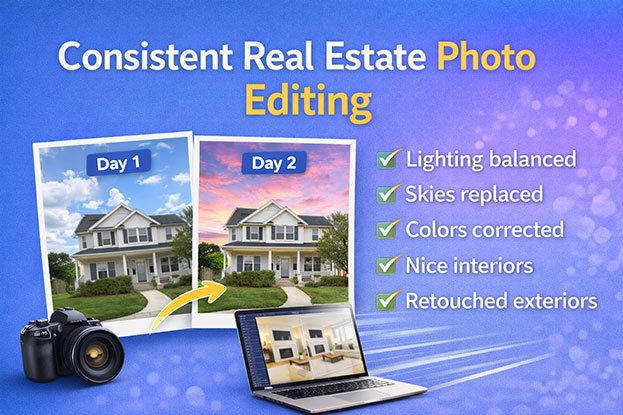
Real estate photo editing is the post-production process of correcting and enhancing property photos after they are taken. It usually includes exposure correction, white balance, color correction, HDR blending, window balancing, perspective and vertical line correction, sky replacement, object removal, cropping, and resizing.
The purpose is simple: show the property clearly, accurately, and attractively. A camera captures what’s in front of it, but it doesn’t always capture it the way the human eye sees it. Editing closes that gap.
Why Consistency Matters in Real Estate Photo Editing
Consistency matters because buyers, sellers, and partners judge your business across many listings, not just one. When every set of property photos follows the same quality standard, your brand looks deliberate and reliable.
Think about how people actually browse. A buyer looking for a three-bedroom home might view a dozen of your listings in one evening. A seller choosing an agent will often scroll through that agent’s past listings before booking a call. Each listing is a small sample of how you work.
If the samples look alike in quality, the message is “this team has standards.” If they vary wildly, the message becomes “results depend on who handled it that day.”
Over time, consistent real estate listing photos also create recognition. People start to associate a certain clean, natural look with your name, the same way a hotel chain’s rooms feel familiar before you read the sign.
One honest caveat: photo consistency does not guarantee trust or sales. Your service, communication, pricing, reviews, and reputation carry more weight. Photos are one signal among many. They are, however, often the first one people see.
How Inconsistent Property Photos Can Hurt Brand Presentation
Here’s a common situation. Two listings go live the same week from the same brand.
Listing A has:
- Bright, clean interiors
- Neutral, true-to-life colors
- Straight vertical lines
- Windows that show the view outside
Listing B has:
- Dark rooms with muddy shadows
- A strong yellow cast from indoor bulbs
- Tight, uneven cropping
- Blown-out white windows
- Walls leaning inward
- A different image size and ratio
Neither listing is a disaster on its own. Side by side, though, they look like they came from two different companies. The brand feels disconnected, and the weaker listing drags down the perception of the stronger one.
Scenario 1: Thirty Listings, Four Editing Styles
Picture an agency that publishes about 30 listings a month. It works with four freelance photographers, and each one edits their own photos.
One prefers warm, glowing interiors. Another likes cool, crisp whites. The third pushes HDR hard, so rooms look cartoonish. The fourth barely edits at all. The agency’s website ends up looking like a patchwork. Social media posts don’t match. Printed brochures look uneven. Nobody did bad work on purpose, but no one was working to the same standard.
Who Feels the Impact
- Real estate agents: Your listings are your portfolio. Sellers compare them when deciding who to hire.
- Brokerage firms: Many agents under one brand can produce many different looks, which weakens the brand as a whole.
- Property management companies: Rental listings that look inconsistent can make a portfolio seem poorly maintained.
- Real estate photographers: Clients hire you for a predictable result. Uneven editing makes repeat bookings harder.
- Marketing agencies: Campaigns built on mismatched images look less polished and are harder to design around.
- Developers: A new development sold with mixed-quality renders and photos can feel less cohesive than the project itself.
- Luxury property brands: At the high end, buyers expect precision. Small inconsistencies stand out more.
What Makes Real Estate Photo Editing Consistent?
Consistent real estate photo editing means applying the same standards to every image, not making every image identical. A sunny kitchen and a dim basement will never look the same. They should, however, feel like they were edited by the same careful hand.
Here are the main areas where consistency shows.
Exposure and Brightness
Exposure is how light or dark an image looks overall. In real estate photography editing, the aim is usually bright but realistic rooms, with visible detail in both shadows and highlights.
Inconsistent exposure is one of the easiest problems to spot. One living room looks airy, the next looks like it was shot at dusk. A set target for brightness keeps rooms comparable across listings.
Color and White Balance
White balance controls whether whites look truly white. Indoor lighting often adds a yellow or orange cast, while shade and overcast skies can add blue.
Consistent color correction for property photos means walls, ceilings, and cabinets look neutral and believable. It also covers color temperature (warm vs cool feel) and saturation (how intense colors appear). Oversaturated grass and bright turquoise pools are a common sign of heavy-handed editing.
Perspective and Vertical Lines
When a camera tilts even slightly, walls and door frames appear to lean. This is called converging verticals. It makes rooms look unstable and less professional.
Perspective correction straightens those lines so walls stand upright. This is one of the clearest signs of professional property image editing, and it should be applied the same way on every image.
Cropping and Image Dimensions
Mixed crops and ratios make a gallery look messy, especially on listing portals and websites that display images in grids. Standardizing the aspect ratio (for example, 3:2 landscape) and the output size keeps galleries clean.
Sharpness belongs here too. Images should be sharpened to a similar degree so some don’t look crisp while others look soft.
HDR and Window Balancing
Interiors often have a bright window and a dark room in the same shot. A single exposure can’t handle both. HDR blending combines several bracketed exposures into one balanced image.
Window balancing (sometimes called window pulls) brings back the view through the glass instead of leaving a white rectangle. The key is to keep the HDR strength natural and the same across a property. Overdone HDR creates gray halos and flat, unreal rooms.
Consistent vs Inconsistent Editing at a Glance
| Area | Inconsistent Editing | Consistent Editing |
|---|---|---|
| Exposure | Some rooms bright, others dark | Balanced brightness across all rooms |
| White balance | Yellow, blue, or mixed casts | Neutral whites, realistic tones |
| Saturation | Varies from dull to overdone | Natural, controlled color |
| Windows | Some blown out, some recovered | Views recovered to a set standard |
| Vertical lines | Some straight, some leaning | Corrected on every image |
| Cropping and ratio | Mixed dimensions | Standard ratio and size |
| HDR look | Ranges from flat to heavy | Same natural strength throughout |
| Sky treatment | Random or none | Replaced only when needed, realistic |
| Workflow | Ad hoc, depends on the person | Defined, documented process |
| Quality control | Occasional or missing | Checked against a standard |
| Brand presentation | Disconnected | Cohesive and recognizable |
How Consistent Property Photos Build Brand Trust
Trust usually comes from repeated positive experiences. Consistent real estate image editing supports that in a few practical ways.
Better first impressions. Photos are often the first thing people see. A clean, accurate gallery makes a strong start before anyone reads the description.
Visible attention to detail. Straight lines, balanced windows, and neutral colors show that someone checked the work. People tend to assume that care extends to the rest of your service.
Reliability. When every listing meets the same standard, viewers learn what to expect. Predictability is a big part of trust.
Brand recognition. A steady visual style helps your listings, website, and social posts feel like one brand. That makes your marketing easier to remember.
A consistent customer experience. Sellers see how their home will be presented because they’ve already seen your other listings look the same way.
Visual credibility. Natural, honest editing signals that you aren’t trying to hide anything. That matters a lot in a market where buyers are wary of over-edited photos.
Consistency Starts Before Editing
Editing can do a lot, but it works best with good raw material. Think of the full chain:
Photography → Editing → Quality Control → Listing → Brand Presentation
If the first step is weak, every later step has to work harder. A few photography factors make consistent editing much easier:
- Camera settings: Similar ISO, aperture, and white balance approach across shoots
- Exposure and bracketing: Enough bracketed frames to support clean HDR blending
- Lighting: Lights switched on or off consistently, blinds handled the same way
- Shooting angles: Corner shots at a similar height, usually around chest level
- Lens choice: Wide enough to show the room, not so wide it distorts it
- File quality: RAW files hold far more detail for correction than compressed JPEGs
Professional real estate post-production can fix exposure, color, and lines. It can’t fully rescue a blurry photo, a badly chosen angle, or a room shot in total darkness. Good photography and good editing work together.
Creating a Real Estate Photo Editing Style Guide
A style guide is a short document that tells every photographer and editor what “finished” looks like for your brand. It doesn’t need to be long. One or two pages with reference images is often enough.
Here’s an example of what one might include:
- Brightness: Bright, airy interiors with no crushed blacks. Rooms should look well lit but realistic.
- Contrast: Moderate. Enough depth to avoid a flat look, not so much that shadows turn black.
- White balance: Neutral whites on walls and ceilings. Remove yellow and blue casts.
- Color temperature: Slightly warm for residential, neutral for commercial (or whatever fits your brand).
- Saturation: Natural. Lawns, pools, and skies should look real, not neon.
- HDR strength: Light and natural. No halos around windows or furniture.
- Window highlights: Recover the outside view where possible.
- Shadow detail: Visible detail in corners and under furniture.
- Sky replacement: Only on gray or blown-out skies, using a realistic sky that matches the time of day and lighting.
- Perspective: All verticals straightened on interiors and exteriors.
- Cropping: Consistent composition with a little breathing room around the edges.
- Image ratio: One standard ratio, such as 3:2 landscape.
- File format: JPEG in sRGB color space for web and listing portals.
- Output resolution: A standard web size (check your MLS or portal rules) plus full-resolution files for print.
Add three or four “approved” before-and-after examples. Visual references remove guesswork far better than written rules alone.
The goal of any style guide should be natural, realistic, and consistent images, not aggressive editing. If a buyer walks in and the home feels darker, smaller, or different from the photos, the editing has worked against you.
Building a Consistent Real Estate Post-Production Workflow
A consistent workflow is a repeatable set of steps every image passes through, checked against the same standard. Here’s how a professional real estate image editing workflow typically runs:
- Image intake: Photos arrive through a shared upload system with the property name and any special instructions.
- File organization: Brackets are grouped by shot and files are named clearly, so nothing gets mixed up.
- Editing guidelines: The editor reviews the client’s style guide and any notes for that property.
- Exposure correction: Overall brightness is set to the target level.
- White balance: Color casts are removed so whites look neutral.
- Color correction: Saturation and tones are adjusted to look natural and match the brand style.
- HDR blending (when appropriate): Bracketed exposures are merged for balanced light.
- Window exposure balancing: Outside views are recovered through windows and doors.
- Perspective correction: Lens distortion and tilt are fixed.
- Vertical line correction: Walls, door frames, and cabinets are straightened.
- Sky replacement (when appropriate): Dull skies are replaced with realistic ones.
- Object removal (when appropriate): Small temporary distractions, like a trash bin or a cable, are removed.
- Cropping and resizing: Images are cropped to the standard ratio and exported at the required sizes.
- Quality control: A second person checks the full set side by side for consistency.
- Final delivery: Files are delivered in the agreed format, naming, and folder structure.
Step 14 is the one many teams skip. Checking images one at a time won’t catch a set where the kitchen is warmer than the living room. Reviewing the whole gallery together will.
A defined standard matters most at volume. When you edit five photos a month, you can rely on memory. At 500 or 5,000, you need a process that works no matter who does the editing.
Scenario 2: The Same Agency, One Standard
Back to the agency with 30 listings a month and four photographers. It writes a one-page style guide, shares approved reference images, and sends all editing through a single post-production workflow.
The photographers still shoot the way they know best, but they now bracket consistently and deliver RAW files. Every set is edited to the same brightness, color, and crop, then reviewed as a full gallery before going live. The website grid starts to look unified. Social posts match. Sellers comparing agents see a clear, repeatable standard. None of this guarantees more listings, but it removes a visual weak spot that was working against the brand.
Real Estate Photo Editing for Different Property Types
A consistent brand look doesn’t mean every property gets identical treatment. Different properties need different handling within the same standard.
- Residential homes: Warm, welcoming, and bright. Focus on clean interiors and inviting exteriors.
- Apartments and condos: Often smaller and darker. Careful exposure and window balancing help rooms feel open without exaggerating size.
- Luxury properties: Precision matters most. Clean lines, accurate materials, subtle color, and detailed retouching.
- Commercial properties: Neutral, crisp, and practical. Accurate color and straight lines matter more than mood.
- Vacation rentals: Guests want to picture their stay. Bright, true-to-life images that match reality protect reviews.
- New developments: Photos may sit next to renders. Matching tone and color between the two keeps the project cohesive.
- Interior spaces: Mixed lighting is the main challenge, so white balance and window work are key.
- Exterior spaces: Sky, lawn, and facade color need to look real, with straight verticals.
The trick is to keep your core rules (neutral color, straight lines, natural HDR, standard crop) fixed, then adjust mood and emphasis for the property type.
Manual vs AI-Assisted Real Estate Photo Editing
AI tools have changed real estate photo editing, but they haven’t replaced skilled editors. Each approach has strengths.
Manual Editing
- Greater control over every adjustment
- Better handling of difficult images, like mixed lighting or complex windows
- More precise masking around edges, glass, and fine details
- Easier to follow detailed, custom brand standards
AI-Assisted Editing
- Faster processing for large batches
- Useful for repetitive corrections like basic exposure and white balance
- Supports high-volume workflows with quick turnaround
- Still requires human quality control, since AI can misjudge colors, edges, and skies
Neither is universally better. The right mix depends on image volume, property type, quality expectations, turnaround time, budget, and how detailed your brand standards are. Many professional teams use AI for the first pass and skilled editors for refinement and final checks.
When Should You Outsource Real Estate Photo Editing?
Outsourcing makes sense when editing takes time you’d rather spend shooting, selling, or growing your business, or when volume makes consistency hard to maintain in-house.
Common reasons real estate professionals choose outsourced real estate photo editing:
- Saving time: Photographers can shoot more properties instead of spending evenings editing.
- Handling large batches: Busy seasons don’t create backlogs.
- Faster turnaround: Many providers work across time zones, so photos shot today can be ready by tomorrow.
- Consistent editing standards: One team following one style guide produces a more uniform result.
- Scalable workflows: Volume can go up or down without hiring or training.
- Less repetitive work: Tasks like window pulls and vertical corrections are handled for you.
If you only edit a handful of photos a month and enjoy doing it, keeping it in-house may be fine. If editing is slowing you down or your results vary, it’s worth testing a provider.
How to Choose a Real Estate Photo Editing Partner
Before you commit to any real estate photo editing company, check these points:
- Sample quality: Ask for a test edit on your own photos, not just their portfolio.
- Editing style: Does their natural style match your brand, or can they adapt?
- Turnaround time: Confirm standard and rush options.
- Revision policy: Find out how revisions are handled and whether they cost extra.
- File handling: Check upload methods, file formats, and naming conventions.
- Communication: Is it easy to reach someone who understands your request?
- Quality control: Ask how they check consistency before delivery.
- Data and privacy practices: Property photos can show private homes. Ask how files are stored and deleted.
- Pricing structure: Look for clear per-image pricing and volume discounts.
- Brand-specific instructions: Can they follow your style guide on every order?
A good partner feels like an extension of your team. You shouldn’t have to re-explain your standards with every batch.
Ethical Real Estate Photo Editing: Enhancement vs Misrepresentation
Enhancement makes a property look its best as it really is. Misrepresentation changes what a buyer would actually find. Trust depends on staying on the right side of that line.
Appropriate editing includes:
- Exposure and color correction
- Natural HDR blending
- Perspective and vertical line correction
- Removing minor, temporary distractions (a hose, a car in the driveway, personal photos)
- Realistic sky replacement when the original sky is dull
Editing should not falsely change:
- Property condition: Hiding water stains, cracks, or damaged flooring
- Size: Stretching rooms or using distortion to make spaces look larger
- Structural features: Adding or removing walls, windows, or architectural elements
- Permanent fixtures: Removing power lines, poles, or neighboring buildings that are really there
- Major defects: Covering roof damage or foundation issues
- Surroundings: Changing the view, adding greenery that doesn’t exist, or hiding nearby roads
Rules vary by market, and some listing platforms have their own policies on edited images. When in doubt, ask one question: would a buyer feel misled when they visit? If yes, don’t make the edit. Honest photos protect your reputation, and a trusted reputation is worth far more than one flattering image.
How Clipping Area Helps Maintain Consistent Real Estate Image Quality
Clipping Area is a professional post-production photo retouching agency that has worked with photographers and businesses since 2014. For real estate clients, the focus is on natural, accurate images edited to the same standard across every batch.
Clipping Area’s real estate photo editing services cover:
- HDR real estate photo editing and bracket blending
- Exposure and white balance correction
- Color correction and image enhancement
- Window balancing
- Perspective and vertical line correction
- Sky replacement
- Object removal
- Cropping, resizing, and export to your required sizes
- Batch editing for high-volume listings
Clients can share their own style guide, or build one with the team from a test batch. Every order is then edited to those instructions and checked before delivery, so a listing edited this month matches one edited six months ago. That is what consistency looks like in practice: a repeatable process, not a lucky result.
Frequently Asked Questions
1. What is real estate photo editing?
Real estate photo editing is the post-production work done on property photos to correct and enhance them. It includes exposure and color correction, HDR blending, window balancing, perspective correction, sky replacement, object removal, and resizing. The goal is clear, accurate, attractive listing images.
2. Why is consistency important in real estate listing photos?
Consistency shows that your business follows a standard every time. People often browse many of your listings, and a steady visual quality makes the brand look organized and reliable. It also makes your website, social media, and print materials look cohesive.
3. How does photo editing affect real estate brand trust?
Clean, natural, consistent photos create strong first impressions and show attention to detail. Honest editing also signals transparency. Photos alone won’t build trust, but poor or misleading photos can easily damage it.
4. What should be consistent across real estate photos?
The main areas are exposure, white balance, color temperature, saturation, sharpness, HDR strength, window treatment, vertical lines, cropping, aspect ratio, and output size. The overall editing style should feel the same from listing to listing.
5. Can AI help maintain consistent real estate photo editing?
Yes, AI can speed up repetitive corrections and help with large batches. It still needs human quality control, because AI can misread colors, edges, windows, and skies. Many teams combine AI for speed with manual editing for accuracy.
6. Should real estate photographers outsource photo editing?
It depends on volume and time. If editing takes hours you could spend shooting, or your results vary between jobs, outsourcing can help. Start with a small test batch to check quality and style fit.
7. What does professional real estate photo editing usually involve, and what does it cost?
A typical job involves HDR blending, white balance and color correction, window balancing, and vertical correction, plus optional sky replacement and object removal. Pricing is usually per image and depends on the services and volume. At Clipping Area, for example, HDR merge with color adjustment starts around $0.60 per image, and full editing with all corrections is around $0.90 per image, with volume discounts for regular orders.
8. How can a real estate agency create an editing style guide?
Pick three or four of your best-edited photos as references. Write short rules for brightness, color, HDR strength, windows, skies, verticals, cropping, ratio, and file format. Share it with every photographer and editor, and review new galleries against it.
Conclusion
A single great photo can make one listing shine. A consistent standard across every listing makes your whole brand look dependable. That’s the real value of consistent real estate photo editing: it turns your listings into a unified, recognizable body of work.
Consistency won’t replace good service or honest marketing, and it won’t guarantee sales on its own. What it does is remove visual doubt, show care in every detail, and give buyers and sellers one less reason to hesitate.
Start with a simple style guide, bracket and shoot with editing in mind, and build a workflow that checks every gallery as a whole. If you’d rather hand the editing to a team that works this way every day, Clipping Area can help.
Get a Free Sample: Send a few of your property photos to Clipping Area and get 2 free trial edits edited to your preferred style. Compare the results with your current workflow, then decide what works best for your listings. You can also request a free quote for your monthly volume.